In addition to the two acts, I was surprised to find that Finns have had their fingers in other countries’ Eurovision pies, too: besides Erika Vikman’s stage show, designer Ari Levelä has participated in creating the visuals for Austria and Cyprus, and Estonia’s song Espresso Macchiato is co-written and produced by Finnish songwriter Johannes Naukkarinen. It is indeed a very exciting Eurovision year for Finland!
The grand finale takes place late tonight, 22.00 / 10 p.m. our time, and it’s going to run at least four hours. (Gosh, I almost have a headache from the mere thought of staying up that late!)
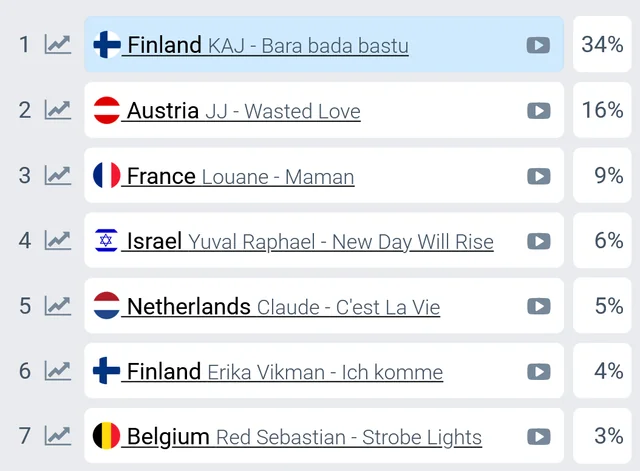
I’m really torn. I really hope KAJ wins, because Bara bada bastu is so joyful, cozy, and sweet, exactly what the world needs right now. But only if KAJ guys get to keep their quirkiness, happiness, and wholesomeness, because it’s part of their charm, and you can’t do that if you’re sleep deprived and exhausted and harangued by media and fans alike. Plus, it would give Sweden their 8th Eurovision win, pushing them ahead of Ireland (both have seven wins ATM), which as a Nordic person I would LOVE.
At the same time, though, Erika Vikman’s win would be stupendous—it would be the second time Finland wins, the first win for a female solo artist from Finland, and a win for female empowerment. It’s a catchy song with a great beat at the end, and a challenging tune (i.e., meant for a skilled singer). Apparently, after Thursday’s second semifinal there’s been a surge of interest; some have even wondered whether she might really turn out to be this year’s dark horse.
Moreover, Erika’s is an act where a grown-up woman dresses and sings how she wants, instead of a serving of bare female flesh centered around stereotypical male sexual desire (i.e., a slip of a girl decked up in barely-there sparkly cover-ups furiously gyrating and tossing her hair). (*cough* Cyprus 2018, Cyprus 2019, Cyprus 2021 *cough*) Acts are acts, sure, but like KAJ’s, Erika’s seems to contain a certain amount of authenticity that people respond to.
Ohwell. In the end, I suspect I’ll just be overjoyed that Finland has two such strong contenders this year. Following Käärijä’s second place in 2023, recent years have been exceedingly good from the point of view of Finnish Eurovision fans, and that’s not something to sneeze at. 🙂
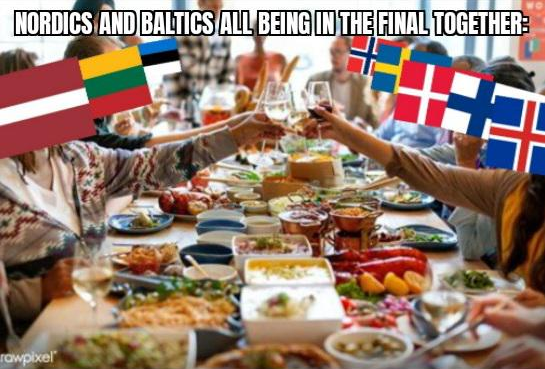
As a cherry on top, all of the Nordic countries (Finland, Sweden, Norway, Denmark, and Iceland) AND all of the Baltic countries (Estonia, Latvia, and Lithuania) qualified for the grand final. All at the same time, for the first time. Yay for us smaller countries in the north! 🙂
Alexander Skarsgård and cast of Murderbot TEASE what to expect from All Systems Red adaptation by Radio Times on YouTube
I haven’t yet seen the latter; I’m saving it for just the right time. (It’s Eurovision week, and as Finland entirely and utterly unofficially has two representatives this year, I have more incentive to stay up wayyy past my usual bedtime three nights this week. I’m almost too old for this shit, but not yet!)
Despite digging, I haven’t been able to find exactly when the episodes become available. keydekyie on Tumblr very kindly reminded the world that Apple lists the next day as the air date to avoid confusion due to different time zones, so the first episodes actually dropped on Thursday at 9 p.m. EST.
Woot! Although in Finnish time, that’s 4 a.m., which is definitely not the easiest of viewing times. (It’s been a long while since being 7 hours ahead of EST felt this hard.) OTOH, it means we could see each new episode over breakfast… That’s an intriguing thought…! Anyway, we *still* need to decide whether we want to see one episode a week, or whether we’ll wait till the end to binge it all at once.
Hey, look! We found a thing on the internet! We thought it was cool, and wanted to share it with you.
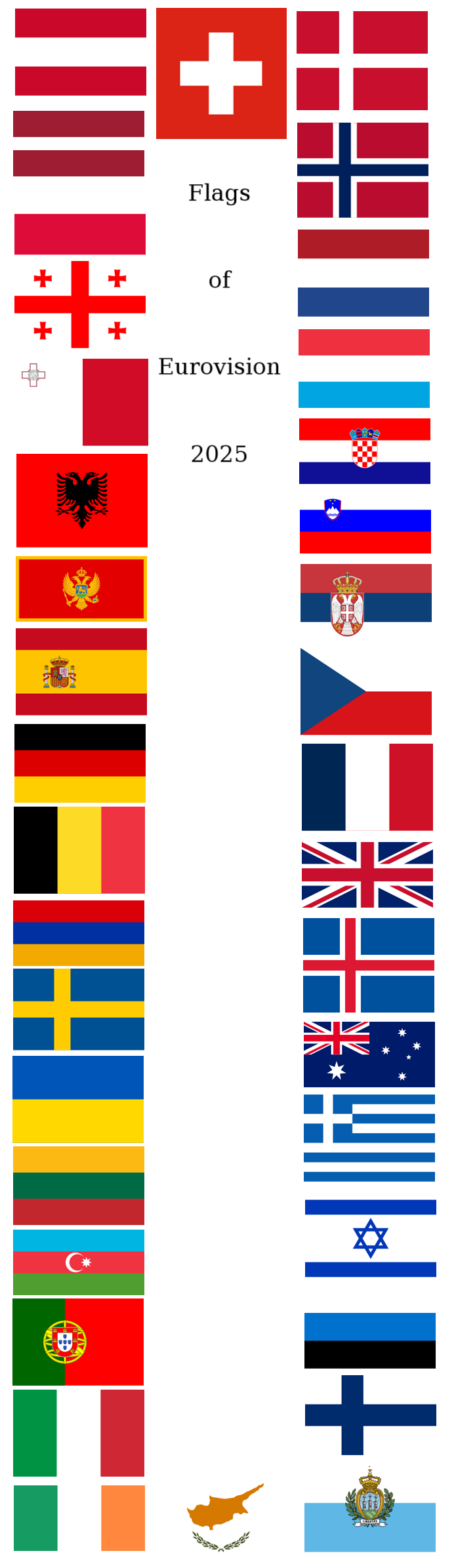
Every year when we watch the Eurovision Song Contest, I find myself distracted from the music and stage shows by all the European flags. I enjoy seeing all the different combinations of colors and designs, and every year I find myself thinking: “I wonder if I could organize the Eurovision flags in such a way that they flow from one to the next with similar colors and patterns?” Well, this year I finally decided to try it, so here it is! My Eurovision 2025 flag carousel, starting with this year’s host, Switzerland, and circling through the flags of all the other participating countries!
Why did I make this? No good reason. Just because I wanted to.
Should you care? I really can’t think of any reason why you would.
But if you’re a fellow fan of flags, I hope you enjoy it!
Ooh! A new version of Jane Austen’s Pride and Prejudice is in the works!
Netflix is producing the 6-episode adaptation. Author Dolly Alderton will adapt and Euros Lyn direct. Of the cast so far announced are Olivia Colman as Mrs. Bennet—which will be a fantastic performance, I’m sure—plus Emma Corrin as Elizabeth Bennet and Jack Lowden as Mr. Darcy.
At this writing the new P&P series is only in preproduction, so lots of unknowns remain, including release date. According to Netflix, production is slated to start in the UK this year, but that’s all so far.
Wow, I’ve been wanting another Jane Austen adaptation for a while, so this is great! Not necessarily P&P, though, it’s been done so many times, but I’ll take it. 🙂
As I said, I firmly believe Colman will be great, and I seem to remember good things about Corrin (Princess Diana in The Crown and Cassandra Nova in Deadpool & Wolverine). Lowden, however, is completely new to me; I have no idea what kind of an actor he might be.
Another complete unknown to me is writer Dolly Alderton. However, I’ve seen the work of director Euros Lyn in Doctor Who and Torchwood as well as Broadchurch and Sherlock (the latter with Martin Freeman and Benedict Cumberbatch). Broadchurch, especially, was fantastic, and he and Colman worked together in that.
Very promising! Looking forward to hearing more about this adaptation.
Every now and then you read snippets where an overused truism is poked and prodded in a way that nudges something loose.
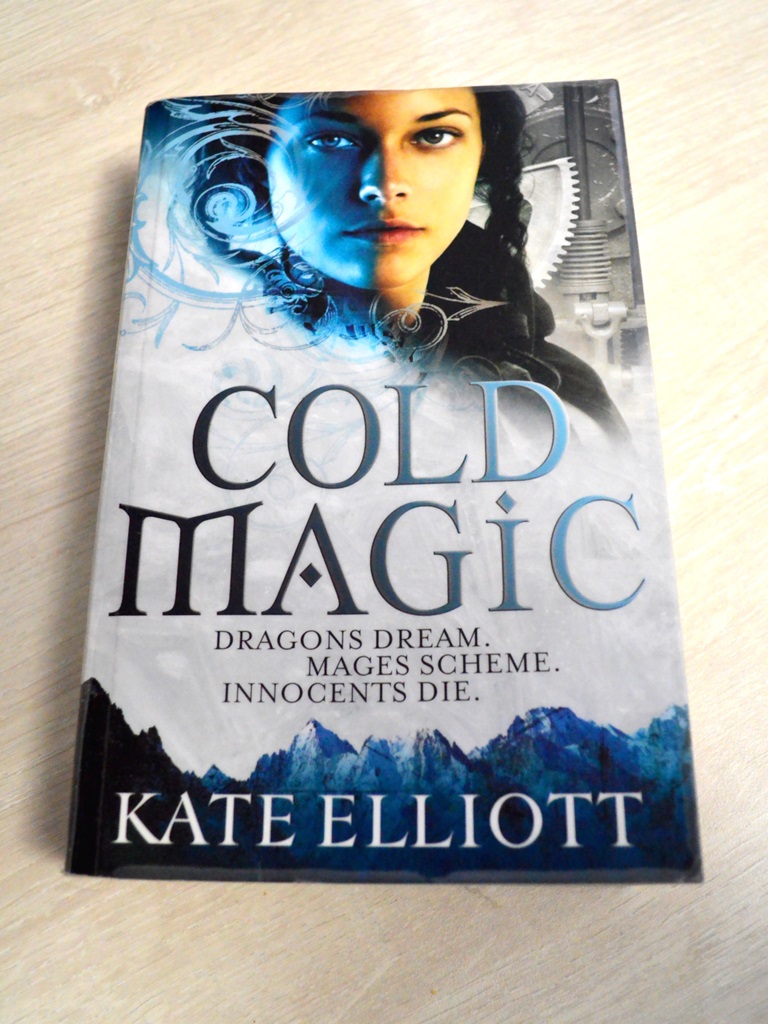
“His features, his gestures, his long black braid: All these had become as familiar to me as if I had known them my entire life long, yet I had first encountered him only a few days ago. I did not understand it. Was this what kinship meant? A sense, deep in your bones, that the person next to you is part of you? Inextricable from what you are? That you could not be who you are without their existence as part of the architecture of your very self?
“We are none of us one thing alone and unchanging. We are not static, or at rest. Just as a city or a prince’s court or a lineage is many people in one, so is a person many people within one, always unfinished and always like a river’s current flowing onward ever changing toward the ocean that is greater than all things combined. You cannot step into the same river twice.”
– Catherine in Cold Magic by Kate Elliott
I remember being kinda stunned one time, years ago now, when talking to a coworker and she said she never re-reads books. I find that unfathomable, to be honest. It’s a bit like never eating the same food twice.
Strictly speaking, of course, the two examples are different, since repeatedly cooking the same dishes makes the kind of pragmatic sense that re-reading does not and cannot offer. But if you eat your favorite foods more than once, why wouldn’t you read your favorite books more than once? It’s so exhilarating to gain a deeper or a wider understanding of a work or phenomenon you think you thoroughly know already, because you have changed.
Elliott, Kate. Cold Magic. London: Orbit, 2010, p. 384-385.
Image by Eppu Jensen
Serving exactly what it sounds like, the Quotes feature excerpts other people’s thoughts.
Do not be too sad, Sam. You cannot always be torn in two. You will have to be one and whole, for many years. You have so much to enjoy and to be, and to do.
– Frodo, in The Return of the King
I recently reread The Lord of the Rings for the first time in over a decade. It is also the first time I’ve read the book since we moved from the US to Finland. This line, from Frodo to Sam before his departure from the Grey Havens at the end of the novel, was always a beautiful line, but it hit me harder now.
Eppu and I have always lived a life torn in two. Coming from two different countries on different continents, we always knew that to be together, one of us would have to be far away from the people, places, and things we have grown up with and loved. For many years, she was the one who was far from home, as we lived in the US for my studies and work. Since we moved to Finland a few years ago, now I am the one whose familiar places and people are far away.
You might think that the romance between the human Aragorn and the Elf Arwen would speak to me the most, but their love story plays out on the scope of high mythology, beautiful but too remote to relate to. The simple words of a Hobbit, wishing healing and hope to a beloved friend, struck my heart.
We cannot always be torn in two. Love makes us one and whole.
Tolkien, J. R. R. The Lord of the Rings. Harper Collins edition, 1994, p. 1006.
Serving exactly what it sounds like, the Quotes feature excerpts other people’s thoughts.
The article is definitely worth a look, especially since (at this writing) it has more photos than IMDB. Way more. And they look great! I mashed up some of them into a collage, below, mostly for my own enjoyment:
We still don’t see much of the company or Corporation Rim even in these first look photos, but it looks dark and imposing (top left in my mashup). I assume the other spaces with orange accents are either the Preservation Aux habitat down on the planet or their hopper, or (less likely) the DeltFall survey habitat.
Readers of Murderbot books know that Preservation is everything Corporation Rim isn’t when it comes to human rights and comfort, and it’s fantastic how the set design has implied that with a paler, more cheerful color scheme and with plants (bottom right in my mashup). Looks like some of them are edible, but some look decidedly decorative.
A tidbit that’s definitely not from the first Murderbot book is revealed by the first look article: “One of the funniest sequences in the series involves […] a human indentured servant who has been alone too long in the reaches of space and makes the mistake of trying to seduce the uninterested security unit.”
Err. Hm. I could see why they’d want to include the scene (as a further hint of how SecUnits in general work), but mostly I can’t see how it could add more than confuse. We’ll have to wait for the series to dissect it further.
The clip doesn’t reveal much, just that Murderbot doesn’t have a bellybutton or nipples.
But the trailer!
(Confession: My very first thought was ‘Murderbot has a stupid voice’—sorry, Alexander—followed by ‘but I’m sure I’ll get over it’.)
The writing team has included Murderbot’s favorite show The Rise and Fall of Sanctuary Moon. For real: we’ll actually get to see some of the show, and it looks fabulous! And what a cast—according to Vanity Fair, Sanctuary Moon stars John Cho, Jack McBrayer, Clark Gregg, and DeWanda Wise.
Also, they’ve kept Murderbot’s inner dialogue—woot!—and the Preservation team looks and feels absolutely bang on. They even have colorful rugs on their mission! Plants and rugs lugged along on a planetary survey—if that doesn’t tell you anything about Preservation’s attitude towards life in general, I don’t know what will.
I’m ridiculously excited about the Murderbot series. (I had to force myself to go back and delete a whole bunch of exclamation marks from this post, if you can believe it!) I really, truly hope it’ll be good, and no-one’s marketing-directored it to death. So far it’s looking promising!
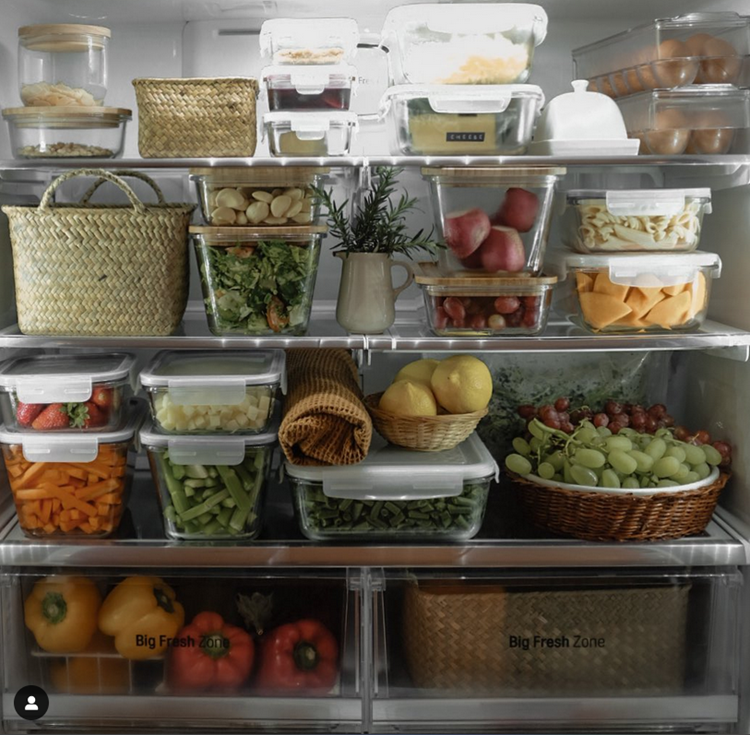
Have you heard of fridgescaping? The phenomenon apparently started on TikTok, and in a nutshell comes from “landscaping” your fridge.
Sounds like some people got into it during the covid lockdowns. There are various approaches to decorating the inside of your refrigerator, and ways to organize are, of course, as varied as the creators.
All of the above are still mainstream. Lynzi Judish (lynziliving) takes fridgescaping to another level. Hers designs are very pretty, lushly styled, and themed. There is, for instance, a Beetlejuice…
However: I have A LOT of questions! I’m not on Instagram or TikTok, and plan not to begin just to do a bit of research. But, like—
I see a lot of snack-type produce. Where do the fridgescapers store their actual food? Food food, the cooked food? (Surely they do cook warm meals…?) Or leftovers?
Are the containers food safe? Please tell me they all are!
Are they ruining the books or photos or decorative boxes placed in the fridge?
Why does everything need to be decanted? (Yes, I know why—it’s the look. However, all those themed empty containers are just more clutter to store elsewhere and more $$$ down the drain.)
How do they keep re-arranging their fridges without wasting an inordinate amount of energy?
Also: While I do enjoy a (thoughtfully) decorated space, for me, function has to come first. It absolutely must; I cannot live otherwise. I have to have a home that works; if it looks good, too, that’s great! But I must be able to use things I need when I need them, not after five minutes of digging or setup. (Which is also why I must have a dedicated sewing room with the machine on a table, ready to go at a moment’s notice.) If a space or area isn’t useable, it’s a source of frustration for me, which isn’t worth it, especially not for everyday functions like the fridge.
(A super-short recap of his post: the song Bara bada bastu, ‘Just having a sauna’, despite representing Sweden, is in fact performed by the Finnish comedy group KAJ. As a result of KAJ’s popularity, Swedes and Finns are finding a new spirit of Eurovision togetherness, and it has also brought some international recognition to the little-known Swedish-speaking minority in Finland.)
Here, as a companion post, is a listing of cultural references in KAJs song and in the performance.
I’m pulling some of this from my own experience growing up in Finland, but others from online commentary, or my Swedish-Finnish friends’ stories. This list is, therefore, likely not to be complete. Additions are very welcome!
KAJ—which rhymes with the English word guy—is made up of Kevin Holmström, Axel Åhman, and Jakob Norrgård, who all originally hail from Vörå, Ostrobothnia, Finland. The idea behind the song is to gently poke fun at how Swedes view Finns and our culture. Here we go! 🙂
Bara bada bastu by KAJ is the song representing Sweden in the Eurovision Song Contest 2025, and it’s been shaking things up in Sweden, Finland, and the Eurovision bubble as a whole. If you haven’t been following the run-up to Eurovision 2025, you may not know the story of Bara bada bastu and why it matters so much to so many people. Here’s a short introduction to get you caught up.
Finland, Sweden, and Swedish-speaking Finns
Finland and Sweden have a long and complicated history, grounded in the fact that what is today Finland was conquered by Sweden in the Middle Ages and ruled as part of the Swedish kingdom for centuries. Until recently, Finland was largely a poor and undeveloped area compared with metropolitan Sweden. The elite in Finland were traditionally Swedish transplants or had close social ties to Sweden. As a result, the typical Finnish stereotype of a Swede is a stuck-up, rich dandy, while the Swedish stereotype of a Finn is an uncultured, violent drunk. It is an old joke in Finland to say (of a hockey game, or some other equally serious contest) “I don’t care who wins as long as Sweden loses.”
Relations are not purely hostile. The two countries also have a history of cooperation and mutual support. Sweden supported Finland’s self-defense against and recovery from Russian invasion in World War II, and it has long been a commonplace that Finland is Sweden’s first line of defense. Despite this solidarity, there is still a lingering antagonism. When Finland and Sweden joined NATO in response to Russian aggression in Ukraine, it was important to both sides that they join together. It was also important to Finns that Finland was accepted into the alliance first.
Caught in the midst of this sibling rivalry are the Swedish-speaking Finns. Finland has a minority population who speak Swedish as their mother tongue, mostly concentrated in the cities in the south and along the western coast and islands. They make up about five percent of the population. Some are descended from the old Swedish aristocracy, but most of them these days are just ordinary folks, not much different from other Finns. Because of this population and Finland’s historical ties to Sweden, Swedish is the second official language in Finland, and Finnish-speakers are required to learn Swedish in school (just as Swedish-speakers are required to learn Finnish). Many Finnish-speaking Finns resent this language requirement, and some turn that resentment against their Swedish-speaking neighbors. Swedish-speaking Finns are stereotyped in much the same way as Swedes: rich, snobby, and stuck-up. While Swedish-speaking Finns are subject to this sort of low-level resentment and caricaturing at home, they are practically invisible to the rest of the world. Even in Sweden, not everyone knows that some of their Finnish neighbors speak Swedish as their first language.
The Eurovision Song Contest
Leaving aside the world of frosty Finns and snooty Swedes for a moment, let me introduce you to the next thing you need to know about: the Eurovision Song Contest. The Eurovision Song Contest (commonly just called Eurovision) is an annual multinational extravaganza in which countries from around Europe and beyond (G’day, Australia!) compete in putting on musical performances. The exact format and rules have changed frequently since the contest was first held in 1956, but if you’re not up on Eurovision, here are the essentials you need to know.
Every participating country sends one stage act with a song (not longer than three minutes).
Every country chooses its competing act in whatever way it likes. Many production and performance teams are international, and while at least some members of the overall team usually come from the country they are representing, nothing requires the artists appearing onstage to come from or be in any way connected with that country. (Write this down! It’ll be important later!)
The participating acts compete against one another in two semifinals. The viewing audience votes a set number of acts from each semifinal into the four-hour grand final, where they join a small set of acts from countries who get an automatic place by paying the major costs of the broadcast (currently: France, Germany, Italy, Spain, and the United Kingdom).
After all the acts have performed in the grand final, two sets of votes are collated. In each participating country, a jury made up of music industry professionals awards points to their top ten favorite songs. The top song gets 12 points, the second 10, and rest from 8 down to 1. The viewing audience in each country also gets to vote on their favorite songs, with points awarded in the same way. (Neither juries nor audience are allowed to vote for their own country.)
The points are announced onstage in dramatic fashion, and the country with the most combined points wins.
Traditionally, the winning country each year hosts the next year’s contest, although exceptions are sometimes made (such as in 2023, when Ukraine won the contest, but because of the ongoing war, the runner-up, United Kingdom, stepped in as host).
The Eurovision Song Contest has been a venue for good-spirited competition between nations, using music to foster both national pride and international solidarity in much the same way the Olympic Games use sports. It has also created its own subculture with traditions, factions, customs, and quirks of its own.
One of the long-running truisms of Eurovision is that juries and audiences tend to favor different kinds of songs. Conventional wisdom says that juries like serious songs that demonstrate artistic virtuosity and range, while audiences like wacky stage hijinks, fun gimmicks, and a danceable beat. Neither assumption is entirely borne out by the voting results, but Eurovision acts often try to court one set of votes or the other. The way points are divided often means that a song that would have won on the strength of audience votes doesn’t win because the juries favor something else, sometimes to ire of some fans who feel their favorite was cheated.
Finland has traditionally done quite poorly in Eurovision. The country has only one win to its credit, 2006, when the monster metal band Lordi unexpectedly pulled off a win in what is seen as the audience rebelling against a contest they felt had grown stale with too much bland, predictable pop music.
Finland has become a semi-reliable source of audaciously weird contributions to Eurovision, most of which fall absolutely flat in the voting results, but which appeal to some parts of the audience by standing out against a background of highly-polished pop.
Sweden, on the other hand, is a Eurovision powerhouse, with a current total of seven wins to its credit. Highly-polished pop is Sweden’s Eurovision bread and butter, and they pull it off better than most other countries, earning frequent recognition from juries. Sweden is home to a major pop music industry, and Swedish composers, lyricists, and choreographers are frequently found working on other countries’ Eurovision entries.
Recent Eurovision history
With the stage set, we turn to the recent history of the Eurovision Song Contest to see how these deeply-rooted forces have played out to lead us to this year.
In 2012, the Eurovision Song Contest was hosted in Azerbaijan and won by the Swedish singer Loreen with her song Euphoria. While Euphoria leaned a little to the weird side for Sweden, it was still highly produced and sung in English, making it easy for an international audience to follow. Euphoria swept both the audience and the juries.
Sweden took home the trophy again just three years later in 2015, when Austria was hosting. The singer Måns Zelmerlöw won with his song Heroes. Like the usual Swedish entry, Heroes was an immaculate pop anthem with a clever stage show, but it caught the heart of Europe. While Italy and Russia did better in the audience vote, Heroes soared with the juries, and Måns’s telegenic charisma won over even those fans who didn’t place Sweden first.
The next year, 2016, Sweden hosted the contest. Måns returned to the stage not just as a performer but as co-host of the festivities along with comedian Petra Mede. The 2016 show was carried off brilliantly and established Måns as not just a beloved past winner but one of the contemporary faces of the contest. He reappeared in several following contests as part of the general entertainment and the interval acts that fill up time while votes are counted. (2016 also gave us Peace Peace, Love Love, a loving parody of the contest itself, performed by Petra and Måns.)
In the following years, Finland and Sweden continued their usual patterns. Swedish songs routinely scored well with juries, and Finland’s songs occasionally excited some fans while mostly ending up near the bottom of the vote tallies. Then came Käärijä.
Finland chooses its Eurovision act with a televised national contest called Uuden Musiikin Kilpailu (New Music Contest, abbreviated UMK). In 2023, a young Finnish rapper/singer known as Käärijä had a runaway victory at UMK with his song Cha Cha Cha and quickly became a sensation among Eurovision fans. Cha Cha Cha was a challenging song: unabashedly weird, sung in Finnish rather than internationally-friendly English, and reflecting in complicated ways on Finnish alcohol and dance culture, but something about it spoke to a wide and adoring audience in Europe.
Sweden selects its competitor with Melodifestivalen (Melody Festival, casually known as Melfest or Mello), a multi-week tournament of songs which finally crowns a winner after several rounds. In 2023, Loreen returned to Eurovision by winning Melfest with Tattoo, a smooth jury-pleasing vocal performance.
Going into Eurovision 2023 (hosted in the United Kingdom on behalf of Ukraine), Finland was in the strange position of audience favorite. The outpouring of fan love for Käärijä and Cha Cha Cha was unheard-of in Finland’s Eurovision history. It quickly became clear that Tattoo was also gathering momentum. In the final voting tally, Finland came out way ahead with the audience, but the juries showed Finland much less love and delivered the victory to Sweden.
The 2023 contest felt like an encapsulation of the Finland-Sweden relationship: Finland the scrappy, weird underdog went up against Sweden the polished, practiced former winner, and the juries swung for Sweden. In the days after the contest there was a lot of resentment from Eurovision fans who felt the juries had cheated Käärijä of a win and the audience of their favorite. Finns felt deflated, and losing to Sweden rankled especially hard. Unkind things were said. In time, tempers cooled, and Finns and Swedes got back to the usual routine of quiet mutual disdain.
The 2024 contest, hosted again by Sweden, did what it could to soothe tempers. The Swedish hosts (Petra Mede again and actress Malin Åkerman) had plenty of self-deprecating jokes about Sweden’s Eurovision obsession, and Käärijä himself performed in one interval act.
It was a turbulent contest, however. Protesters demonstrated against Israel’s participation, and there were rumors about the Israeli delegation at the contest harassing other performers. The biggest cause of discontent, however, was when the Dutch performer, Joost Klein, an audience favorite and one of the leading contenders for victory, was suddenly booted from the contest after an altercation with a camera operator. The details of the incident are murky, but it was widely seen as an overreaction by Eurovision’s governing body. The live audience at the event was vocal with its displeasure, and in the aftermath many Finns enjoyed some schadenfreude at Sweden’s expense.
When do we get to the sauna brothers?
We’re almost there! I promise!
Finally we come to 2025. This year, Finland selected Erika Vikman’s Ich komme (I’m coming) to represent the country. Ich komme is a pumping, upbeat song celebrating a woman’s sexual desire. Sexiness is no stranger to the Eurovision stage, but it traditionally caters to the male gaze. Ich komme, though plenty sexy, is very clear in being about a woman’s own joy in her body and does it without disparaging men, either, a novelty for Eurovision. After UMK, Ich komme gathered some positive buzz, and, while probably not a winner, looks like it may do well at the contest.
And then came this year’s Melfest. As usual, it was a smörgåsbord of well-known Swedish pop music talent, but the star attraction was the return of Måns Zelmerlöw. Måns competed with Revolution, another highly-polished pop anthem in the same spirit as his winning Heroes.
Other great names in Swedish music filled the roster, including John Lundvik, a former Eurovision contestant who came close to winning in 2019. And then there was KAJ.
KAJ is a Finnish comedy group made up of three Swedish-speaking Finns from one of the smaller municipalities on Finland’s west coast. The group takes its name from the first letters of its performers’ names: Kevin, Axel, and Jakob. Although they were locally popular, they were not well known even on the national stage, and were practically unheard-of outside of Finland. KAJ was invited to join Melfest by one of the festival’s producers, and the trio figured it might be a good way to increase their name recognition and maybe score a few more gigs in Sweden but without much hope of anything more. KAJ joined the contest with Bara bada bastu (Just having a sauna), a light-hearted but sincere tribute to the joys of relaxing in sauna after a long day, performed in their own regional dialect of Finland Swedish. KAJ and Måns went up against each other in one of the last rounds of the competition and both passed through to the final.
KAJ stood out from the other performers in the final. Surrounded by media-sexy pop stars and their slickly-produced English-language international hits, the performers in KAJ were self-consciously nerdy, unfashionably authentic, and the only contestants so gauche, so outré, so utterly unsophisticated as to show up to the Swedish song-selection contest and sing in Swedish! Yet the audience loved them! When the votes were counted (Melfest uses a voting system similar to Eurovision’s), it came down to KAJ and Måns. It felt like Käärijä and Loreen all over again: the weird, provincial Finnish nobodies singing a niche but heartfelt little song in their own language up against Eurovision royalty with a whole national pop music industry behind him belting out a focus-group-perfect anthem in English.
And then the impossible happened: KAJ won! The juries broke just barely in Måns’s favor, but the Swedish audience went for KAJ by a million votes, giving KAJ the most audience votes in Melfest history! In this year’s Eurovision Song Contest, Sweden will be represented by a little-known humor group from Finland!
(Måns was less than gracious about his loss. One might have forgiven him for a few unguarded comments in the heat of emotion after a tense contest, but in the weeks since the Melfest final Måns’s wife has announced a divorce with allegations of abuse and drug use that have tarnished Måns’s reputation. Many Swedes are relieved that he will not be representing them on the international stage, especially not with the bitter aftertaste of 2024’s contest.)
The effects of the win have been remarkable to witness. Coming after the rancor of 2023 and chaos of 2024, Swedes and Finns are finding a new spirit of Eurovision togetherness. KAJ’s win has gone some way to patch over old resentments and break down timeworn stereotypes. It has also brought some international recognition to the little-known Swedish-speaking minority in Finland.
This year’s Eurovision Song Contest will be held in Switzerland in the middle of May. We will see what the rest of Europe makes of Ich komme and Bara bada bastu. At this moment, the boys in the sauna are running strong for the top spot, and if they win, then for once Finns will be just as happy for Sweden’s victory as the Swedes are.
An occasional feature on music and sound-related notions.





 Co-Geeking
You must be logged in to post a comment.