I Know You’re a Barbarian, But What Am I?

The ancient Greeks had certain stereotypes about the people they called barbaroi: Romans were brutes; Scythians were drunkards; Persians were perverts, and so on. Like all ethnic stereotypes, these conventional views were based on prejudices and assumptions rather than truth. Not everyone necessarily believed in or agreed with these stereotypes, but they were recognizable elements of Greek culture in the same way that “French are cowards” or “Italians are reckless drivers” are recognizable stereotypes today. But what stereotypes did other peoples have for the Greeks? We don’t have very many sources that offer non-Greek views of the Greeks, but there are some hints that suggest that the common view of the Greeks, and Athenians in particular, is that they talked too much.

The Greek historian Herodotus reports a story that a Scythian named Anacharsis had traveled in Greece and come home to Scythia with a pointed opinion on the Greeks:

In fact, I have heard a story told by the Peloponnesians about Anacharsis, who was sent by the king of the Scythians to Greece to learn about our ways. When he returned, he told the king that all the Greeks strive for wisdom except the Spartans, but the Spartans are the only one who talk and listen thoughtfully.


Herodotus, Histories 4.77

Since the Spartans were famous for being people of few but well-chosen words, the point of the anecdote is that other Greeks talked to much and said too little. We can compare the story of Anacharsis visiting Greece with Herodotus’ account of the Greek scholar Hecataeus visiting Egypt and getting a lesson from the priests there about Greek pretensions:

The scholar Hecataeus was once in Thebes and recounted his genealogy back to the sixteenth ancestor, which he made out to be a god. The priests of Zeus did the same thing for him that they also did for me, though I made no such claims about my ancestry. They led me into the hall of the temple and counted out the wooden statues that were there, which equaled the number they had already told me. Every high priests erects a statue of himself there during his lifetime. Pointing to these statues and counting as they went, the priests showed me that each was the son of the man before him, from the one who most recently passed away back to the earliest of them all. When Hecataeus claimed to be descended from a god in the sixteenth generation, they did not believe that was possible. They instead traced the ancestry of the priests by counting the statues, each one a piromis, the son of a piromis (piromis being their word for a gentleman), counting back three hundred and forty-five statues, and not a one of them a god or demigod.


Herodotus 2.143

The stories of Anacharsis and Hecataeus both come to us from a Greek source, so neither is a direct report of a foreign view of the Greeks, but it is interesting that they seem to have the same point. Anacharsis approved of the Spartans because they were careful with their words. Hecataeus got put in his place by the Egyptian priests because he had made an outrageous claim before listening to people who knew better. In both cases, the Greeks would have been better off if they talked less and paid attention more. Since Herodotus was widely-traveled and had spoken with people of many different cultures, he may be giving us something reflecting an authentic perception of the Greeks by outsiders.

The richest source we have for outside views of the Greeks is the Romans. The Roman perspective is complicated because so many Romans admired and identified with Greek culture, but when we hear negative views of the Greeks from Roman sources, they often tend the same way: Greeks, and Athenians in particular, talk too much.

The Greek antiquarian Plutarch, in his life of the Roman politician Cato the Elder, reports that Cato’s opinion of the Greeks as long-winded and superficial:

He dealt with the Athenians through an interpreter, although he could have spoken to them himself […] He said that the Athenians were astonished at the speed and punch of his [Latin] words, for what he said briefly [in Latin] took the interpreter many words to say [in Greek]. It was his opinion that on the whole, the words of Greeks came from their lips, those of Romans from their hearts.


Plutarch, Life of Cato the Elder 1.12

The Roman satirist Juvenal gives a similar anti-Greek attitude to his character Umbricius:

Quick-witted, damned audacious, always ready with a

speech, and they can out-talk Isaeus [a famous orator]. What do you

suppose that one is? He’s brought us a bit of everything:

schoolteacher, professor, surveyor, painter, wrestling coach,

seer, tight-rope walker, doctor, magician—your hungry little Greek

does it all! Tell him to fly and up he goes!


Juvenal, Satires 3.73-78

While we don’t know what words non-Greeks would have used for the Greeks, parallel to the Greek word barbaros for non-Greek-speakers, there’s a good chance it was something along the lines of “blabbermouth” or “bore.”

History for Writers looks at how history can be a fiction writer’s most useful tool, from worldbuilding to dialogue.

A Compelling Mashup of Columbo and Star Trek: TOS

Someone ingenious—who only goes by the moniker cursedtrekedits on Tumblr—photoshopped Lieutenant Columbo (played by the inimitable Peter Falk) into screencaps from Star Trek: The Original Series. Take a look:

Tumblr cursedtrekedits ST-TOS Mashup5
Tumblr cursedtrekedits ST-TOS Mashup4

Very nice, isn’t it! Make sure to visit cursedtrekedits’s Tumblr for more; I’ve only shown two of the photos.

Although I haven’t seen either series in full, this combo seems plausible—with a wink and a little handwaving—and I’d definitely watch it. 🙂

Images by cursedtrekedits Tumblr.

Hey, look! We found a thing on the internet! We thought it was cool, and wanted to share it with you.

A Retirement Transmog for My Priest

At the end of Shadowlands, I was planning to retire my holy priest. He’s the first character I ever played, so I’m never going to delete him, and he will always be holy specced, but I don’t do group play any more where a healer would be needed, and leveling up a holy priest has been a slog for a long time. I put together a nice transmog for him to wear and was thinking about where I was going to leave him to enjoy his retirement.

Then the talent changes in Dragonflight made leveling as a holy priest pretty okay, so he’s come back out of retirement after all, but I thought I’d share his transmog anyway. Here you go!

And here’s the pieces it’s composed from.

Image: World of Warcraft screencap

Of Dice and Dragons talks about games and gaming.

Living Vicariously Through Social Media: Rainbow Eucalyptus Trees

Rainbow eucalyptus trees (Eucalyptus deglupta) shed their bark at a strip at a time, and the tree trunks look stripy as a result. That’s not all, however—the stripe colors can vary surprisingly much. A freshly revealed area will look bright pale green, which then darkens and changes to orange, red, brown, and grey or blue.

Flickr spencer9 Rainbow Eucalyptus
Flickr Jean-Francois Schmitz Rainbow Eucalyptus

Rainbow eucalyptuses are native to the Philippines, Indonesia, and Papua New Guinea, but have been planted elsewhere in suitable climates.

Amazing, aren’t they? I wonder whether the Weta artists looked at rainbow eucalyptus trees as an inspiration for their saturated, weird Mirkwood trees for the Hobbit movies. (They talked about the design in the behind-the-scenes documentaries; the movies as released are too dark to see the colors properly, if memory serves.)

Images: Two eucalyptuses by spencer9 via Flickr (CC BY-NC 2.0). Closeup by Jean-François Schmitz via Flickr (CC BY-NC-ND 2.0).

Out There is an occasional feature highlighting intriguing art, spaces, places, phenomena, flora, and fauna.

Thoughts on Dungeons & Dragons: Rules and Options

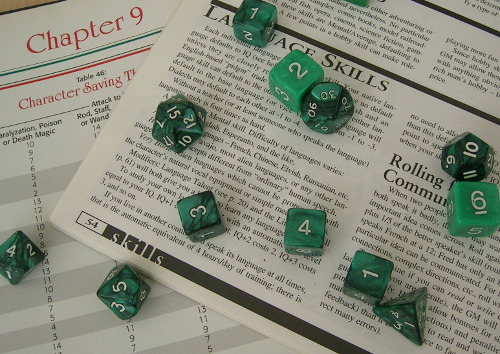
Not long ago I found myself reflecting on my history playing Dungeons & Dragons. It’s been a bit of an odd road. I first started playing in the days of Advanced Dungeons & Dragons in the late 80s, continuing on with the 2nd edition of AD&D in the 90s. I then had a break from the game until I started playing again with a group of friends in grad school in the mid-aughts. Version 3.5 of the game had come out by then, but we kept playing with the 2nd edition rules. I then had a long hiatus from D&D until 2021, when I started playing 5th edition.

In some senses, the long break from the game was good, since I lost a lot of gaming muscle memory in the meantime and didn’t have as much to fight against when learning the new edition. On the other hand, missing out on so much of the ongoing development of the game also meant having to make some big adjustments to my basic approach to running games when I started up again. I’ve been thinking for a while about how to put that shift into words, and I think I can sum it up best like this:

Advanced Dungeons & Dragons was designed for people who like rules. 5th edition Dungeons & Dragons was designed for people who like options.

In AD&D, the rules spell out very clearly what a character can and cannot do. A DM’s job is to apply those rules consistently and fairly so that players can do their best to overcome challenges while staying within those rules. Fighters can’t be sneaky; that’s a Thief thing. Magic Users have to figure out their spells at the beginning of every day, then they have to make the best of their choices. Characters get XP from killing monsters and finding treasure; they’ll level up when they reach the right amount on the chart and not before.

In 5th edition, players have lots of options for how to approach any given challenge, and the rules have a lot of flexibility built into them to allow for alternative solutions. A DM’s job is to present the players with interesting challenges that push them to be creative. Fighters can be sneaky if they roll well on Stealth. Spellcasters have spell slots they can use for any spell they have prepared. A DM has options, too. You can use XP for leveling if you want, or you can just say: “You completed the adventure and saved the day. Everyone gets a level!”

Neither way of gaming is wrong. Some players thrive on the challenge of a tightly prescribed set of rules—chess hasn’t survived for thousands of years by being wacky and unpredictable. They want and enjoy a game with fixed parameters, where failure has a real cost and victory comes through precise tactical execution. That’s the gaming experience that AD&D delivers, but I’ve learned in the past couple years that it’s not the gaming experience I enjoy best. I’m happy with 5th edition’s flexibility and willingness to let players figure out their own ways of engaging with the challenges an adventure presents them with.

It used to be my job as DM to make my players play by the rules. Now it’s my job to make them make the most of their options. I like this way better, but that doesn’t the other way bad; it’s just a different way of playing.

Image by Erik Jensen

Of Dice and Dragons talks about games and gaming.

MCU Secret Invasion Trailers

In two weeks, the Marvel Cinematic Universe miniseries Secret Invasion becomes available.

Here’s the first trailer:

Marvel Studios’ Secret Invasion | Official Trailer | Disney+ by Marvel Entertainment on YouTube

And the second trailer:

Marvel Studios’ Secret Invasion | Official Trailer | Disney+ by Marvel Entertainment on YouTube

Wow, ok. Yes, more of Fury, Hill, Rhodes, and Ross! I’ll also enjoy seeing Ben Mendelsohn, I’ve never seen him do a role poorly. The new characters played by Olivia Colman and Emilia Clarke look interesting, if the tiny glimpses can be trusted.

Not sure how entertained I can be by a series that focuses on high-stakes power struggles and war—it may well be a little too close for comfort right now. (I.e., when Finland’s neighboring country is waging war against their sovereign neighbor, with behind-the-scenes high-stakes power struggles that very well might affect European if not world history.)

If nothing else, I will probably try at least the first episode to see how well it’s written. The acting should be fine.

Secret Invasion releases for streaming on June 21, 2023.

Hey, look! We found a thing on the internet! We thought it was cool, and wanted to share it with you.

A Roman Holiday (with Crocodiles)

When you go on vacation, you want to make sure you get the best experience. If you’re rich enough, other people will do it for you. That was just as true in the past as it is today. Here’s a fragment of a letter that has survived on papyrus from the Ptolemaic period in Egypt about preparations for a tour of the Faiyum oasis.

A Roman senator, Lucius Memmius, was touring Egypt in the late second century BCE. Someone in Alexandria wanted to make sure that Memmius had a good trip, so instructions were sent on ahead to make sure everything was ready for the important guest.

From Hermias to Horos, greetings. Attached is a letter to Asclepiades. Make sure that these instructions are followed. Be well. Year 5, 17th of Xantikos, 17th of Meikheir (March 5, 112 BCE)

To Asclepiades.

Lucius Memmius, a Roman senator who holds a position of great worth and honor, is making a grand expedition from the city [of Alexandria] to the Arsinoite nome to see the sights. See that he is properly welcomed, and take special care to see that lodgings are furnished along with landing places at the proper locations […] Make sure that the welcoming gifts listed below are ready to be handed over to him at the landing places, and that the furnishings for the lodgings, the usual morsels for Petesouchus and the crocodiles, the equipment for visiting the Labyrinth, the […] and the offerings and supplies for the household sacrifice are provided. In all respects, take the greatest care that everything should be prepared for his enjoyment, and be zealous […]

P. Tebt. (Papyri from Tebtunis) 1.33

(My own translation)

It looks like Memmius’ itinerary included watching crocodiles being fed and visiting the Labyrinth, a sprawling ancient temple complex whose walls and passageways were famous in antiquity.

It’s also interesting to note that, although Hermias wanted to make sure that special care was taken for Memmius’ visit, Memmius was evidently following an established tourist route. Hermias does not need specify where lodgings should be prepared for him or what equipment is needed for visiting the Labyrinth. The crocodile feeding was apparently a customary spectacle. Asclepiades clearly knew what to do to receive an important visitor, Hermias just wanted to make sure he did it. Faiyum tourism was evidently an established practice at the time.

History for Writers looks at how history can be a fiction writer’s most useful tool, from worldbuilding to dialogue.

A Dragon Crawls Down from the Ceiling to Make a Fireplace

A dragon fireplace. A DRAGON. Fireplace!

Twitter Into the Forest Dark Dragon Fireplace

Ok, thinking about it a little longer than half a second, it’s not surprising that there are a number of dragon designs for fireplaces and stoves for both indoors and out, in addition to firepits, fireplace screens, and andirons.

This particular one must be custom work and as such, it cannot be inexpensive. But, dang, is it handsome or what?

By unknown. Found and image via Into the Forest Dark on Twitter.

Out There highlights intriguing art, places, phenomena, flora, and fauna.

Completely New Night Elf Balance Druid Transmog

Since the Dragonflight expansion has some major differences from previous World of Warcraft expansions, I decided it was time for a major change in my main toon’s transmog.

Erik often has a conceptual approach to his mogs. Unlike him, I tend to start from a particular piece and build an outfit around it, or choose a color and go from there. This time it was more or less a combination of the two: I wanted to include the whimsical wings in Sprite Darter’s Flutterers—because why not—and chose the rest of the colors to highlight the shoulderpiece.

Dragonflight F Night Elf Druid Black Transmog

So, I chose the unassuming Black Swashbuckler’s Shirt and Black Tuxedo Pants. The Chestguard of Insidious Desire was also reasonably subdued. Gloves and belt were a little difficult, but Frostcarver Grips and Stygian Belt went well enough with the chestpiece. Conveniently, one of the options on Scythe of Elune had purple glow; that choice was easy. To round the set off, the helm, cloak, wrist, and boots are hidden. (Gosh, the ability to hide pieces is such a great change to the transmog system!)

Here’s the mog viewable in the Wowhead Dressing Room.

Image: World of Warcraft screencap

Of Dice and Dragons talks about games and gaming.

A Greco-Scythian Gorytos

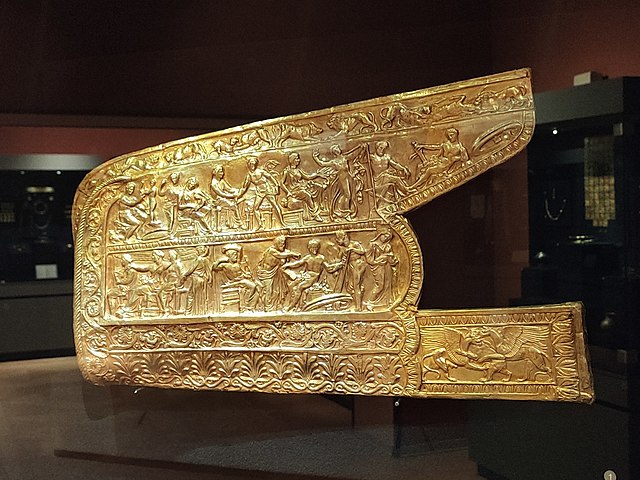
Here’s a beautiful work of art. This is a golden decorative panel from a gorytos, a combination quiver and bowcase that was used widely among ancient peoples of the steppes and the Iranian plateau. This example was found in Melitopol in southeastern Ukraine.

Gorytos, photograph by VoidWanderer via Wikimedia (found Melitopol, currently Kyiv; 4th c. BCE; gold)

Scythian artisans were expert metalworkers, and the Scythian elite valued high-quality metalwork, especially in gold, as emblems of status. This panel was made by Greek crafters serving the Scythian market. The central panel shows scenes from the life of Achilles, a Greek hero whose legends were sometimes associated with Scythia and whose warrior prowess was appealing to Scythian tastes. The outer panels feature decorative scenes of animals hunting, a popular motif in Scythian metalwork.

This piece is not just a beautiful work of art, it’s also an example of how art and artisans in antiquity crossed boundaries and bridged cultures.

Out There highlights intriguing art, places, phenomena, flora, and fauna.