Ancient d20s

If you’re a role-playing gamer, you probably recognize the profile of a twenty-sided die, or d20, right away: the collection of triangles making up a bumpy sphere by which we invoke the capricious god of random numbers. This shape (technically known as an “icosahedron”) has been in use a lot longer than Dungeons & Dragons has been around. Here’s an example from Roman-period Egypt which has the names of Egyptian gods marked on its faces in demotic, an Egyptian script.

161103dakhleh
Dakhleh die showing “Isis” face via Martina Minas-Nerpel, “ A Demotic Inscribed Icosahedron from Dakhleh Oasis,” Journal of Egyptian Archaeology 93 (2007), 137-48 (Dakhleh Oasis, Egypt, currently Valley Museum, Kharga, Egypt; 1st c. CE; limestone)

Here’s another example from Egypt. This one has Greek letters on each of its faces.

Icosahedron via Metropolitan Museum of Art (Egypt, currently Metropolitan Museum; 2nd c. BCE - 4th c. CE; serpentine)
Icosahedron via Metropolitan Museum of Art (Egypt, currently Metropolitan Museum; 2nd c. BCE – 4th c. CE; serpentine)

It’s possible that these dice were used for some kind of game, but more likely they were used for divination. The die with the names of gods may have been used to determine which god a person should pray to for help. The Greek letters probably corresponded to a list of pre-written oracular responses: ask your question, roll the die, and consult the table for the answer, sort of like the ancient version of a magic 8-ball.

Some might say the uses of the twenty-sided die haven’t changed much in a couple thousand years.

Of Dice and Dragons is an occasional feature about games and gaming.

Stained Glass Dalek

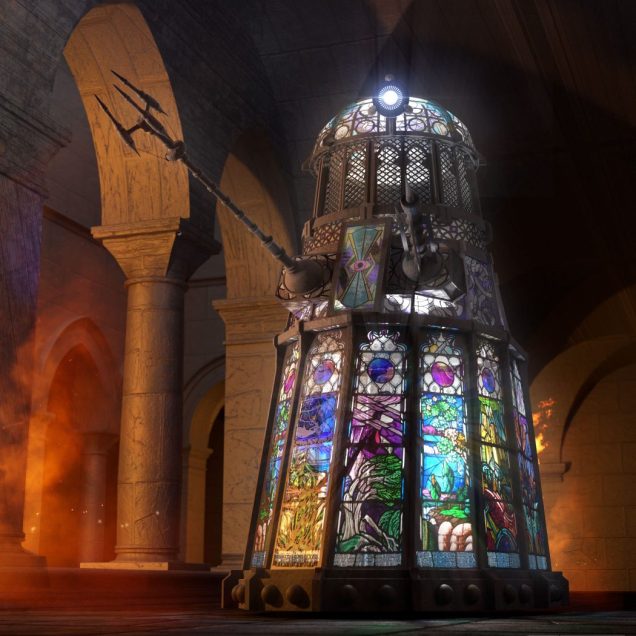
Did you see this amazing stained glass Dalek already?

Jamie Anderson Chris Thompson Stained Glass Dalek Stainley-1050x1050

Producer / director / writer Jamie Anderson worked with designer Chris Thompson to help make the lead and stained glass Dalek a reality. It’s based on a Doctor Who audio drama script by Mike Tucker called Order of the Daleks.

Thompson describes the making-of process:

“My main thought process was to create a “Gothic” Dalek and replace all the flat surfaces with glass designs. My initial sketches had palisades, crowns, spikes and other gothic elements, but we decided to dial a lot of these back for story reasons. In the episode itself these Dalek casings are made by very primitive monks so the focus needed to be on the stained glass and not the metal elements.”

The detailing is absolutely exquisite. There is, of course, more to the design than that—visit Jamie Anderson’s site for the full story and the meaning of some of the elements.

Found via Tor.com.

Image via Jamie Anderson

Out There is an occasional feature highlighting intriguing art, spaces, places, phenomena, flora, and fauna.

Ancient Skeleton Wishes You Happy Halloween

This skeleton lounging with a drinking vessel in its hand, sitting next to bread and an amphora of wine is definitely very apropos:

The History Blog Anadolu Agency Antakya Turkey Skeleton Mosaic

Known as the skeleton mosaic, the panel is part of a triptych discovered in the dining room of a house in Antakya, Turkey (ancient Antioch). The accompanying words (‘euphro’ + ‘synos’) have been translated as “be cheerful, live your life,” presumably to remind diners of the briefness of life.

Found via Colossal.

Happy Halloween to those celebrating!

Image: Anadolu Agency via The History Blog (Antakya [Antioch], İplik Pazarı district, Hatay, Turkey; probably 3rd c. CE; mosaic)

Out There is an occasional feature highlighting intriguing art, spaces, places, phenomena, flora, and fauna.

Quotes: There Is Something about Talking in the Night

“There is something about talking in the night, with the shreds of sleep around your ears, with the silences between one remark and another, the town dark and dreaming beyond your own walls. It draws the truth out of you, straight from its little dark pool down there, where usually you guard it so careful, and wave your hands over it and hum and haw to protect people’s feelings, to protect your own.”

– Margo Lanagan: Tender Morsels

The magic of night-time works in many ways.

Lanagan, Margo. Tender Morsels. New York, NY: Alfred A. Knopf, 2008, p. 307.

(This quote comes from my 21 new-to-me SFF authors reading project.)

Serving exactly what it sounds like, the Quotes feature excerpts other people’s thoughts.

Arrival—Establishing Common Ground

A new Arrival screen ad is out! (Published today, in fact!) In an atypical move, the trailer (if you can call it that) starts with several completely unrelated clips of people in an experimental situation:

Arrival (2016) – “Common Ground” – Paramount Pictures by Paramount Pictures

…except that, of course, the clips aren’t unrelated. They show two strangers with no shared language trying to figure out what they have in common. It’s quite clever; see for yourself.

Two weeks to go till opening night!

Hey, look! We found a thing on the internet! We thought it was cool, and wanted to share it with you.

Memos Never Change

Memos. Inter-office memos never change.

161027legionThe Roman fort at Vindolanda, near Hadrian’s Wall in northern Britain, is a special place. One reason it is so special is that a collection of wooden writing tablets were preserved there, accidentally, in waterlogged ditches. These tablets were used for everyday matters—personal letters, shopping lists, legionary paperwork—and give us a glimpse into the daily life of the Roman army in a way we rarely get. Here’s an example, a message from the leader of a detachment of cavalry back to his commander at the fort, which may feel depressingly familiar:

To Prefect Flavius Cerialis

From Decurion Masclus

Masclus to his lord, Cerialis, greetings.

My lord, please send us your instructions for tomorrow. Should we all return to the crossroads with our standard or just half of us?

Best of fortune to you and may you look on me with favor. Farewell.

PS. My fellow soldiers are out of beer. Please have some sent.

Tabulae Vindolandenses III 632

Sucking up to the boss. Not getting clear instructions. Needing beer. Some things just never change.

Image: Roman army reenactors, photograph by ChrisO via Wikimedia, text by Erik Jensen

Serving exactly what it sounds like, the Quotes feature excerpts other people’s thoughts.

Doctor Strange Trailers

It’s now just over a week until Doctor Strange opens. (Gosh, November is so close!) There are a bunch of trailers on the InterTubes, for instance the official ones by Marvel:

Marvel’s Doctor Strange Teaser Trailer by Marvel Entertainment

Doctor Strange Official Trailer 2 by Marvel Entertainment

The tv spot from the end of September, however, is my favorite:

Doctor Strange TV Spot by Marvel Entertainment

Kaecilius: “Mister…?”

Strange: “Doctor.”

Kaecilius: “Mister Doctor.”

Strange: “It’s Strange.”

Kaecilius: “Maybe. Who am I to judge?”

Harf! 🙂

I have to say I know next to nothing about Doctor Strange. The character was referred to from time to time in the translated X-Men I read in my youth in Finland, but “odd name” and “magic user of some sort” was pretty much what I got out of them.

The cast is something to look forward to. I loved Chiwetel Ejiofor in Serenity and The Martian, and Benedict Cumberbatch should be marvelous (I’d listen to him pretty much just reading a phone book). Mads Mikkelsen looks like the quintessential bad guy. Perhaps too much so; I fear I might find his character too corny, but we’ll see.

Tilda Swinton I’m conflicted over. I’ve enjoyed her past performances. Her character in this movie, The Ancient One, has been gender-swapped, which is really cool. However, apparently the role is whitewashed. I guess we’ll see.

I also know nothing of the director Scott Derrickson; again, we’ll see. It’s been such a slow latter half of the year, movie-wise, that I’m looking forward to Doctor Strange even if I’m not sure whether it’s exactly my cup of tea.

Hey, look! We found a thing on the internet! We thought it was cool, and wanted to share it with you.

Klingons, Homer, Falstaff, and the Dread Pirate Roberts: Understanding Honor

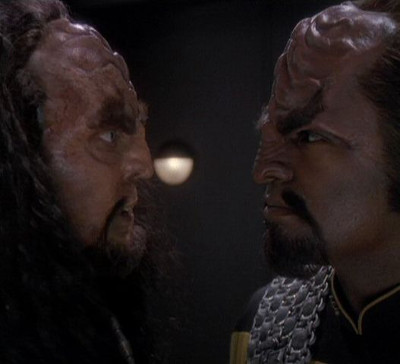
161024klingonsIf you grew up on Star Trek: The Next Generation like me, you’re probably most used to hearing the word “honor” come out of the mouths of Klingons, especially our beloved Lt. Worf. Star Trek offers one of the most brilliant portrayals of honor in fiction. As you watch Worf’s story unfold over the seasons of TNG and Deep Space Nine, it seems like, for all that Klingons like to talk about honor, Worf is the only one who actually cares about it. Worf always makes the honorable choice, even when it’s not the smart one. Other Klingons are cynical and self-serving. They pay lip service to the idea of honor, but they don’t follow it.

But what is honor? It seems like such a simple word, but what does it really mean? When we say that a person, either someone in the real world or a fictional character, is driven by a sense of honor, what actually motivates them? I often put this question to my students when we read the the quarrel of Achilles and Agamemnon in the Iliad. They usually answer something like: “Pride,” or “Following a code.” Those are ideas related to honor. They are honor-adjacent. But at its core, honor is something else: honor is reputation.

Agamemnon and Achilles are warrior kings in a world where there is no one to enforce rules. There are no police, no courts, barely anything we would recognize as law. What is it that stops people from being constantly at war with one another? How can Achilles or Agamemnon have a single moment’s rest from every other warrior in the world trying to take away their homes, families, and treasures? Because of their reputation. Because everyone knows that if you hurt them, they will come after you and they will not stop until they have destroyed you. That’s what honor is. It’s the first line of defense.

161024achillesHonor is not an emotion, a code, or an abstract concept. It is a practical tool that Homer’s warrior kings and people in similarly lawless societies use to keep control of their homes and property. When Agamemnon and Achilles break into a fight at the beginning of the Iliad, it’s not because they’re being petty or overly sensitive about wounded feelings. It’s because neither one of them can afford to look weak. A warrior who gets a reputation for giving up easily or not standing up to defend his property is a warrior who will soon be dead.

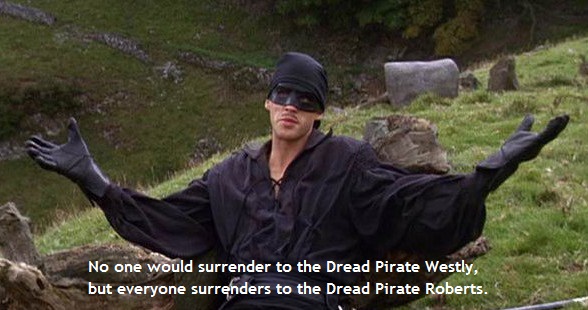
Honor is what people believe about you. Honor is why, when the Trojans had almost routed the Greeks, Achilles was able to turn the tide of battle just by showing up—unarmed—on the battlefield and yelling his warcry. In other words, honor is like the dread pirate Roberts.

161024robertsWhich also means that there is something artificial about honor. It’s sort of a bluff. The greater a warrior’s reputation as an unbeatable fighter, the less actual fighting they have to do. At the same time, anyone who lets slip that they may not live up to their reputation is just inviting attack, which is why, like in the Iliad, warriors often fight hardest not for the things they want but for the reputation itself.

Honor only matters if it is seen, and it is only what is seen that matters. What makes honor is not what kind of person you are but what kind of person people think you are. What happens in the darkness does not matter to honor. It’s easy to get cynical about honor and call it out as a kind of bullshit. Falstaff, in Shakespeare’s Henry IV, Part 1, does just that:

Can honor set to a leg? no. Or an arm? no. Or take away the grief of a wound? No. Honor hath no skill in surgery, then? No. What is honor? A word. What is in that word “honor”? What is that “honor”? Air. A trim reckoning. Who hath it? He that died o’ Wednesday. Doth he feel it? No. Doth he hear it? No. ‘Tis insensible, then? Yea, to the dead. But will it not live with the living? No. Why? Detraction will not suffer it. Therefore, I’ll none of it. Honor is a mere scutcheon.

– Shakespeare, Henry VI, Part 1, act 5, scene 1

Falstaff isn’t wrong. Neither are Achilles and Agamemnon. Honor is a kind of game that everyone plays along with. The wise understand that it’s a game and what seems like cynicism is really just practicality. Only the naive think that honor is real.

This is what makes Star Trek‘s take on honor so brilliant. It seems at first that Worf is the only Klingon who understands honor, but really it’s the other way around: Worf is the only Klingon who doesn’t understand honor. Worf thinks that honor is real. Other Klingons know it’s a game—a game with the highest of stakes that they play for all they’re worth, but a game nonetheless.

Images: Worf and Martok via Memory Alpha. Achilles battling Memnon, photograph by Bibi Saint-Pol via Wikimedia (Vulci, currently Staatliche Antiknesammlungen, Munich; c. 510 BCE; black-figure pottery). Dread Pirate Roberts via History Mine.

Quotes: Discover Not Just the Abstract Thought

“As he watched the TV, he remembered a lecture in his second year of college by a professor of environmental science. The gist had been that institutions, even individual departments in governments, were the concrete embodiments of not just ideas or opinions but also of attitudes and emotions. Like hate or empathy, statements such as ‘immigrants need to learn English or they’re not really citizens’ or ‘all mental patients deserve our respect.’ That in the workings of, for example, an agency, you could, with effort, discover not just the abstract thought behind it but the concrete emotions.”

– Control (John Rodriguez)

That… sounds like sociology or anthropology. Clearly environmental science has more connections with humanities / social sciences than I’ve previously thought!

VanderMeer, Jeff. Authority (Southern Reach Trilogy 2). New York, NY: Farrar, Straus and Giroux, 2014, p. 147.