An Autumnal Druid Transmog

The beginning of autumn is upon us. Trees are putting on their fall colors as the days grow shorter and the night chill begins to bite. What’s a druid to do but put together an autumn-themed transmog? This includes a few of the beautiful woodsy leafy pieces from the Emerald Dream zone mixed with some other gear.

Here’s a link to the pieces in the set.

Image: World of Warcraft screencap

Trailer for Megalopolis, with Thoughts

The first trailer for Megalopolis by director Francis Ford Coppola is out:

Megalopolis (2024) Official Trailer – Adam Driver, Giancarlo Esposito, Nathalie Emmanuel by Lionsgate Movies on YouTube

Strictly speaking, this is, in fact, the second iteration for a trailer. There was a bit of a kerfuffle, for the first version of the trailer was taken down because it included fake quotes from critics, which reportedly may have been algorithmically generated.

I have to say that I’m not wowed. It’s very pretty to look at, beautifully cinematic, even breathtaking at times. However, it really doesn’t seem to be a movie for me.

We’re not in the 80s or 90s anymore, when just about any SFFnal movie was sure to get my eyeballs simply by existing. Then, for a while during and after the aughts, handsome effects and CGI often got me to see a movie I wouldn’t necessarily have seen at the theater otherwise. Now we have reached a saturation point. For a good long while I have just not been able to be bothered about seeing a new release at the theater unless there’s something special about it, or a movie hits a very particular interest of mine.

(I will certainly not take the trouble, if trailers merely make a movie look like a whole bunch of men doing man-things and relegates women to the sidelines. It’s one thing to place your story in a society where minorities aren’t formally given recognition by the society, but there’s a huge difference between writing or filming those minorities in a dismissive way and a respectful way. I found Oppenheimer, for example, a wonderful example of the latter.)

Even reading that Megalopolis is loosely based on Roman history (the Catilinarian Conspiracy in 63 BCE involving an aristocrat attempting to overthrow the Republic) didn’t make it more interesting to me. Granted, the time stop gimmick is slightly interesting, but I confess that it, too, lost its appeal by the end of the trailer.

It is a shame I won’t see more of Nathalie Emmanuel, whose work in the Fast & Furious franchise and in Game of Thrones I’ve liked. Perhaps I’ll find Megalopolis in the library, if it’s ever imported to Finland. At this writing it doesn’t look like it, but we’ll see.

Megalopolis opens on September 27, 2024.

The Art of John Howe in Tampere

Last month we saw an exhibit of fantasy art by John Howe in Tampere-talo, Tampere, Finland. Titled The Art of John Howe: Journeys through the worlds of J.R.R. Tolkien, the exhibit is the first time that Howe’s work has been comprehensively displayed in Finland.

2024 08 13 Howe Exhibit1

Over 250 original works were presented, from pencil drafts to finished color paintings and sculpture, along with sketchbooks and even some metal armor belonging to Howe. Some images were also enlarged into murals or banners, and a number of video screens scattered around the exhibit looped captioned interviews.

2024 08 13 Howe Exhibit2
2024 08 13 Howe Exhibit3

Apart from various illustrations of The Lord of the Rings and The Hobbit, on display were for example works on mythical topics or sagas, like Beowulf and Arthurian legends. Also various architectural or creature studies were included.

2024 08 13 Howe Exhibit4

The exhibit space was partitioned into irregular areas. Walls framed your route in interesting ways, and the murals created striking views. In one corner there was even a video with flying dragons projected up on the wall high above the framed artworks so that the dragons were visible from a distance. The art pieces had enough room, and no area was too small—clearly accessibility was planned in.

2024 08 13 Howe Exhibit5

There was no predetermined loop, merely a path suggested by the layout, which made it easy to pick your preferred viewing order and to avoid the occasional crowd. It was also easy to double back without first having to finish the whole route.

Color and lighting were used in a fascinating way. Most spot lights were warm orangey-brown or in the blue-purple range. Otherwise the hall was surprisingly dark, but not unsafely so. It was very interesting from a mood point of view.

2024 08 13 Howe Exhibit6
2024 08 13 Howe Exhibit7

Visitors were encouraged to take photos. Unfortunately, the ceiling lights reflected on the glass, which made photographing individual framed artworks difficult.

2024 08 13 Howe Exhibit8

It was great seeing the complexity, detail, and vividness of Howe’s art in person, not to mention the variety of his work. We were absolutely delighted to be able to visit!

Images by Eppu Jensen

Quotes: Innumerable Shapes of Letters

There’s an old law of probability often phrased that if an infinite number of monkeys sat at an infinite number of typewriters pressing random keys for an infinite amount of time, they would at some point type out Shakespeare’s Hamlet. The point is that, given a large enough scope of opportunity, things that are very unlikely but not impossible can and do happen.

One of the earliest known expressions of this idea comes from the Roman statesman and philosopher Cicero, although Cicero takes the negative view. He poses the idea as a thought experiment to reject materialist philosophies, like Epicureanism, which held that the world was not created by the gods but was the product of random collisions of matter:

How can anyone look on these things yet convince themselves that certain solid and discrete bodies are carried by force and gravity, and the beautiful and exquisite world is made by the fortuitous arrangement of these bodies? If someone thinks this is possible, I don’t see why they shouldn’t also think that innumerable shapes of the twenty-one letters, made out of gold or whatever material, could be tossed down on the ground so that one could read the words of Ennius’ Annals in them. For myself, I doubt that chance could make a single verse out of them.

Cicero, On the Nature of the Gods 2.93

(My translation)

As unlikely as it is that just tossing letters down on the ground once will yield any comprehensible lines from Ennius’ early Roman historical epic, the infinite monkey theory tells us that if we threw an infinite number of letters an infinite number of times, some verses of Ennius would eventually emerge, not to mention lines from Cicero himself, or any other text that could be written in the Latin alphabet.

One might say that Cicero’s mistake was an insufficiency of monkeys.

Visual Inspiration: Late Babylonian Clay Map

Recently I ran into this Late Babylonian map of the world on a clay tablet from the British Museum:

BM Late Babylonian World Map
The Map of the World, Late Babylonian (found Abu Habba (Sippar), currently British Museum; c. 6th c. BCE; clay)

The map shows the world as a disc surrounded by the circular “Bitter River”. Babylon is marked as a rectangle, the river Euphrates flows south in the middle, and small circles show cities or districts.

The curator’s comment in the BM catalog says that according to the tablet it was copied from an earlier one. Clearly there was an established practice by 6th c. BCE—this object is quite recent in Mesopotamian terms, after all.

Obviously, the map was meant to be more conceptual than realistic. However, there are many notes (and even some time / linear measurements) which make it more usable. (Please visit BM and read the item description; it’s quite fascinating.)

BM Late Babylonian World Map Drawn Plate
The Map of the World, Late Babylonian (found Abu Habba (Sippar), currently British Museum; c. 6th c. BCE; drawing of clay tablet)

What an intriguing map, isn’t it?

As the fragment is approximately 12 by 8 cm (approx. 3″ x 5″), it’s believable that it could’ve easily been transported if desired. Which makes it quite plausible that intrepid adventurers in a story or role-playing campaign in a similar setting could carry around maps made in the same style. There could quite well be professional mapmakers and a developed cartography for your world, even if writing doesn’t happen on sheets of paper as we know it.

Images: The Trustees of the British Museum (CC BY-NC-SA 4.0)

The Amazing Colors of an Ancient Perfume Bottle

So much of what survives of ancient art has lost the colors it originally held—statues have lost their paint, pigments have faded, textiles have weathered. One of the few materials that holds its color well over time is glass. Just look at this ancient Greek glass perfume bottle and see!

This type of bottle, called an alabastron, was used to store small quantities of valuable liquids like perfumed oil. Like this one, they typically had pointed or rounded bottoms and were kept in wooden or metal stands or hung from loops. The bright colors of this bottle are made from layers of colored glass and gold, bent around one another and blown into shape.

The swirling colors of this bottle almost make me think of 1960s psychedelia. It can be startling to find an ancient object that has kept its color and be reminded that it was created and used in a world that was equally colorful.

Image: Alabastron via Metropolitan Museum of Art (found Greece, currently Metropolitan Museum, New York; 1st c. BCE; glass)

A Delightful Chefpunk Costume

The Glasgow Worldcon—known as A Worldcon for Our Futures—has been done and dusted for a couple of weeks now. Some buddies of mine went, but I didn’t. Instead, I’ve enjoyed reading various reports and stories, and looking at photos, of course.

For one, Olav Rokne made his Flickr album for the Masquerade 2024 available. Among the many fantastic photos and costumes my favorite is Linda van der Pal’s chefpunk:

Flickr Olav Rokne Linda van der Pal Chefpunk

A chef, steampunk-style. Aaaah! So inventive and different! 😀

There are the requisite rivets, of course, and valves, dials, gauges, and piping, but also burner coils, a pan, a spatula, and plates (in another photo). What really stopped me in my tracks are the burner coils, though—so, it’s not just any generic steampunk gadget you strap onto your back, it’s a portable stove!

Flickr Olav Rokne Linda van der Pal Chefpunk Closeup

It looks like the stove might have been built from a cardboard box, but I haven’t been able to find the story behind this outfit to confirm. (If anyone knows, please share or link!) It would be interesting to hear details, for instance whether it’s feasible to carry anything inside the oven. So clever, though!

Do you have a favorite among the cosplays?

Images by Olav Rokne via Flickr (CC BY-NC 2.0): Chefpunk. Closeup of chefpunk.

Quotes: Find Joy, Every Kind … It’s What Time Was Made For

In a Tumblr chain earlier this year, people were sharing what they learned each decade as they got older. The exchange included this gem from user atlinmerrick:

“Find joy, every kind, it’s always worth it

“I’m talking that massive, never-ending Discord chat with your bestie? The one that makes you giggle through the day? It’s not a ‘waste of time,’ it’s what time was made for


– atlinmerrick on Tumblr

Hear, hear!

Flickr Oliver Schmidt Joy

As much as it might frighten us some days, change is permanent and the only absolutely realiable thing in life. (Apart from the sheer impossibility of taking anything with you when it’s time to go.) Why not find happiness while you can? Why not allow yourself to feel the joy you feel? Lots of adults would be happier, I think, if they allowed more of the delight they used to feel in their childhood to remain in their lives. (Mostly talking to my Protestant forebears here…!)

Image by Oliver Schmidt on Flickr (CC BY-ND 2.0)

Cults and the Cult of Bacchus

Cults are a staple of modern fantasy. When you need a shadowy organization for your hero to go up against, whether they’re protecting an ancient secret or scheming to bring about the end of days, you can’t go wrong with a cult.

There are plenty of modern examples of secretive organizations that draw in forlorn or gullible people and condition them to submit to the will of charismatic leaders. Such organizations can serve as models for imagining fictional cults, but if you want to write a cult in a fantasy setting, it can be helpful to look at ancient examples. One of the oldest documented examples of a secretive religious organization in conflict with larger society is the ancient Roman cult of Bacchus.

The cult of Bacchus emerged in southern and central Italy in the late third century BCE. It was centered on the worship of the god Bacchus, a version of the Greek Dionysus associated with wine, fertility, and ecstatic release. The Italian Bacchus also borrowed some traits from the Roman god Liber, connected with grapevines, wine, fertility, and freedom. The worship of Dionysus, Bacchus, and Liber was well established as part of the state religion of the Roman republic, which by this time had solidified its control over the whole of the Italian peninsula. The cult of Bacchus was a new religious movement that drew on older traditions but offered its followers new ways of celebrating them.

Followers of this movement practiced their worship in secret, not as part of the state-sanctioned public religion. Only initiated members of the cult were allowed to join in. Unlike traditional Roman religious celebrations, which maintained distinctions between social classes and had separate roles for men and women, initiates of Bacchus included people of all genders and classes who mixed together indiscriminately in their rites. Celebrations were raucous nighttime affairs that featured feasting, drinking, music, and dance.

The Roman elite was scandalized by the popularity of this religious movement. All the surviving sources describing its activity come from this hostile perspective and include lurid suggestions that the Bacchic revelers were practicing magic, engaging in wild sexual frenzies, and scheming at poisonings and other nefarious deeds. Despite these unfavorable sources, there is no reason to think that the cult of Bacchus was actually so outrageous. Seen in the context of the time, we may actually find the cult appearing in a much more favorable light.

To understand the cult of Bacchus, we need to set aside both the hostile attitude of the Roman elite and many of our modern associations with the term cult. While we associate the term today with secretive, manipulative organizations, cult, in its historic use, refers simply to the set of practices that are appropriate to the worship of a particular god or divine entity. All ancient gods received cult from their worshipers, from the official ceremonies for gods of the state to the everyday rituals that attended family and household spirits. Although the cult of Bacchus carried out its rituals in private, there is no indication that the organization was manipulative or coercive, or that members were isolated from the rest of society. In fact, in many ways, the cult offered a positive experience for its members.

Italy in the late third century BCE was recovering from the devastation of the second Punic War. From 218 to 204 BCE, the Carthaginian army led by Hannibal operated largely unchecked in Italy. The effects of war were far-reaching. Many young people from Rome’s Italian subjects were called up to fight in Rome’s legions, some never coming home again. Roman and Carthaginian armies alike ravaged farms up and down the peninsula. In the aftermath of the war, many small farms faced ruin, and a lot of Italian families had little choice but to sell their land to the aristocratic elite at whatever price they could get and move into cities like Rome looking for any work they could find to scrape together a living. Italy in the late third and early second centuries BCE had a vast population of poor people barely getting by, dislocated by war and poverty from their ancestral homes, and resentful of the elite who had come out of the war riding high on plunder and foreign slaves.

The cult of Bacchus offered relief from the pressures of life—if not a hope for a better world, at least a temporary distraction from the troubles of this one. It helped people who had been displaced from deeply rooted ties of family and community find new connections outside the limitations of gender and class. For people who had little joy in their lives and faced a hard daily grind just to eat, the appeal of a celebration full of food, music, and dance was strong. It’s not hard to understand why the cult gained a following in post-war Italy.

It’s also not that hard to see why the Roman aristocracy reacted with such alarm and hostility. The Second Punic War had hit Rome hard. Even though the Romans emerged victorious over Carthage in the end, a generation of potential recruits for Rome’s armies was killed or wounded in the fighting. Rome’s resources were stretched to the limit. What’s more, the war exposed weaknesses in Rome’s hold on Italy. Hannibal’s strategy was to deny Rome resources and fighting power by helping its subjects in Italy rebel. Not all of Italy took Hannibal up on his offer, but enough cities did, especially the Greek cities of southern Italy, to make the Roman elite nervous about their ability to maintain control of the peninsula. Since the cult of Bacchus particularly appealed to the southern Italian Greeks, it doesn’t take much to see why the Roman aristocracy in the years after the war saw disaffected poor Italians gathering together in secret and challenging established social lines as a dangerous thing that needed to be stamped out. The Roman state aggressively suppressed the cult of Bacchus, the first documented example in Western history of a religious movement persecuted by the state.

The cult of Bacchus may not fit the mold of the classic sinister fantasy cult, but understanding the context in which it arose and the forces which drew people to it can help with the worldbuilding for a story in which a cult may not be so benign. Desperate times drive people to find community, relief, and happiness in whatever ways they can. The cult of Bacchus was in reality a benevolent organization that provided much-needed fellowship, but unscrupulous people and organizations can take advantage of the same needs for darker ends.

Image: A scene of Bacchic revelry from a Roman sarcophagus, photograph by Wolfgang Sauber via Wikimedia (currently Anatalya Archaeological Museum; 2nd c. CE; marble)

Some Cozy Fiction Favorites

Recently I’ve been very drawn to cozy fiction. I focus on SFF and mystery for the most part, but not exclusively; my consumption also tends to (but doesn’t exclusively) fall under fantasy. (I do also continue to read and watch other kinds of stories like competence porn). But regardless of genre, the works I enjoy the most share a certain element of comfort in them.

Thematically I need:

  • lower stakes—the problems must be smaller. (They can be large-ish for the characters, however.) No cataclysms or world-enders (i.e., quests that only the protagonist can complete before the looming threat will irrevocably ruin life in the whole universe), and absolutely nothing gloomily post-apocalyptic. Legends and Lattes by Travis Baldree amply fills this criterion. (Although if L&L had had any more faffing about with coffee than it already did I might have screamed.) His Bookshops and Bonedust was good, too.
  • protagonists who either already have or within the story make at least one reliable, supporting connection. The Earthsea world by Ursula K. Le Guin has quite a few characters like this. (Nostalgia does also help.) A found family counts for me, too, of which the Wayfarers series by Becky Chambers is a delightful example. (The Monk & Robot duology, however, I emphatically bounced off of.)
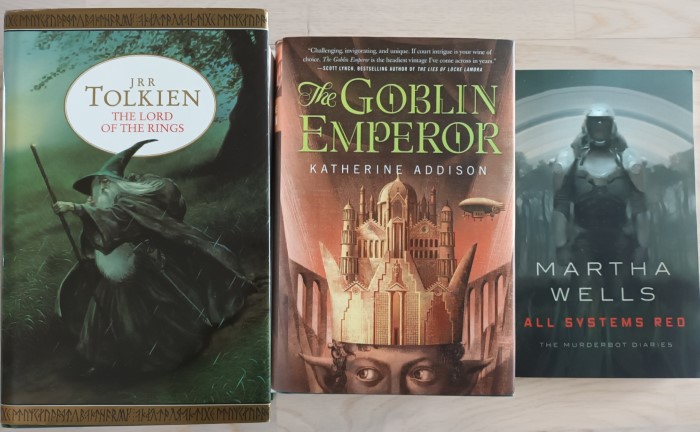
  • antagonists who form reasonable obstables, but aren’t too far-out or vile. I might mention The Goblin Emperor by Katherine Addison.
  • things to eventually settle into a comfortable state. If not an outright happy ending like in The Princess Bride movie, then at least a kind of a happy ending. As Erik put it, as happy an ending as possible under the circumstances. Thornhedge by T. Kingfisher comes to mind.
  • and last but not least, protagonists who know themselves and are comfortable with themselves and their place in the world, like Ellis Peters’s Brother Cadfael stories. (Sadly, you can’t binge read the series without quickly noticing what a boring copy-paste job Peters does with the featured young women—they tend to be perky and pretty and often strong-willed. That’s all fine and good, in itself, but there are already enough Smurfettes, thank you.)


As always, learning to work together is a huge bonus for me. Plus, the focus characters need to come across as rounded personalities, not paper dolls being carted around delivering plot-advancing lines. The Murderbot Diaries by Martha Wells handsomely fit these two criteria (even if some of the problems are larger), as does T. Kingfisher’s The Saint of Steel paladin series (even if there’s a little more romance than I’d generally care for).

There are also a number of works that fill some of the wishlist points but not others. Katherine Addison has added to the fascinating world of The Goblin Emperor in the excellent duology The Witness for the Dead and The Grief of Stones, which I’d count cozy otherwise (or cozy enough, like Christie’s mysteries), but the protagonist Thara remains troubled throughout, with just the tiniest glimpse of contentment at the end of TGoS.

The Keeper’s Six by Kate Elliott also follows a protagonist with a number of established allies, but the problem was too grand and some of the characters too snide to fit it into my comfort reads category. And the otherwise excellent Thorn by Intisar Khanani has a very nice but ultimately helpless human who remains far too helpless for far too long.

In the visual media, if possible I would like to pull everything concerning the village of Ta Lo in Shang-Chi and the Legend of the Ten Rings into its own story; there isn’t too much of it in the Marvel Cinematic Universe version, but what there is is lovely. Peter Jackson’s The Lord of the Rings and The Hobbit show snippets of the ultimate cozy setting, the Shire, but, alas, they don’t amount to a long sequence either.

Character-wise, the Disney+ Obi-Wan Kenobi series features a delightful growing friendship between young Leia and Obi-Wan, but I couldn’t call the series cozy otherwise. To venture into the historical, most Jane Austen adaptations and the Miss Marple series with Joan Hickson always deliver. In fact, we just finished a most satisfying Miss Marple rewatch. 🙂

Unsplash Mariah Krafft Hygge Essentials Sm


There is, however, something elusive about my sense of cozy fiction which I haven’t yet been able to quite put my finger on. Oddly, as much as like tea, taking a mystery and slapping in ample servings of tea doesn’t necessarily cut it. For instance, Malka Older’s The Mimicking of Known Successes and The Imposition of Unnecessary Obstacles were complete misfires for me.

Some commentaries on the rising popularity of cozy fiction talk about foregrounding sensory details. That might have something to do with the appeal, although I think an overload is an overload regardless of what you’re overloading. (Hello there, Legends and Lattes, faffing about coffee.) I suspect, though, that the crucial factor for me is the protagonist’s sense of comfort with their situation; a comfortable amount of self-knowledge or self-awareness. I’ll have to think about it some more.

Apart from this mystery ingredient, it seems the works I enjoy most right now are basically about recognition of the ordinary. They have ordinary people persevering, or, in case of people with extraordinary skills, characters who nevertheless know how ordinary they are in other respects. Quite ordinary motives behind even the most elaborate murder plots. Or perhaps simply the enjoyment of commonplace situations and routines—but in a SFFnal setting, because I do still want a little bit of a twist in my fiction. 🙂

With the past three years having been very trying, I don’t wonder at taking comfort in a slower pace, lower-stakes challenges, more familiar burdens, and happy endings. With tea and yummy noms, if possible.

I may, in fact, be turning into an old cat, LOL! 🙂

Unsplash Sebastian Latorre Cat Sleeping Sm

Anything you could recommend along these lines? Do chime in! Also, if you have any cozy gaming experiences, I’d love to hear about them.

Images via Unsplash: Hygge essentials by Mariah Krafft. Cat sleeping by Sebastian Latorre.