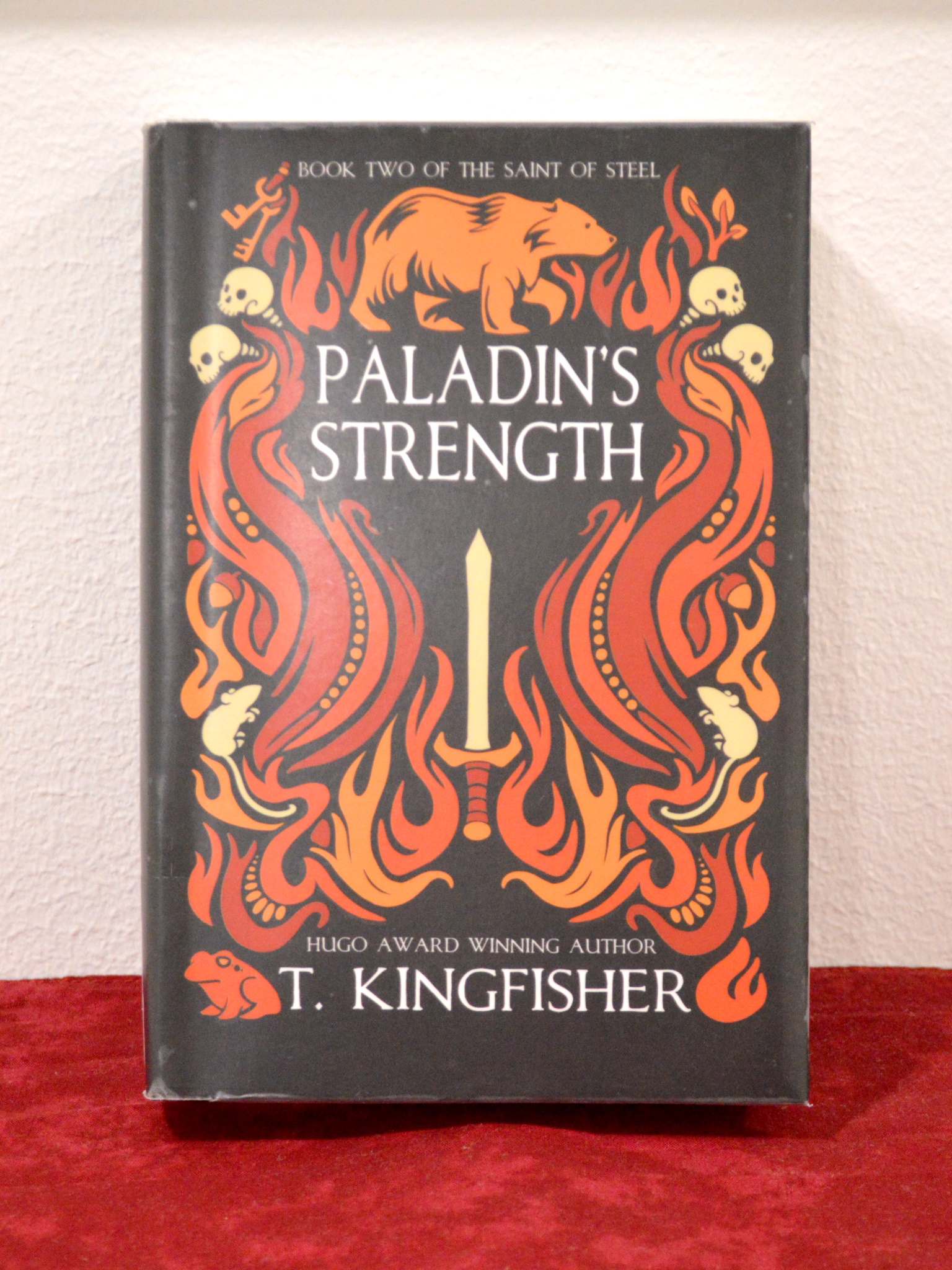
“You learned better and you got on with things. You learned that you were what you were, and tried to be the best version of that person, because you were never going to be anybody else. And you stopped envying other people because everyone had problems you didn’t know about.”
–Sister Clara in Paladin’s Strength by T. Kingfisher
I can’t think when I’ve last felt envious of another person. I’m sure it has happened, and relatively recently, too; I just can’t remember it. Which means—I hope, at least!—it can’t have been a very strong emotion or moment, which is a good thing.
In any case, more of the best version of myself for the coming year would also be great, not just for me but for the people around.
Kingfisher, T. Paladin’s Strength. Dallas: Argyll Productions, 2021, p. 200.
Image by Eppu Jensen
Serving exactly what it sounds like, the Quotes feature excerpts other people’s thoughts.
“The companies that make AI—which is, to establish our terms right at the outset, large language models that generate text or images in response to natural language queries—have a problem. Their product is dubiously legal, prohibitively expensive […], and it objectively does not work. All of these problems are essentially intractable. […]
“That non-technology industries are falling for this spin [that AI is inevitable] is perhaps unsurprising […] What’s more interesting is that other Silicon Valley companies are doing the same, even though, again, the result is almost always to make their product worse. Google has essentially broken its key product, and Microsoft is threatening to spy on all its users and steal their data, all because a bunch of CEOs have been incepted into the idea that this technology is the future and they cannot afford to be left behind.”
Nussbaum is packing quite a bit into a relatively short post. With regard to the claim that Google’s search engine is broken, she refers to an article in The Verge by Elizabeth Lopatto. Lopatto in turn provides some examples that are truly hair-raising: apart from unusable—or plain wrong—data, Google has offered potentially life-threatening answers to user queries.
Personally, for at least a decade if not longer, I haven’t used Google unless I can’t get anything sensible out of other engines, so I’m not the best person to comment on Google specifically. However, I have noticed that pretty much every search engine I’ve tried has gotten worse.
(Please note that my opinion below is based on my experience as an information professional, and on the experiences of my friends and acquaintaces as well; I don’t want to repeat “in my experience“ in every other sentence. Please also note that your experience may differ, and that I am aware of this possibility. And, finally, please note that this is an opinion post, so I will be selective with my point of view and using hyperbole.)
For one large problem, ads are rife among search results. It used to be possible to see a page of results with a couple of ads. Now it’s almost a page of ads with a couple of results sprinkled in for appearance’s sake. I understand the necessity of procuring funding. What I do not understand is destroying customer trust by no longer providing the service you claim to provide.
For another, advanced search is disappearing. (Here Google does seem to work slightly better than its competition, at least in some contexts, at least some of the time.) One example of a basic operation that’s stopped being reliable is excluding a word from your query by typing a minus in front of it; the term almost always if not always shows up in your results anyway. Another example is specifying a phrase by surrounding it with quotation marks. For example, at times I want to check a new-to-me multi-word term, or try to find a phrase I only hazily remember. But that only works if the search works. Even if it does work, an engine might offer other phrases containing your search terms, just in a different order. Obviously that isn’t helpful. A recent example is “price cliff”, for which Google offered the Instagram profile of one “Cliff Price” among the top results. Categorically not what I was looking for!
The results might also be interspersed not just by ads but other irrelevant blocks (“People also ask” or “Related Searches” or such). Granted, related searches do have their use; there are times when it is helpful to see adjacent topics or terminology. They definitely shouldn’t take space from the most relevant results, though, and the suggestions must actually be, you know, related to be relevant.
Further, search engines have stopped displaying the number of results for a query. (Remember when that was a thing?) These days it’s anyone’s guess whether you’re being served with a butt-load or a crap-ton of increasingly poor results.
Finally, at worst your search engine of choice will serve pop-ups in the margins (“See all!” “More from source!”) or push their “mobile experience”. *sigh*
These days, the search engine “experience” (WTH is that even supposed to be?!?) is like going to a restaurant and ordering pasta, but being served paste instead: not at all what was expected, entirely wasteful, and potentially harmful—and if you were to claim that the deliverable is “close” to the request, it is just insulting.
If this is what “smart” business people believe counts as quality output these days, I wouldn’t trust them to think their way out of a pillow case. (Yes, a pillow case, since the poor airbrains would probably hurt themselves with something as sharp as a paper bag.)
According to BBC, a Google spokesperson has defended AI-created overviews saying that “[t]he vast majority […] provide high quality information, with links to dig deeper on the web”. Speaking of vast majorities, most people are just not interested in digging and absolutely will not dig deeper; they want a clear-cut answer and they want it quickly. That means improving the quality of results, and neither the recent, pre-AI iterations nor the curret AI-“improved” engines deliver that.
I can’t think what the heck is up with the encrapification of search engines. Or why does it seem absolutely necessary to keep tweaking a good product what feels like every few months until it’s unrecognizeable.
Is it sunk cost fallacy? A form of mass hysteria spreading from Silicon Valley? Is maintaining a steady level of good service so moth-eaten a concept that it can’t attract resources anymore beyond the barest minimum? Are developers (or developers’ bosses) really that unable to comprehend that a change does not automatically mean an improvement? Is the only thing that matters the ceaseless chase after new features, regardless of whether they will shape up your service or shatter it?
It’s so frustrating, in any case. We, here, are nerds and do at times dig very deep. Sadly, these days search engines often hinder research instead of helping. Lately I’ve noticed that I’m turning more to bookmarks saved in my browser, or pick a specific site I’ve vetted earlier. It’s obviously not a foolproof answer, either, because I need to remember which entity has or might have the information I’m after in order to go and search their pages.
I’m quite ready to live in the most boring of times, with reliable basic services, please and thank you.
There’s an old law of probability often phrased that if an infinite number of monkeys sat at an infinite number of typewriters pressing random keys for an infinite amount of time, they would at some point type out Shakespeare’s Hamlet. The point is that, given a large enough scope of opportunity, things that are very unlikely but not impossible can and do happen.
One of the earliest known expressions of this idea comes from the Roman statesman and philosopher Cicero, although Cicero takes the negative view. He poses the idea as a thought experiment to reject materialist philosophies, like Epicureanism, which held that the world was not created by the gods but was the product of random collisions of matter:
How can anyone look on these things yet convince themselves that certain solid and discrete bodies are carried by force and gravity, and the beautiful and exquisite world is made by the fortuitous arrangement of these bodies? If someone thinks this is possible, I don’t see why they shouldn’t also think that innumerable shapes of the twenty-one letters, made out of gold or whatever material, could be tossed down on the ground so that one could read the words of Ennius’ Annals in them. For myself, I doubt that chance could make a single verse out of them.
Cicero, On the Nature of the Gods 2.93
(My translation)
As unlikely as it is that just tossing letters down on the ground once will yield any comprehensible lines from Ennius’ early Roman historical epic, the infinite monkey theory tells us that if we threw an infinite number of letters an infinite number of times, some verses of Ennius would eventually emerge, not to mention lines from Cicero himself, or any other text that could be written in the Latin alphabet.
One might say that Cicero’s mistake was an insufficiency of monkeys.
Serving exactly what it sounds like, the Quotes feature excerpts other people’s thoughts.
“I’m talking that massive, never-ending Discord chat with your bestie? The one that makes you giggle through the day? It’s not a ‘waste of time,’ it’s what time was made for“
– atlinmerrick on Tumblr
Hear, hear!
As much as it might frighten us some days, change is permanent and the only absolutely realiable thing in life. (Apart from the sheer impossibility of taking anything with you when it’s time to go.) Why not find happiness while you can? Why not allow yourself to feel the joy you feel? Lots of adults would be happier, I think, if they allowed more of the delight they used to feel in their childhood to remain in their lives. (Mostly talking to my Protestant forebears here…!)
Murderbot, the sardonic human-machine construct Security Unit who was designed to fight and kill but would rather just watch media, reflects on what makes a good story:
The latest show I was watching had started out good but turned annoying. It was about a pre-terraform survey (on a planet with completely the wrong profile for terraforming anyway, but I didn’t care about that part) that turned into a battle for survival against hostile fauna and mutant raiders. But the humans were too helpless to make it interesting and they were all getting killed. I could tell it was heading toward a depressing ending, and I just wasn’t in the mood. […] I didn’t want to see helpless humans. I’d rather see smart ones rescuing each other.
Murderbot, in Rogue Protocol
Me too, Murderbot. Me too.
Wells, Martha. Rogue Protocol. New York: Tom Doherty Associates, 2018, pp. 22-23.
Serving exactly what it sounds like, the Quotes feature excerpts other people’s thoughts.
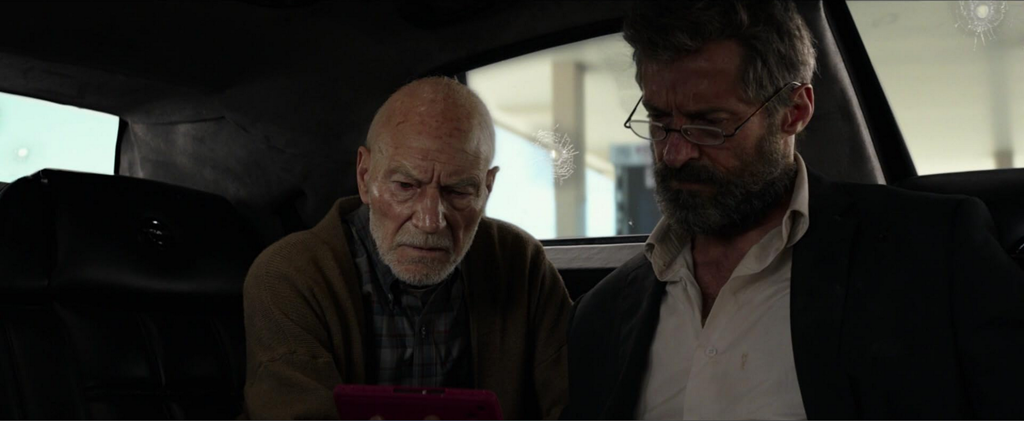
In honor of the movie Deadpool & Wolverine coming out next week, here’s a lovely tidbit concerning an earlier Wolverine movie. Sir Patrick Stewart apparently had the following to say on seeing Logan for the first time with an audience at the Berlin Film Festival in 2017:
“It was Hugh [Jackman] and [director] James Mangold and myself, and when it got to the last 10 minutes of the movie, it was emotional and intense, and I could feel myself getting choked up. Then I looked over at Hugh and he was wiping his eyes, and I thought if Wolverine can weep at a movie, Charles Xavier can do the same thing. Then Hugh reached over and grabbed my hand and we held hands for the rest of the movie.”
-Sir Patrick Stewart
HUGE props for Hugh Jackman and Sir Patrick—it’s not always easy being a man and showing emotion in the Anglo-American world, never mind when you’re supposedly this tragic tougher-than-nails superhero. (Sorry, sorry, bad pun very much intended!)
(I do appreciate Sir Patrick so much—he’s such a humane and decent man, not to mention a superb actor!)
Lang, Brent. “Patrick Stewart on ‘Logan,’ Harvey Weinstein and Returning to ‘Star Trek’.” Variety, December 05, 2017.
Complaining about “kids these days” with strangely-spelled names is a well that never runs dry. It’s also an older habit than many who indulge in it would think. Here’s a bit from a 1930 P. G. Wodehouse story where Bertie Wooster’s Aunt Dahlia chides him for falling in love with a young lady with an eccentrically-spelled name.
‘Yes, Aunt Dahlia,’ I said, ‘you have guessed my secret. I do indeed love.’
‘Who is she?’
‘A Miss Pendlebury. Christian name, Gwladys. She spells it with a “w”.’
‘With a “g”, you mean.’
‘With a “w” and a “g”.’
‘Not Gwladys?’
‘That’s it.’
The relative uttered a yowl.
‘You sit there and tell me you haven’t enough sense to steer clear of a girl who calls herself Gwladys? Listen Bertie,’ said Aunt Dahlia earnestly, ‘I’m an older woman than you are – well, you know what I mean – and I can tell you a thing or two. And one of them is that no good can come of association with anything labelled Gwladys or Ysobel or Ethyl or Mabelle or Kathryn. But particularly Gwladys.’
P. G. Wodehouse, “The Spot of Art”
The next time someone gets in a snit about Kaytlynn, Jaxson, or Alexzandre, you can let them know they’re part of a tradition at least a century old.
Wodehouse, P. G. “The Spot of Art.” Very Good, Jeeves. First published 1930. Reprinted in The Jeeves Omnibus. Vol. 3. London: Hutchinson, 1991, p. 460.
Serving exactly what it sounds like, the Quotes feature excerpts other people’s thoughts.
In the acknowledgements for her novella Thornhedge, author T. Kingfisher talks a little about the process of writing this particular story.
“Many characters bolt off with the story, and I am left staggering behind them, frantically trying to take notes, but Toadling was very polite. Her backstory unfolded pretty much as I typed it. I learned she was raised by greenteeth as I wrote the sentence about them; I learned that she could turn into a toad when she did it on the page—all the little discoveries that you always make writing a book, of course, but happening at my usual typing speed, without sitting and staring at the wall for an hour, or nearly rupturing my wrist tendons trying to keep up.”
–T. Kingfisher in the acknowledgements for Thornhedge
I’m not a fiction writer, but I do recognize the phenomenon of suddenly uncovering details from role-playing. It’s delightful to just suddenly realize a pertinent, obscure, or particularly distinguishing detail about your character.
(This kind of serendipitous discovery also makes me think any algorithmically generated (“AI”) content won’t be replacing the most original types of human-generated content terribly soon, nor will machine translation replace human translators in a hurry. Oh, make no mistake, people will try to replace human creators with machines. But at least thus far we’re still more sophisticated when it comes to pure innovative leaps or getting smoother translations.)
There have been many times I’ve wished to be able to tap into the unconscious mulling process or consciously force a creative leap, but of course it doesn’t work that way. It makes the moments when it does happen all the more precious, doesn’t it? 🙂
Kingfisher, T. Thornhedge. London: Titan Books, 2023, p. 122.
Image by Eppu Jensen
Serving exactly what it sounds like, the Quotes feature excerpts other people’s thoughts.
The ancient Roman naturalist Pliny the Elder wrote a good deal about painting. His interest stemmed from curiosity about which plants and minerals were used to make make pigments, but he also recorded the names of famous artists and some details about their paintings.
Unlike the stretched canvases we are used to today, ancient painters worked on wooden panels, of which extremely few survive, or on plastered walls, a few of which have survived in places like Pompeii and Dura-Europus. Most of the famous painters of antiquity were men, but Pliny makes sure to note that women also took up the brush.
Women have also painted. Timarete, daughter of Micon, created the very old panel painting of Artemis of Ephesus. Irene, daughter and student of the painter Cratinus, painted an Eleusinian maiden, Calypso, Theodorus the juggler, and Alcisthenes the dancer. Aristarete, daughter and student of Nearchus, painted Aesculapius. Iaia of Cyzicus, who was a lifelong virgin, painted and engraved ivory at Rome during the youth of Marcus Varro [late second century BCE]. She mostly made images of women, including a large panel painting of an old woman at Naples, as well as a self-portrait made using a mirror. Nobody had a faster hand for painting than she did, and in fact she was so accomplished an artist that the prices for her works far exceeded those commanded by Sopolis and Dionysius, who were the most celebrated portrait painters of the time and whose paintings fill the galleries. A certain Olympias was also a painter, but all that is recorded about her is that Autobulus was her student.
Pliny the Elder, Natural History 35.147-48 (=35.40)
(My own translation)
Women created famous works, were paid well for their craft, and taught others. It is unsurprising that some of these women were daughters of well-known male painters, since art was often a family business in the ancient Mediterranean.
Wooden panel paintings were among the most highly-prized forms of art in ancient Greece and Rome. Thanks to writers like Pliny, we know more about the famous painters of antiquity and their paintings than we would ever know from the few examples that survive today. It is good to have evidence that women, too, took part in this prestigious art form.
Image: Women preparing for a ritual, cropped from a photograph by WolfgangRieger via Wikimedia (Pompeii, Villa of the Mysteries; 1st c. BCE; fresco)
Serving exactly what it sounds like, the Quotes feature excerpts other people’s thoughts.
Saint Patrick’s Day is coming, and while some folk will be out there marching in parades or drinking green beer, I am reminded that Patrick is the source of one of the clearest early accounts of sleep paralysis and the frightening sensations that can come with it.
Patrick wrote an account of his life, called the Confession. This document was written late in his life and in response to some unknown allegations of misconduct during his mission in Ireland. Patrick’s Confession accordingly focuses on his humility and spiritual piety as it tells the story of how he was enslaved in Ireland as a young man, escaped to Britain, and finally returned to spread the Christian message. At one point in narrating his escape, Patrick recounts a frightening nighttime experience which he perceived as a demonic attack:
On that very night as I was sleeping, Satan tested me powerfully, such that I shall remember it for as long as I am in this body. He lay on top of me like an enormous stone, and I had no strength in any of my limbs. How did it occur to me, ignorant in spirit, to cry out “Elias?” In the midst of this, I saw the sun begin to rise in the sky, and as I shouted “Elias! Elias!” with all my strength, behold, the splendor of the sun fell over me and at once all the weight left me.
Saint Patrick, Confession 20
(My own translation)
Sleep paralysis is a frightening experience that happens when the brain’s processes for falling asleep or waking up are not quite in sync. In normal sleep, the body becomes paralyzed at the same time the brain becomes unconscious, and both states pass when we wake up. Sleep paralysis happens when the body is paralyzed but the brain is partially aware of its surroundings. Unable to properly process stimuli, the brain fills in the gaps with hallucinations. Because the brain is aware of the body’s vulnerability in its paralyzed state, these hallucinations often feel threatening. It is not unusual for a sufferer to scream themselves awake in response. Sleep paralysis most often happens in the evening when first going to sleep or in the early morning while waking up.
Many cultures have folk traditions that interpret sleep paralysis as the effect of hostile supernatural visitation. Old-fashioned explanations include incubi, night hags, and ghosts; more modern folktales may feature alien abduction. Patrick details a clear account of sleep paralysis—it happens at dawn, he is unable to move, he feels a weight on his body and perceives a hostile presence which he shouts away—but interprets the events in a specifically Christian context.
Patrick’s night terrors are a reminder of both the universality of human experiences, and how powerfully our own specific cultural outlook can shape our reactions to those experiences.
Serving exactly what it sounds like, the Quotes feature excerpts other people’s thoughts.