Klingons, Homer, Falstaff, and the Dread Pirate Roberts: Understanding Honor

161024klingonsIf you grew up on Star Trek: The Next Generation like me, you’re probably most used to hearing the word “honor” come out of the mouths of Klingons, especially our beloved Lt. Worf. Star Trek offers one of the most brilliant portrayals of honor in fiction. As you watch Worf’s story unfold over the seasons of TNG and Deep Space Nine, it seems like, for all that Klingons like to talk about honor, Worf is the only one who actually cares about it. Worf always makes the honorable choice, even when it’s not the smart one. Other Klingons are cynical and self-serving. They pay lip service to the idea of honor, but they don’t follow it.

But what is honor? It seems like such a simple word, but what does it really mean? When we say that a person, either someone in the real world or a fictional character, is driven by a sense of honor, what actually motivates them? I often put this question to my students when we read the the quarrel of Achilles and Agamemnon in the Iliad. They usually answer something like: “Pride,” or “Following a code.” Those are ideas related to honor. They are honor-adjacent. But at its core, honor is something else: honor is reputation.

Agamemnon and Achilles are warrior kings in a world where there is no one to enforce rules. There are no police, no courts, barely anything we would recognize as law. What is it that stops people from being constantly at war with one another? How can Achilles or Agamemnon have a single moment’s rest from every other warrior in the world trying to take away their homes, families, and treasures? Because of their reputation. Because everyone knows that if you hurt them, they will come after you and they will not stop until they have destroyed you. That’s what honor is. It’s the first line of defense.

161024achillesHonor is not an emotion, a code, or an abstract concept. It is a practical tool that Homer’s warrior kings and people in similarly lawless societies use to keep control of their homes and property. When Agamemnon and Achilles break into a fight at the beginning of the Iliad, it’s not because they’re being petty or overly sensitive about wounded feelings. It’s because neither one of them can afford to look weak. A warrior who gets a reputation for giving up easily or not standing up to defend his property is a warrior who will soon be dead.

Honor is what people believe about you. Honor is why, when the Trojans had almost routed the Greeks, Achilles was able to turn the tide of battle just by showing up—unarmed—on the battlefield and yelling his warcry. In other words, honor is like the dread pirate Roberts.
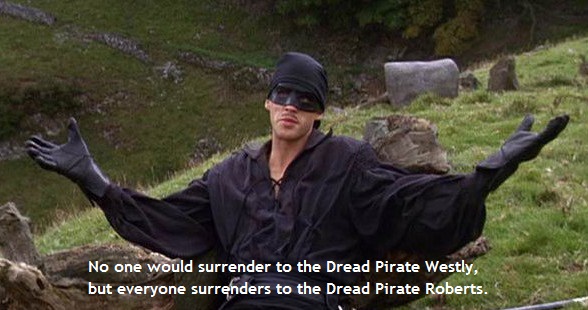
161024robertsWhich also means that there is something artificial about honor. It’s sort of a bluff. The greater a warrior’s reputation as an unbeatable fighter, the less actual fighting they have to do. At the same time, anyone who lets slip that they may not live up to their reputation is just inviting attack, which is why, like in the Iliad, warriors often fight hardest not for the things they want but for the reputation itself.

Honor only matters if it is seen, and it is only what is seen that matters. What makes honor is not what kind of person you are but what kind of person people think you are. What happens in the darkness does not matter to honor. It’s easy to get cynical about honor and call it out as a kind of bullshit. Falstaff, in Shakespeare’s Henry IV, Part 1, does just that:

Can honor set to a leg? no. Or an arm? no. Or take away the grief of a wound? No. Honor hath no skill in surgery, then? No. What is honor? A word. What is in that word “honor”? What is that “honor”? Air. A trim reckoning. Who hath it? He that died o’ Wednesday. Doth he feel it? No. Doth he hear it? No. ‘Tis insensible, then? Yea, to the dead. But will it not live with the living? No. Why? Detraction will not suffer it. Therefore, I’ll none of it. Honor is a mere scutcheon.

– Shakespeare, Henry VI, Part 1, act 5, scene 1

Falstaff isn’t wrong. Neither are Achilles and Agamemnon. Honor is a kind of game that everyone plays along with. The wise understand that it’s a game and what seems like cynicism is really just practicality. Only the naive think that honor is real.

This is what makes Star Trek‘s take on honor so brilliant. It seems at first that Worf is the only Klingon who understands honor, but really it’s the other way around: Worf is the only Klingon who doesn’t understand honor. Worf thinks that honor is real. Other Klingons know it’s a game—a game with the highest of stakes that they play for all they’re worth, but a game nonetheless.

Images: Worf and Martok via Memory Alpha. Achilles battling Memnon, photograph by Bibi Saint-Pol via Wikimedia (Vulci, currently Staatliche Antiknesammlungen, Munich; c. 510 BCE; black-figure pottery). Dread Pirate Roberts via History Mine.
Recommended Reading: Apuleius, The Golden Ass

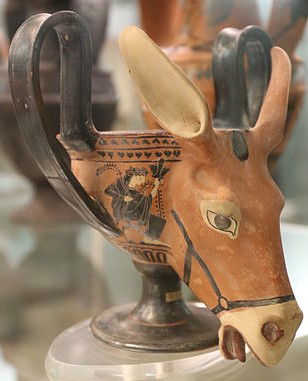
161017kantharosModern fantasy literature has taken a lot of inspiration from ancient Greek and Roman mythology. Many people have noted how comic book superheroes play much the same role in modern culture that heroes like Hercules and Odysseus did for ancient readers. The important difference is that Greeks and Romans regarded their heroes as real, semi-divine figures of history. Modern fantasy knows it’s all made up. That’s one of the fundamental differences between myth and fiction: the poet who retells a myth wants you believe that the story is true; the fiction author knows they’re spinning a tale.

But modern people aren’t the first to tell stories just as stories. Ancient literature, in addition to myths that made claims to historical and religious truth, offered tales of adventure, romance, and comedy, just like modern fiction. It even had some works that we would class as speculative fiction. Metamorphoses—more commonly known as The Golden Ass—by Apuleius is one of them.

There are lots of translations available. Here’s one you can read online, but I particularly recommend the translation by Sarah Ruden (Yale, 2012), which expertly captures the wit and cheek of Apuleius’ original text.

The story is told by Lucius, a young man about town who gets in over his head with magic and accidentally turns himself into a donkey. He then has madcap misadventures—getting stolen by bandits, requisitioned by a soldier, displayed in the arena, and mutely witnessing all kinds of domestic comedy and tragedy as he tries to stay alive long enough to find the antidote to cure his transformation.

In this passage, Lucius the donkey has been bought by a local magnate and is being trained to perform tricks, which causes a bit of a tricky situation for the human mind in the donkey body:

He gave me to a favored freedman of his, a well-off man, having instructed him to take good care of me. This man treated me kindly and fed me well and, to please his patron, eagerly encouraged my tricks. First he taught me to recline at the dining table, then to wrestle and even dance with my forelegs in the air. Then—even more remarkable—to respond to words by tossing my head, signing “no” by throwing it back and “yes” by nodding. When I was thirsty, I could request a drink by alternately winking my eyes at an attendant. Of course, this was all perfectly simple for me to follow and I hardly needed a trainer, but I was afraid to behave in too human a way at the table uninstructed, or they might take me for an ill omen, set on me as a monster, and serve up my fat body to the vultures.

– Apuleius, The Golden Ass 10.17

(My own translation)

Lucius’ adventures range from the lewdly ludicrous, as when a rich lady takes him for a lover, to the tragic, as when he witnesses the death of a happy newlywed couple. On the way, just about every level of society, from poor farmers to rich landowners comes in for a bit of satirical skewering. There’s also a surprise ending, which I won’t give away here.

In transforming Lucius into a donkey, Apuleius also addresses the anxieties of his time, in a society where slavery was routine and barriers of language and culture often impeded communication. Romans of his time looked on some other peoples in their world as little better than animals, and must have worried about being seen the same way themselves by others. Sudden loss of status, whether by being taken captive in war or stripped of citizen rights in the court, was nothing strange. While no one had to worry about not behaving donkeyishly enough, as Lucius does, many Roman slaves probably faced the predicament of ingratiating themselves with their masters without seeming too clever or ambitious. The story of Lucius’ adventures, like much fantasy and science fiction of recent decades, provides a way to observe and comment on these anxieties and even, in the end, to offer some hope.

The Golden Ass is a good read and a nice example of how there’s nothing new in the human urge to make up fantastical stories, or to use that fantasy to contemplate contemporary problems.

Image: Donkey head kantharos, photograph by Pymouss via Wikimedia (Athenian, currently British Museum; late 6th c. BCE; black-figure pottery)

History for Writers looks at how history can be a fiction writer’s most useful tool. From worldbuilding to dialogue, history helps you write. Check out the introduction to History for Writers here.

Becoming Egyptian

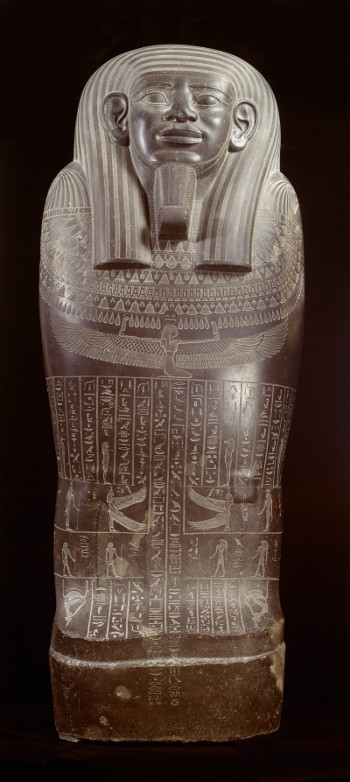
Sarcophagus of Wahibre-em-akhet, via Rijksmuseum van Oudheden (Egypt, possibly Giza, currently Rijksmuseum van Oudheden; basalt; 664-525 BCE)
Sarcophagus of Wahibre-em-akhet via Rijksmuseum van Oudheden (Egypt, possibly Giza, currently Rijksmuseum van Oudheden; basalt; 664-525 BCE)

The sarcophagus of Wahibre-em-akhet, from Egypt in the seventh or sixth centuries BCE, is a typical Egyptian sarcophagus, not for a king but for a man of wealth and status in Egypt’s Twenty-Sixth Dynasty. The Egyptian iconography is easily recognized: the long beard and braided wig of the portrait; the conventional Egyptian ways of depicting eyes, ears, and other features; the winged protective goddesses; the hieroglyphic text. There is nothing about this sarcophagus to suggest its owner was anything other than a native Egyptian, born and bred, from a people who had lived in the Nile valley since time immemorial. Nothing, that is, until you read the hieroglyphic text and find out that Wahibre-em-akhet’s parents were named Alexicles and Zenodote; both are Greek names.

We know nothing else about Wahibre-em-aket or his parents. We can’t say definitively where they came from, where they grew up, what language or languages they spoke, or how they identified themselves in daily life. It seems very likely, though, that we are looking at someone who was born to Greek parents but lived as an Egyptian.

Wahbire-em-akhet’s family probably had connections to Naukratis, a Greek city founded in Egypt with royal permission. The original settlers of Naukratis were Greek mercenaries who had served the Egyptian pharaohs in their war for freedom from the Assyrian empire. Alexicles may have been one of those mercenaries or the descendant of one. The mercenaries and their descendants continued to serve the kings of Egypt and seem to have gradually assimilated into Egyptian culture. One gang of soldiers left graffiti on the temple of Abu Simbel in upper Egypt while on campaign, including a soldier who identified himself as Psammatichus, son of Teocles, another Egyptian-named son of a man with a Greek name.

Whatever role he played, Wahibre-em-akhet must have done well for himself to afford such a fine sarcophagus. Like many other later-generation immigrant communities, the Greeks in Egypt probably found that assimilating to local customs, names, and languages was useful for getting ahead. They were not the first people to do so. We tend to think of Egypt as isolated, even xenophobic, but Egypt was also a powerful and wealthy kingdom that needed foreign trade connections and could afford to supplement its army with mercenaries from abroad. Greeks, Carians, Jews, Nubians, and Libyans are all well documented as traders and soldiers in Egypt. Many other peoples certainly found their way to the Nile valley as well. As they assimilated into the local culture, adopting Egyptian names and presenting themselves according to Egyptian traditions, these peoples become hard to discern in the archaeological record, but the occasional find like Wahibre-em-akhet’s sarcophagus reminds us that they were still there.

Thoughts for writers

Traditional histories have conditioned us to think of ancient cultures as discrete units: this is Greek, that is Egyptian, that over there is Persian, and the other thing in the corner is Etruscan. It’s useful to be reminded that the lived experience has always been more complicated. Wahbire-em-akhet was, in some ways, both Egyptian and Greek. Most likely his parents were, too. They must have faced many of the same challenges and intersections that immigrant families still face today.

People like Wahbire-em-aket and his parents existed in history. They belong in our stories, too. There is nothing new about multiculturalism.

History for Writers looks at how history can be a fiction writer’s most useful tool. From worldbuilding to dialogue, history helps you write. Check out the introduction to History for Writers here.

Catch!

War can be a nasty business. It’s no wonder soldiers sometimes enjoy a bit of cheeky humor. This ancient Greek sling bullet was cast with the word DEXAI on it, meaning “Catch!” or “Take that!”

Sling bullet, photograph © Trustees of the British Museum via The British Museum (Athens; 4th c. BCE; lead)

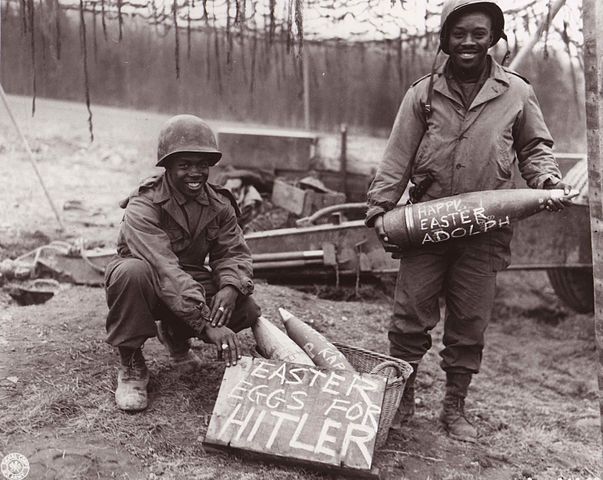
It’s in much the same spirit as these American soldiers in World War II offering “Easter eggs” for Adolf Hitler.

Easter eggs for Hitler, US National Archives via Wikimedia

Some things just don’t change.

History for Writers is a weekly feature which looks at how history can be a fiction writer’s most useful tool. From worldbuilding to dialogue, history helps you write. Check out the introduction to History for Writers here.

History, Disability, Inclusion

160822CaludiusThe Roman emperor Claudius walked with a limp, spoke a with a stutter, and sometimes experienced sudden and uncontrollable movements of his body. These effects were moderate when he was calm but became more pronounced when he was agitated. Claudius’ symptoms are well documented and modern scholars have suggested various diagnoses. Polio was at one time the preferred explanation but has fallen out of favor. More recent suggestions are cerebral palsy and Tourette syndrome.

If he lived today, Claudius could be diagnosed and receive appropriate treatment or accommodation. The systems we have now to describe various disabilities helps us to recognize an individual’s particular set of symptoms as part of an identifiable condition or disease. Knowing what to call things, where they come from, and how to treat or accommodate them makes a difference to how we handle individual cases. In antiquity, all anyone knew was that Claudius behaved strangely in ways that no one could explain.

Lack of labels and explanations does not mean that people did not live with all the same things we live with today. Some are obvious. Romans may not have been able to explain why Claudius’ distant relative, the censor Appius Claudius Caecus, went blind, but there was no doubt about the state of his vision. Other conditions are less obvious, but no less real.

We have only very recently learned to recognize the chronic traumatic encephalopathy experienced by sports players who receive repeated trauma to the head, for example, but brains are not more vulnerable now than they were in past centuries. For most of the past several thousand years, war has meant large numbers of people repeatedly hitting each other in the head, with or without helmets. CTE and the changes in behavior that go with it must have been part of the experience of pre-modern warriors, whether they knew how to identify it or not.

Post-traumatic stress disorder is also a modern diagnosis, but people have always experienced traumatic stresses, not just in warfare but from violence within families and between individuals, sexual assault, and life-threatening accidents. In any population that has experienced such stress, some individuals will experience aftereffects, whether they have a name for them or not.

Similarly, we have only recently (in historical terms) learned to diagnose autism and related conditions, but people have lived with them throughout human history. The same can be said of Alzheimer’s disease. Many people who are described in historical sources as “simple-minded,” “senile,” etc. may have been living with one of these conditions.

Even when people couldn’t name or explain the disabilities and conditions they lived with, their experiences of life could be profoundly shaped by them. Claudius’ family considered him an embarrassment and kept him out of public view. He himself reportedly exaggerated his symptoms and avoided the public sphere when he was a young man to keep himself from seeming like a threat to the rest of the dynasty, which may have helped him survive the murderous palace intrigues of the early empire. When he unexpectedly became emperor after the assassination of Caligula, though, his lack of experience in public business made his claim to the title precarious. To improve his reputation, he initiated the Roman conquest of Britain. Claudius’ condition, whatever it was, ended up affecting the lives of thousands of people.

Thoughts for writers

Historians and writers of speculative fiction are in a similar position: we spend our time thinking about a world in terms that the people living in it would not, perhaps even could not, think of themselves. No historian can suppose that Romans simply didn’t experience post-traumatic stress disorder because they didn’t have a word for it. Writers have a similar responsibility.

Of course, in speculative fiction, anything is possible. We can imagine worlds with magic, or warp drive, or both. We can imagine worlds without gender, without water, without music. All of these are valid artistic choices, but we have to recognize them as choices and take seriously the causes and consequences of those choices.

It’s entirely plausible to construct a fictional world in which people don’t have a word for autism or don’t recognize cerebral palsy as a physical condition, but those conditions exist and affect people whether their culture acknowledges them or not. An ancient Roman could not have explained the laws of gravity, but things still fell down. To create a fictional world in which such conditions simply do not exist is a choice. If we make that choice as writers, we owe it as much serious thought as if we created a world without gravity. Creating a world in which people do not understand disabilities is no excuse for creating a world in which no one experiences a disability.

(Author’s note: I have tried, to the best of my understanding, to use the current accepted terminology to refer to the various symptoms, conditions, and disabilities I have mentioned in this post, but if I have made any mistakes, I welcome corrections in the comments and will update the post accordingly.)

Image: Portrait head of Claudius, photograph by Cnyborg via Wikimedia (currently Ny Carlsberg Glyptotek, Copenhagen; 1st c. CE; marble)

History for Writers is a weekly feature which looks at how history can be a fiction writer’s most useful tool. From worldbuilding to dialogue, history helps you write. Check out the introduction to History for Writers here.

Representation Is for Everyone

Monday is when I write, from a historian’s perspective, about some interesting or useful tidbit for writers, especially writers of genre fiction. I’m doing that again today, but from a different angle. Today I want to talk about representation, specifically the representation of people who are not straight white cis men in books, television, movies, games, and other media.

First things first: I’m a straight white cis man with no significant mental or physical challenges. I am a native-born citizen of the country in which I live and a native speaker of its majority language. I am financially secure and socially comfortable. I am not, as far as I know, heir to any titles of nobility, but other than that, if a privilege exists in the world, I’ve probably got it.

Yeah. I’m about to talk about representation. If anyone wants to get off this ride, now’s the time.

When creators and fans talk about adding representation to popular media, the refrain from people who look like me is often: “Why do we have to have X in this story? What do you mean you can’t identify with the characters? Why can’t all you Xes identify with people who aren’t exactly like yourselves?”

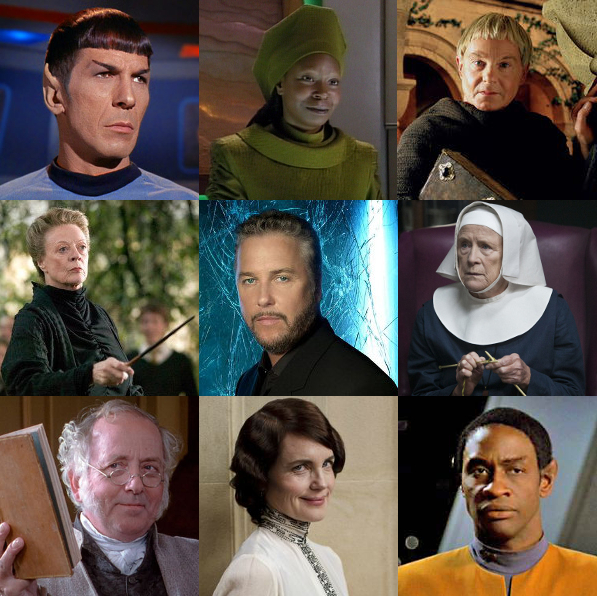
I understand where this response comes from. There are white guys all over the place in popular media, but I’ve never identified with a character just because he was a white guy.  There are so many of them that I couldn’t identify with them all if I wanted to. When I look at a character and think Hey! That’s me! it comes from traits other than outward identities. Here are some of the characters I’ve felt connected to over the years:

Spock (Star Trek), Guinan (Star Trek: The Next Generation), Brother Cadfael (Cadfael novels and Cadfael tv series), Minerva MacGonagall (Harry Potter novels and films), Gil Grissom (CSI), Sister Monica Joan (Call the Midwife), Mr. Bennet (Pride and Prejudice), Cora Crawley (Downton Abbey), Tuvok (Star Trek: Voyager)
Spock (Star Trek), Guinan (Star Trek: The Next Generation), Brother Cadfael (Cadfael novels and tv series), Minerva MacGonagall (Harry Potter novels and films), Gil Grissom (CSI), Sister Monica Joan (Call the Midwife), Mr. Bennet (Pride and Prejudice), Cora Crawley (Downton Abbey), Tuvok (Star Trek: Voyager)

They’re not all the same gender, race, age, or even species as I am. Two of them are members of a religious order, and I’m not religious at all. Most of them don’t even (fictionally) live in this century.

What can we learn from this collection? (Other than that I have a thing for Vulcans and a rather inflated sense of my ability to dole out wise advice to young ‘uns.) That representation is an aspect of privilege even when you’re not being represented. Having white guys all over the place frees me to look at the characters in my media and identify with them not based on the outward categories they fall into but because they’re thoughtful, introverted, curious, even-tempered, and passionate about knowledge.

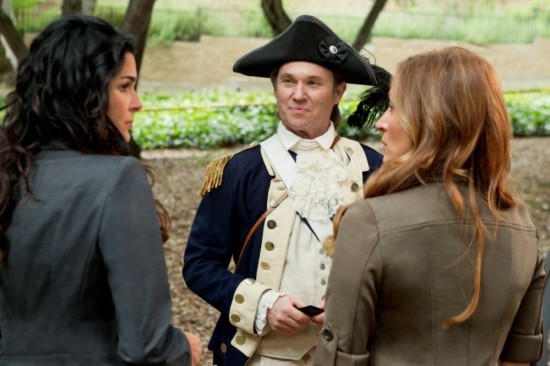
On the other hand, I am a member of a very small minority who is rarely represented in media, and then usually in a dismissive, stereotyped, even offensive way: history professors. According to most books, movies, and tv shows, we are boring, joyless pedants in tweed jackets with elbow patches who obsess over minutiae and care only about names and dates.

“Easily the most boring class was History of Magic, which was the only one taught by a ghost. Professor Binns had been very old indeed when he fell asleep in front of the staff room fire and got up the next morning to teach, and left his body behind him. Binns droned on and on while they scribbled down names and dates, and got Emeric the Evil and Uric the Oddball mixed up.”

– J. K. Rowling, Harry Potter and the Philosopher’s / Sorcerer’s Stone Ch. 8

We always wear period clothes and are at best dimly aware of what century we actually live in, if not actively in denial about it.

160815RizzoliIsles
Professor Dwayne Cravitz from Rizzoli and Isles s. 2 ep. 6 “Rebel Without a Pause”

(Not to mention that we make our (black) graduate students do unpaid labor so that they can have the “authentic slave experience.”)

Oh, and if we’re medieval historians, we’re indistinguishable from renfaire performers. (I can’t find a link to it now, but the memory is seared in my mind of an NPR interview with a scholar attending the annual medieval studies conference in Kalamazoo which made it clear the interviewer thought it was basically a fantasy convention.)

Come on by my history class sometime. I won’t be wearing a costume or droning on about names and dates. I’ll be deep in conversation with my students about social structures, economic forces, multicultrual interactions, source analysis, and all the other interesting parts of history.

Now, history professors are not, by any stretch of the imagination, a historically oppressed or marginalized group. I know how aggravating it can be to be badly represented even as a comfortably privileged middle class white man, but I can’t really imagine what it must be like to be, say, a Native American woman, or a gay man who uses a wheelchair, or a Muslim teenager with Asperger’s, and have to deal with not only the weight of the social disadvantages that come with that and seeing people like myself so rarely and poorly portrayed in media.

Of course we can all identify with people who aren’t like us. That’s not the point. The point is that, no matter who we are, we all deserve to see enough people outwardly like ourselves in books, television, movies, and other media that we don’t have to identify with them just to feel like we’re there.

Images: Spock via Memory Alpha; Guinan via Memory Alpha; Cadfael via Heroes Wikia; Minerva MacGonagall via Harry Potter Wiki; Gil Grissom via CSI: Wiki; Sister Monica Joan via PBS; Mr. Bennet via Jane Austen variations; Cora Crawley via Downton Abbey Wiki; Tuvok via Wikimedia; Rizzoli and Isles “Rebel Without a Pause” via Sidereel

History for Writers is a weekly feature which looks at how history can be a fiction writer’s most useful tool. From worldbuilding to dialogue, history helps you write. Check out the introduction to History for Writers here.

Fantasy Religions: Faith and War

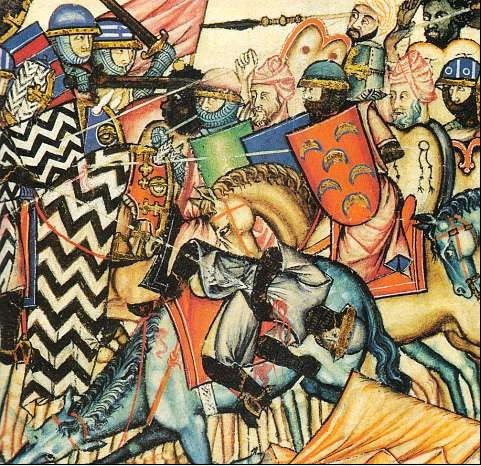
160808ReconquistaReligion often becomes involved when people are in conflict. Many religious traditions provide points of identity around which people can rally when they feel threatened or can offer reassurance and justification to those about to enter combat. Extreme circumstances, like war, have often led people to embrace their own religious traditions (or new ones) more firmly. All of this is undeniably true. Popular history, however, often makes a further claim: that religious differences cause violent conflicts. A careful look at history shows us a different picture. Religious differences have rarely, if ever, caused wars on their own, and where they have been involved in starting hostilities, they have played only a partial role alongside many other forces.

When we look at history, it is easy to find conflicts between people of different faiths, but these are unusual interruptions in a world history that is mostly about people of different faiths getting along reasonably well. Religious differences on their own don’t drive people into conflict. Protestant and Catholic Christians, for example, have been engaged in a bitter conflict in Northern Ireland for most of the past century, but during that time Northern Ireland has been pretty much the only place in the world where Protestants and Catholics have fought a sustained violent conflict. Nor is religion the only thing that separates the sides in Northern Ireland: differences in religion, language, political inclinations, popular culture, and social life are all wrapped up in the thousand-year history of English colonialism in Ireland. Catholic and Protestant denominations in Northern Ireland have provided a structure in which people can organize to pursue their causes and have been markers of identity around which people rally in difficult times, but if all the people of the territory were of the same religion, the conflict there would still have happened. Blaming religious differences for the Northern Irish Troubles is like blaming the US Civil War on a disagreement over what color Army uniforms should be.

Continue reading

Text as Art

Language can be beautiful. We all know this as readers and writers. But language can also be beautiful as a visual, even physical work of art. In pre-modern societies where literacy rates were low, most people who looked at written text experienced it as a work of art, not as a work of language.

Here, for example, is the beginning of the Gospel of John in the Book of Kells.

Book of Kells, folio 292r via Wikimedia (Ireland; c. 800; ink on vellum)

It may be hard at first to tell that there is even a text in the midst of this work of art, but if you know where to look you can find the Latin text: IN PRINCIPIO ERAT VERBUM (In the beginning was the word).

Book of Kells via Wikimedia, text highlighted by Erik Jensen

Continue reading

Ancient Models for Writing About Language Barriers

160718graffitoThe ancient Mediterranean was a multilingual place. Although a few languages were in common usage—Phoenician, Greek, Aramaic, Punic, and Latin, in different times and places—many other languages were spoken, including Iberian, Gaulish, Etruscan, Oscan, Hittite, Hebrew, Egyptian, and Numidian. Many people, especially in the great port cities like Carthage, Rhodes, and Alexandria, would have encountered numerous different languages in their daily lives. It is no surprise that this experience of a polyglot world was reflected in classical literature. The ways in which ancient writers represented multilingualism and language barriers offer some useful models for us as speculative fiction writers today.

Continue reading

The Great Walls of China

The Great Wall is perhaps the most iconic piece of Chinese architecture and the best known outside of China. It is also widely misunderstood. Border walls like the Great Wall in China, Hadrian’s Wall in Britain, and the Great Wall of Gorgan in Persia do not function the same way as the walls of a city or fortress. These walls are less about keeping people out than they are about managing, observing, and sending a message to the people entering the country or already within it.

A view of the wall from near the eastern terminus, photograph by Jack Upland via Wikimedia

Continue reading