Making Clothes 9: Calculations

This post is a part of our Making Clothes series.

Now that we’ve gone through the process of producing raw materials, turning those materials into textiles, and turning those textiles into clothing, we’re rounding out this series with a little math. Given the labor and resources that went into making one outfit, how long would it have taken to make, from start to finish, and how much land did it take to grow everything on?

Our figures here are necessarily approximate. There are too many variables to take them all into account. A good year’s flax harvest or a clumsy hand at wool-carding could make a difference to how fast workers could gather and process materials. We’re also generally working with optimistic estimates. A more thoroughly realistic assessment would have to allow for lost time and material from shrinkage, breakage, wastage, crop failures, inclement weather, and so on. We’re aiming here to get a rough sense of just how much of an investment of labor time and productive land, at minimum, one set of clothes represented in the pre-modern world.

We are also assuming a community of skilled agriculturalists and crafters who know their trade and do not need to be taught or to experiment with processes of production. The passing on of such knowledge to new generations was in itself an important part of historical agricultural and textile production, but we leave that labor out of our calculations.

Pixabay Jo-B Medieval Man

Our example outfit consists of several pieces, each of which required materials and labor to make:

  • A long-sleeved linen undertunic reaching to the mid-thigh
  • A long-sleeved silk overtunic reaching to the knees
  • Leather footwear
  • A rectangular wool cloak of about knee-length

To see what it would take to produce this outfit, it is helpful to think backwards: the dimensions of our imaginary wardrobe tell us how much raw material would be needed to make it, which in turn dictates how much work would go into producing that material. We’re imagining this outfit for a person of any gender of about medium height and build. It does not represent any specific historical outfit, and does not belong to any particular place or time; a certain amount of vagueness in the design allows our outfit to reasonably stand in for clothes that could be found in many places and historical eras.

We calculate the following dimensions for the items in our wardrobe:

  • Undertunic: The undertunic is made from a piece of fabric measuring 210 x 75 cm, which is cut to yield two sleeve pieces and a long piece folded poncho-style for the front and back, with a hole cut for the head. The whole piece of fabric amounts to 1.575 square meters.
  • Overtunic: The overtunic is similarly cut from a piece of fabric measuring 225 x 90 cm, with two sleeve pieces and one long piece for front and back, amounting to 2.025 square meters of fabric.
  • Footwear: Our shoes are made from approximately one third of a square meter or leather per shoe, thus two thirds of a square meter for a pair.
  • Cloak: Our cloak is a rectangle 1 meter by 2 meters, for 2 square meters of wool.
T-Tunic Patterns Small

Finished clothes

Undertunic and overtunic – The construction method of these two garments is essentially identical, so the amount of time spent cutting, sewing, and finishing each one is approximately the same. With some reconstructed historical pieces for reference, we estimate that sewing a tunic-style garment such as these takes about 6 to 9 hours. We’ll take the average of the range and estimate that each garment takes 7.5 hours to cut and sew. The two together add up to 15 labor hours.

Footwear – Leather is slower to sew than fabric, but shoes are smaller than tunics. Our shoe models have around 120 cm of seam, and reconstructions show a leather stitching speed of 50 cm per hour. Allowing time for cutting and shaping (but omitting time for fitting to the wearer), each shoe would take about 2 hours to make, thus 4 labor hours for the pair.

Cloak – The cloak is straightforward, since it is simply a rectangular piece of woven cloth needing no sewing beyond the finishing of the edges. If the fabric was woven at a width of 1 meter, the selvages would make the long sides of the cloak; only the short sides would require hemming. At a hand-sewing speed of 1 meter per hour, sewing the cloak would take 2 labor hours.

Total cutting, sewing, and finishing time: 21 labor hours.

Fabrics/leather

Many factors affect the speed at which woven cloth is produced, from the size of the loom to the skill of the weaver. Historical recreations yield a range of weaving speeds from 180 to 255 square cm per hour. For the purposes of our project, we use an estimate of 200 square cm per hour for all types of fabric.

Linen – We need 1.575 square meters of woven linen, or 15,750 square cm, which would take approximately 79 hours to weave. Allowing time for set-up and maintenance of the loom and other necessary by-work, the production of the linen fabric from thread would require around 90 labor hours.

Silk – The calculations are similar for our silk. Weaving 2.025 square meters of silk would take a bit over 101 hours. With additional by-work, we can estimate about 110 labor hours to produce the silk fabric.

Wool – Likewise for our wool, the 2 square meters of wool we need would take about 100 hours to weave, coming to around 110 labor hours with additional work.

The time that it takes to spin the thread needed for weaving depends on how much thread goes into the finished fabric, which is affected by a host of factors: the thickness of the thread, the density of the weave, the width and length of the fabric, and so on. Rather than try to calculate all these possible elements, we work with a rough estimate that each of our fabric pieces required 10 km of thread, a measure based on both modern textile production and historical reconstructions. The further thread needed for sewing is a negligible addition. This rough figure allows for the possibility of variations in how each individual textile was produced while still giving us a reasonable estimate for the total investment of labor.

Spinning by hand yields around 40 to 60 meters of thread per hour. Taking the average of 50 m per hour, the 30,000 meters of linen, silk, and wool thread needed for our three pieces of fabric would take some 600 labor hours to spin.

Dyeing is a further step in the production process. The amount of time it takes to dye cloth depends on what dyestuffs are used, what kind of fabric is being dyed, and what the desired result is. Sourcing dyestuffs and preparing the dye bath also add to the labor. We estimate 10 hours of labor for each piece of fabric, and soaking in the dye bath adds several days of passive production time.

Flickr Shawn Harquail Spinning and dyeing the fibers

LeatherLeather production is complicated, as we outlined in our post about it. The two thirds of a square meter we need for our shoes could come from a single sheep hide (which typically yield 0.8 square meters of leather), but a lot of preparation and processing would have gone into making that hide into usable leather.

The amount of time it takes to produce leather from a fresh hide is widely variable depending on how the hide is treated and what steps are desirable for finishing it. Much of the time that it takes to prepare leather is passive time, as the hide sits on a rack or in various liquid treatments. For our purposes, we estimate that producing the leather for the shoes took 30 days from beginning to end, during which there were 12 hours of active labor. The passive production time for the leather can overlap with the passive dyeing time.

Total textile and leather production time: 952 labor hours, 30 days passive production.

Raw materials

We are estimating 10 km of thread of each fiber type for our complete outfit, but we must make a further calculation to determine how much raw material went into producing that thread. Threads can be spun at different thicknesses, so to get a sense of how much raw material went into our threads we need to convert length into weight. This conversion is expressed in a unit called tex, which gives the weight in grams of 1,000 m of a thread or yarn. Thinner threads are suitable for finer fabrics, while thicker threads can produce bulkier, rougher textiles. We consulted historical reconstructions to assign texes to our different threads.

Linen – For the linen undergarment, we want a fine fabric that feels good against the skin. For this purpose, we use a tex of 55, which means the 10 km of thread weighs 550 g. To get 550 g of spun linen thread we have to start with a much larger amount of flax, since flax processing removes as much as 90% of the material gathered from the field. Our 550 g of linen thread would require around 5.5 kg of flax.

Modern experiments with historical farming methods have yielded flax harvests of about 1 kg per square meter of field, so 5.5 kg of flax would need only about 5.5 square meters of field to grow in, which would take less than an hour both to plant and to harvest. Flax processing takes several steps, but for a modest amount of flax like this, the total active work time is not great. We can estimate 15 labor hours for flax processing from planting until the fiber is ready to spin. Along the way there is also about 100 days growing time for the plants, and some weeks passive time for retting.

Silk – For the silk tunic, we chose to use a coarser and heavier fabric with a tex of 180, which amounts to 1.8 kg in 10 km of thread. This amount of silk fiber represents the output of around 5,400 silkworms consuming the leaves of some 540 mulberry trees, which would need roughly 2 hectares of land to grow on. If starting silk cultivation from scratch, these trees would need a year to grow to maturity from the planting of cuttings, but we will assume that our silk comes from an established grove, and not count the planting, tree tending, or growing time into our estimates.

What we do need to account for, however, is the growth cycle and tending of the silkworms. Silkworms take 28 days from hatching until they are ready to spin, and require care as they grow. For our purposes, we estimate that caring for the silkworms takes at least eight hours of labor every day, between preparing food, feeding, and management. Once the cocoons are spun, a skilled hand can unreel their fiber quickly. Altogether, we estimate that the production of silk fiber takes 225 labor hours and 28 days of passive production.

Wool – Our wool cloak is a sturdy outer garment meant for warmth and protection against the elements. For this purpose we choose a tex of 500, which makes for 5 kg of wool thread. Historic breeds of sheep yield between 1 and 1.5 kg of wool per shearing, and some of that weight is lost in processing. We estimate that one sheep could yield 0.5 kg of wool fiber fit for spinning, so the 5 kg of fiber needed for our cloak represents one year’s fleece from 10 sheep.

A flock of 10 sheep would need some 10 hectares of grazing land. Sheep are sturdy animals and fairly self-reliant, but they do need tending to keep them safe from hazards and fed during the winter. We are being optimistic (perhaps even unrealistically so) and estimating 100 labor hours for sheep tending in a year. Once the fleece has grown, shearing is quick for a practiced hand. Based on various numbers given by modern shearers using hand shears, we estimate that a skilled shearer would be able to shear our 10 sheep in two hours. For the needs of wool production, then, we count 102 labor hours, a year of passive production, and 10 hectares of land.

Leather – The leather for our shoes could come from one of the sheep in the flock. Since the labor for tending the sheep is already accounted for, and slaughter and skinning are quick processes for an experienced hand, we add only 1 more labor hour to account for the production of the hide for tanning.

Total raw material production time and land needs: 343 labor hours, 1 year passive production, 12 hectares of agricultural and grazing land.

Final calculations

As we have noted many times, a lot of our figures are rough estimates at best. The actual production time for an outfit like ours would depend on numerous real-world factors that are beyond the scope of our project to account for. We are also largely discounting the effects of loss, wastage, and natural or human disaster—a flooded flax field or a neighboring people’s raid on the sheep pastures would throw all our calculations into disarray. Nevertheless, here is a rudimentary good-faith estimate of the time and land investment involved in making a single set of clothes in pre-modern conditions:

Active working time: 1,316 labor hours

Passive time: 1 year

Land requirements: 12 hectares

1,316 labor hours represents over 164 full 8-hours days of work for one person. Some of the work could be shared among several people, but there is a limit to how much efficiency could be gained by division of labor—you can’t make sheep grow fleece faster by adding more shepherds, for instance.

Once raw fibers have been produced, it would take some 973 labor hours to turn those fibers into finished clothes, or nearly 122 full 8-hour days. Even with a worker dedicated full-time to each material type (wool, linen, silk, leather), it would still take more than a month to finish the whole ensemble.

For one outfit, for one person to wear.

Flickr Billy Wilson Small Herculaneum Woman

Furthermore, every labor hour devoted to clothing production was an hour of labor not available to produce food, construct or maintain buildings, care for children or elders, or engage in other activities that were necessary for the safety and well-being of a community. Clothing was not just something to wear for historical people; it was a statement about the prosperity of their own families and the communities they lived within.

Further Reading

Ejstrud, Bo (ed.). From Flax to Linen: Experiments with Flax at Ribe Viking Centre. Esbjerg: Ribe Viking Centre and University of Southern Denmark, 2011. https://ribevikingecenter.dk/media/10424/Flaxreport.pdf

Köhler, Carl. A History of Costume. New York: Dover, 1963.

Mallory, J. P. & Victor H. Mair. The Tarim Mummies: Ancient China and the Mystery of the Earliest Peoples from the West. London: Thames & Hudson, 2000.

Mannering, Ulla & Charlotte Rimstad. Fashioning the Viking Age 2: From Analysis to Reconstruction. Copenhagen: The National Museum of Denmark, 2023. https://natmus.dk/fileadmin/user_upload/Editor/natmus/oldtiden/Fashioning_the_Viking_Age/From_Analysis_to_Reconstruction_-_high_resolution.pdf

Owen-Crocker, Gale R. Dress in Anglo-Saxon England [revised and enlarged ed.]. Woolbridge: Boydell Press, 2004.

Pasanen, Mervi & Jenni Sahramaa. Löydöstä muinaispuvuksi [From Finds to Reconstructed Dress]. Salakirjat, 2021.

Postrel, Virginia. The Fabric of Civilization: How Textiles Made the World. New York: Basic Books, 2020.

Strand, Eva Andersson & Ida Demant. Fashioning the Viking Age 1: Fibres, Tools & Textiles. Copenhagen: The National Museum of Denmark, 2023. https://natmus.dk/fileadmin/user_upload/Editor/natmus/oldtiden/Fashioning_the_Viking_Age/Fibres__Tools_and_Textiles_-_high_resolution.pdf

Walton Rogers, Penelope. Textile production at 16-22 Coppergate. York: Council for British Archaeology, 1997. https://www.aslab.co.uk/app/download/13765738/ASLab+PWR+1997+AY17-11+Textile+Production+for+web.pdf

Images: Medieval man via Jo Justino at Pixabay. Sample T-tunics by Eppu Jensen. Hand-stitching leather shoes, photograph by Jeff Mandel via ExIT Shoes (CC BY 4.0). Spinning and dyeing in Chinchero, Peru, by Shawn Harquail via Flickr (CC BY-NC 2.0). July, from the Grimani Breviary via Wikimedia (Biblioteca Nazionale Marciana; 1490-1510; illumination on parchment). Small Herculaneum Woman, reconstruction of a marble statue, by Billy Wilson via Flickr (CC BY-NC 2.0).

Random Thoughts on The Marvels

In no particular order. Spoiler warnings in effect.

Erik’s random thoughts:

  • The beginning and ending of this movie felt rushed. The beginning had to get the audience caught up on a bunch of streaming shows that not everyone has seen. The ending felt like it ran out of time to properly wrap up both story elements and emotional beats. As ridiculous and entertaining as the musical number on Aladna was, maybe a minute or two of that runtime could have been better spent on other parts of the movie.
  • Even though we have watched most of the relevant streaming shows (we’ve seen WandaVision and Ms. Marvel; we gave up on Secret Invasion after they fridged their third woman in as many episodes), I still felt as though I was missing out on some backstory. It’s like there’s half a movie we all missed somewhere along the way.
  • Iman Vellani is fantastic as Kamala Khan / Ms. Marvel, and she plays brilliantly off both Brie Larson and Teyonah Parris. Carol Danvers may be drivingf this movie’s story, but Kamala is its big, goofy, awkwardly earnest teenaged heart.
  • I think I counted two white men with speaking roles—three at a stretch if you include the stinger (and not getting into complicated questions about South Asian identities). At the same time, the movie doesn’t make any kind of issue about gender or race; people are just people. We’ve come a long way from the blazing white maleness of Iron Man, even from movies like Black Panther and Captain Marvel which showcased the diversity of their representation and made it a feature of the movie. The Marvel Cinematic Universe is better for reaching a place where a movie full of people who aren’t white men is unremarkable.
  • With Guardians of the Galaxy, Thor: Ragnarok, and now The Marvels, the MCU is fully committing to the idea that space is big, colorful, weird, and often kind of silly, and I love it.
  • It was great to see the heroes find their strength not by force of will or emotional epiphany but with practice, and especially by practicing together.
  • Having flerken kittens tentacle-eat people as an evacuation strategy was already pretty funny, but setting it to a song from Cats was comedy genius.

Eppu’s random thoughts:

  • It’s too bad that I’ve never read any Carol Danvers stories. It seems there’s a lot of potential in the character—or a lot of comic book storylines that could’ve been tapped—but for some reason she hasn’t gotten another movie for herself; hardly any time at all, in fact, even in the movies that she has been in.
  • Like MCU’s Peter Parker (Tom Holland), the new Ms. Marvel Kamala Khan (Iman Vellani) actually feels like a teenager. Good job writing and acting that aspect. (So good, in fact, that we almost gave up on Ms. Marvel the series.) Also Khan’s mother Muneeba (Zenobia Shroff) is a treasure!
  • It’s DELIGHTFUL that we had a proper training montage! I was so satisfied to see how exactly the Marvels figured out how to take advantage of their inadvertent swapping-places-snafu, even to the extent of tagging in and out while juggling.
  • I guess it’s an indication of how few women I’m used to seeing in the MCU that I kept being astonished at how many female characters we got not only to see but to hear. (“She got lines! And she got lines, too!”)
  • Teyonah Parris as Monica Rambeau felt the most one-dimensional of the three protagonists. Apart from still suffering from Auntie Carol abandoning her in her childhood, what did she have going on in her life? Not much, as I recall. (Well, work, but don’t they all have that.)
  • In the MCU, there’s a distinct testosterone-and-big-guns strain (e.g., the Avengers and Iron Man movies), another that’s kookier but mostly sticks with humans (Ant-Man, Doctor Strange), and a third that’s waaaay out there (Guardians of the Galaxy, Thor: Ragnarok). I used to think there’s room for all kinds of takes, from serious to silly, but at least in The Marvels the different veins seem almost to quarrel. The result is a mix where the various styles pull in different directions and don’t quite cohere. I would’ve wanted to see a higher quality, more polished movie. Perhaps the writers are still recuperating from the cumulative effects of the pandemic and the Hollywood writer’s strike. (I know I haven’t bounced back all the way yet, and I didn’t even have to strike.)

Image: Screenshot from The Marvels via IMDb

Ghosts of Marathon

Tales of haunted places are a nearly universal part of human experience. Ghost stories can be one of the ways in which we remember the past, especially traumatic or painful parts of it. Even in ancient Greece there were legends of hauntings connected with the site of the battle of Marathon.

Normally, in ancient Greece, the bodies of fallen soldiers were brought back to their home city after the battle and buried wherever their families buried their dead, but an exception was made for the fallen of Marathon in recognition of the exceptional nature of the battle. The dead of Marathon were buried on the site of the battle and an enormous earthen mound raised over their tomb.

The travel writer Pausanias reported local legends about ghostly apparitions around the tomb mound some six centuries after the event (and a warning to any would-be ghost hunters):

Every night there can be heard the sound of horses neighing and men fighting. It has never done anyone any good to go looking for these manifestations on purpose, but those who happen upon the scene by chance do not suffer the spirits’ wrath.


Pausanias, Description of Greece 1.32.4

(My own translation)

If you’re enjoying some ghost stories this Halloween, know that you’re in good company and part of a long tradition.

History for Writers looks at how history can be a fiction writer’s most useful tool, from worldbuilding to dialogue.

Quotes: The Roman Custom When Clearing a Stand of Trees

At least since Tolkien’s Ents smashed up Isengard, the idea of resurgent nature rebelling against those who would destroy it has been a theme in modern fantasy. The idea seems to be a product of modern industrialization and environmentalism. There is no comparable trope in the literature of the ancient Mediterranean, but the idea that humans exist in a relationship with nature that must be properly observed and maintained does find echoes there. The early Roman writer and politician Cato the Elder included this advice in his handbook on farming for those who wanted to cut down trees to clear land:

This is the Roman custom when clearing a stand of trees. With the sacrifice of a pig, use these words: “Whether you are a god or a goddess to whom this wood is sacred, since it is fitting for you to receive the sacrifice of a pig for the clearing of this wood, therefore for these reasons, whether I do it myself or someone does it at my command, let it be correctly done. Therefore with the burnt offering of this pig I pray the correct prayers, so that you may look kindly on me, my family, my household, and my children. For these reasons, therefore, may the burnt offering of this pig be worshipfully made.”

If you wish to plow the ground, make another sacrifice in the same way, adding the words: “for the purpose of doing this work.” As long as the work is ongoing, the same ritual must be done every day in some part of the land. If you miss a day, or if public or family celebrations interrupt the work, you must perform an additional sacrifice.


Cato the Elder, On Agriculture 139-40

(My own translation)

Cato does not elaborate on what might befall a farmer who failed to perform the correct ceremonies. Given what we know of Roman religion, it is more likely that bad luck or a poor harvest was the feared consequence, not angry spirits coming out of the woods to wreak havoc. Still, the idea that interfering with nature is something to be done carefully and with a good purpose is an ancient one.

Serving exactly what it sounds like, the Quotes feature excerpts other people’s thoughts.

Making Clothes 3: Production of Raw Materials

This post is a part of our Making Clothes series.

Our imaginary wardrobe is made up of four different kinds of material: wool, linen, silk, and leather. Each of these materials has a different origin. Today we consider the time, effort, and resources that went into producing the raw materials for each of these components.

Wool

Wool is processed from animal fleece, most typically sheep. Sheep grow their fleece out year round, and it serves them as insulation against cold, wet, and the hazards of the wild. Wool is traditionally gathered in the spring, so that sheep can have the warm summer months to regrow their coats.

There is no definite rule for how much pastureland it takes to raise sheep. Numbers depend greatly on the quality of the land and how it is managed. Modern farming experience gives us a rule of thumb that one sheep needs at least a hectare of land for a year’s grazing, although in historical conditions, the amount of land needed to raise sheep could have been significantly more.

Modern sheep are the result of millennia of breeding. In the pre-modern world, sheep were smaller, and their wool was lighter in weight and less fine. In some places today there are heirloom breeds similar to sheep of antiquity, such as the North Ronaldsay sheep found today in the Orkney Islands. One North Ronaldsay sheep yields between 1 and 1.5 kilos of fleece in an annual shearing. The shorn fleece loses some weight as it is cleaned and processed in preparation for spinning, from as little as 15 percent to as much as 80 percent.

Linen

Linen fibers are derived from flax, a woody-stemmed plant grown both for its fibers and for its oily seeds. Flax historically has been an important crop in many parts of the world.

Producing flax starts with plowing and sowing. An acre of land was traditionally defined as the amount of land that one farmer with one ox could plow in a day. Since a hectare is approximately two and a half acres, plowing a hectare of land in historic conditions would have taken about two and a half days. After sowing, flax plants take about 100 days to grow from seed to maturity.

Flax plants require deep, rich soil and draw lots of nutrients out of the earth, which means that fields repeatedly planted with flax will become exhausted in a matter of years. Sustainable flax production requires rotating with a less demanding crop and fertilizing to restore nutrients. Depending on fertilizer amounts, modern flax may yield between 4.9 and 7.8 tonnes per hectare. In historical conditions, dependent on animal manure or legume cultivation for soil maintenance, flax yields were unlikely to be as high.

Harvested flax requires extensive preparation to create usable fiber. The processing of flax removes 70-90% of the plant to yield fiber fit for spinning and weaving.

Silk

Silk fibers are derived from the cocoons of insect larvae, primarily the domesticated mulberry silkworm, although other creatures’ fibers have also been used historically. Domesticated silkworms are fed on mulberry leaves until they reach their fourth molt. The worms then spin cocoons by producing a long single filament which they wind around themselves.

It takes about 28 days from when silkworms hatch until they spin their cocoons. During that time, domesticated silkworms require careful tending and feeding, since most of their survival instincts have been bred out of them to make them more suitable for fiber production. They move very little and will not go in search of food if it is not provided for them.

Silkworms feed exclusively on the leaves of the mulberry tree. One mature tree produces enough leaves to feed about ten worms until they are ready to spin. Newly planted mulberry trees have to grow for about 8 months before they start producing leaves. To produce 1 kg of silk thread, 3,000 silkworms consume 104 kg of mulberry leaves, grown by about 300 trees.

Leather

Leather is produced from animal skins. A wide variety of different animals, both wild and domesticated, are used for leather. Domesticated mammals like cattle, sheep, goat, and pig yield most modern leather, although leather can also come from wild animals such as deer, squirrel, and rabbit, as well as non-mammals like ostriches, lizards, and fish.

The amount of leather that comes form one animal depends on the size of the animal and the condition of its hide. In modern leather processing, a typical cow hide yields 4.6 square meters of finished leather, while a sheep hide yields 0.8 square meters. Smaller animals naturally have smaller hides, and hides in poor condition may have to be trimmed smaller to be usable.

Skinning an animal after slaughter is relatively quick, but it is only the first step in leather production. The preparation, preservation, and treating of the hide takes many more steps that may amount to months of labor before the leather is ready to be cut, fitted, and finished.

Images: Woman shearing sheep, from Book of Hours by Jehan de Luc via Wikimedia (currently The Hague; 1524; illumination). “Flax blooms,” photographed by Leonid Kulikov or Mykhailo Kvitka via Wikimedia (currently Fine Arts Museum, Kharkiv; 1893; oil on canvas; by Mykhaylo Berkos). Stamp of Afghanistan showing mulberry branch and silkworms via Wikimedia (1963; postage stamp) (this work is in the public domain under Afghan law). Leatherworking via Wikimedia (1568; woodcut)

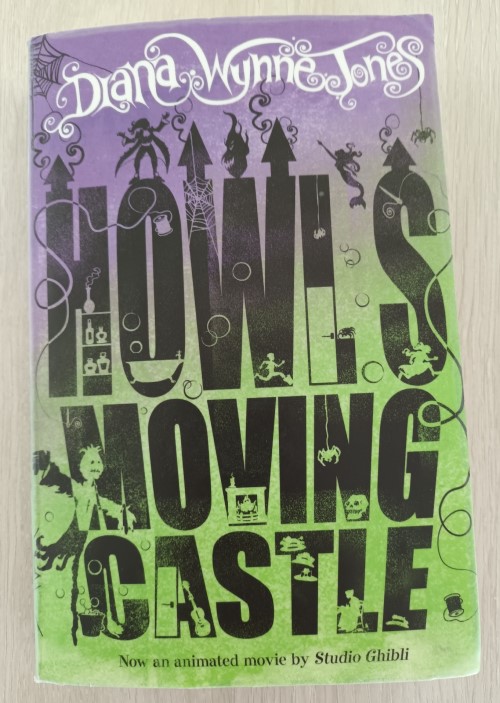
Diana Wynne Jones: Howl’s Moving Castle

I’ve been looking for cozy, comfortable fantasy reads lately, and I’ve seen several recommendations of Diana Wynne Jones’s Howl’s Moving Castle. Until recently, I had known this name only for the Studio Ghibli animation (which I have never watched either), and I was surprised to discover that it was a novel first. I have read and enjoyed some of Jones’s short stories, so I was hopeful about picking up this novel. Alas, my hopes were soon dashed.

The story follows Sophie, a young hatter who is cursed by the Witch of the Waste to turn into an old woman and to be unable to tell anyone about the curse. Sophie goes in search of someone who can not only break the curse, but recognize that there is a curse to break without her having to tell them. She ends up in the small cottage of the wizard Howl, which is enchanted to look like a mobile castle on the outside. Howl seems to take no notice of Sophie, but his pet fire demon Calcifer recognizes the curse and agrees to help her if she will in turn help him break his contract with Howl, which, for magical reasons, he can’t talk about either. So Sophie settles in as a sort of freelance housekeeper to Howl and his apprentice Michael, while keeping her eyes open for anything she can learn about Howl and Calcifer’s contract.

So far so fairy tale. It’s a strong beginning with a promising cast of characters an interesting set of problems for them to unravel. And then nothing happens. Nothing continues to happen for two-hundred pages, until the last twenty pages when all the plot that didn’t happen in the rest of the novel suddenly comes crashing in like five trains trying to run on the same track at once.

It’s not that the characters don’t do anything for all that time—there are trips to the royal palace, covert visits to sisters, and a jaunt to modern Wales, but none of them make any sense or accomplish anything for the characters. Indeed, most of what the characters do is senseless. Over and over again the novel repeats that Sophie does or says something “without knowing why.” Jones, of course, knows why, and most of these nonsensical acts turn out to be coincidentally relevant in the finale, but far too much of what happens in the story happens because the author is setting up what she thinks is a clever ending, not because it makes sense given what motivates the characters and what they know or think they know at the time.

Indeed, it turns out in the end that Howl knew about Sophie’s curse all along. So did her sisters, not to mention the powerful magic-worker one of her sisters was studying under, and they were all trying to help break the curse. In fact, almost everyone Sophie encounters over the course of the novel knew about her curse and was trying to help her all along, but none of them ever bothered to tell her so. Why not? For no reason I can see other than that it would have broken the dramatic tension before Jones was ready.

Although the story mostly takes place in Howl’s small cottage, I found the atmosphere more stifling than cozy. Howl is an irresponsible jerk who makes everyone around him clean up his messes (both literal and figurative) while he moons over one lady or another. He is moody and mean, given to sulking when he doesn’t get his way, and never shows appreciation for how much work the people around him are doing to keep him afloat. Sophie falls in love with him at the end of the novel, as a fairy tale demands, but for no reason that I can fathom.

The only interesting thing I can point to in the novel is how it cleverly remixes themes and elements from The Wizard of Oz. There is a living scarecrow, a wicked witch in a castle, a humbug of a wizard from our world lost in a fantasy land, and a girl in search of a way back to her familiar life. She even eventually acquires a faithful dog and magical traveling footwear. For all these echoes of Oz, the story never feels like a pastiche or homage; it reimagines and recombines these elements to form an entirely different story. If only that story were any good, it would be an impressive narrative feat.

Howl’s Moving Castle left a bad enough taste in my mouth that I think I’ve been put off Jones for a good while. Maybe someday I’ll give her other works a try, but I need to cleanse my palate a bit first.

Image by Erik Jensen

ICBIHRTB – pronounced ICK-bert-bee – is short for ‘I Can’t Believe I Haven’t Read This Before’. It features book classics that have for some reason escaped our notice thus far.

Making Clothes 2: Historical Inspirations

This post is a part of our Making Clothes series.

For the purposes of these posts, we are imagining an outfit that might have been made and worn in many parts of Eurasia or North Africa in the premodern period. Our imaginary wardrobe takes inspiration from a variety of sources, both archaeological and written.

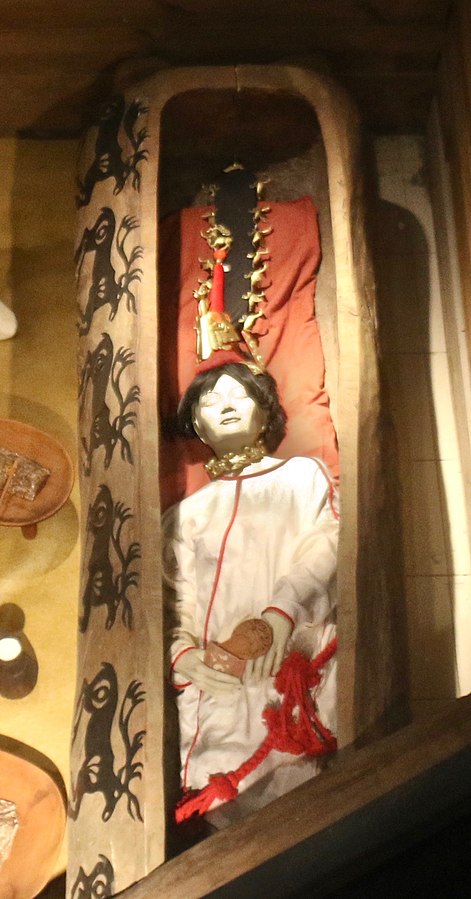
Our oldest piece of inspiration comes from the Altai Mountains in central Asia. In the fifth century BCE, a woman was buried in a tomb on the high Ukok plateau of what is today the Altai Republic in Russian Siberia. The cold, dry climate of the region helped preserve the burial until the late twentieth century when it was discovered and excavated. The woman, popularly known as the Siberian Ice Maiden, was well dressed for her burial, and her clothes were remarkably well preserved. She wore a dress of wool and camel hair, a silk shirt, and thigh-high leather boots, along with a tall headdress made of wood.

Reconstruction of the Ukok woman’s clothing and coffin, photograph by Sue Fleckney via Wikimedia

For our next historical reference, we look to the Vindolanda Tablets, an assortment of documents written on thin sheets of wood found at a Roman fortress near Hadrian’s Wall in northern Britain. Wooden tablets like these were used in antiquity for personal letters, memoranda, and other everyday documents of the kind that rarely survive for very long. These documents were written in the first and second centuries CE, and survived because they were preserved in waterlogged ground around the fortress. Among them we find the household accounts of Roman soldiers and officers detailing what sort of clothes they were spending their money on. A couple of tablets record the business affairs of a man named Gavo. We do not know who he was or what role he played in the life of the fort, but he seems to have supplied a lot of clothing and other textiles. One tablet lists some foodstuffs along with several bedspreads, a cloak, and thirty-eight pounds of wool. (Tabulae Vindolandenses II 192) Another tablet, part of whose text has been lost, listed at least ten cloaks of different types, three tunics, seventeen hooded cloaks, and some number of capes. (Tabulae Vindolandenses II 207) Yet another letter—we don’t know from or to whom—evidently accompanied a gift of underwear, socks, and sandals to some lucky soldier. (Tabulae Vindolandenses II 346)

Reconstruction of a Roman soldier’s dress, photograph by Fabryb13 via Wikimedia

Our last piece of inspiration comes from Egypt in the late antique period, probably the fifth century CE. It is a beautifully preserved tunic made of linen with intricate decorations woven into the fabric in dyed wool. The decorations include flowing vine motifs and depictions of the god Dionysus in surrounded by mythical sea creatures.

Tunic with Dionysian Ornament via the Metropolitan Museum of Art

We’ve chosen this set of examples to inspire our fictional wardrobe for a few reasons. Between them they span nearly a thousand years of history across Asia, Europe, and North Africa. They come from a wide range of environments, from the cold, arid heights of Central Asia to the hot, dry Egyptian desert to the rainy British Isles. The Ukok woman presents us with the complete outfit of one person; the Egyptian tunic gives us a detailed look at the construction of one garment; and the Vindolanda Tablets help us see individual items of clothing in the context of a larger economic and social world.

Our Example Outfit Described

For the purposes of quantifying necessary raw materials and production time to make a single outfit, we needed a specified set of clothing.

Our imaginary wardrobe starts with a long linen undertunic or short linen underdress. (From the point of view of materials and time required, we consider a dress very roughly equivalent of pants plus a tunic.)

The underlayer is topped by a silk overtunic. For the under- and overtunics, we imagined a simple T-style cut. Many historical tunics use gores at the side and central seams to add comfort, but we’ll try to keep our numbers manageable and stick with a basic design.

In addition, we include leather shoes or boots. Finally, a good-sized, rectangular wool cloak or mantle protects the wearer from elements.

For simplicity’s sake, we postulated a dyed but otherwise unadorned outfit, since the size and amount of decorative banding, embroidery, etc., can vary so widely. Accessories like underwear, wool socks and wool legwraps, hoods and headwear, belts, pouches, bags, and the like were also left out of our example.

How It Happens looks at the inner workings of various creative efforts.

Winter Count

As a historian, its always fascinating to me to encounter the historiographic practices of another culture. Every culture has reasons to remember the past, and finds its own solutions to the problems posed by the limitations and fallibility of human memory. While written narrative histories have been privileged in the Western world, they are not the only way of preserving the past.

The winter count is a tradition of the Lakota, Kiowa, and several other indigenous nations of the North American plains. Customarily painted on buffalo hide, the winter count records years with one or two pictographic symbols representing major events of the year. These documents served as an aid to memory so that important past events could be recalled and put in relation to one another. In more recent times, some were also created on fabric or paper.

Copy of a Kiowa winter count for 1889-1892 via Wikimedia (previously Smithsonian Museum, now lost; 1890s; ink on buckskin; copy by Ankopaaingyadete of his original work on paper)

We know of winter counts dating from as early as the late seventeenth century and some still being kept in the early twentieth century. Not many have survived intact to today. Like many cultural objects created by indigenous North Americans, winter counts were sometimes destroyed by white settlers and at other times taken by collectors as anthropological curiosities. Some of those that no longer survive were photographed or copied, and in some cases, while the images have been lost, written descriptions survive.

There’s more than one way to preserve historical knowledge. Here’s one idea to keep in mind when thinking about how we know about the past and how people in a culture different from our own might relate to historical memory.

Making Clothes 1: Introduction

For most of human history, people couldn’t walk into a shop and buy a new outfit. The work of creating clothing was complex and demanded multiple skills and a lot of labor. In the pre-modern world, the processes that led from raw materials to finished clothing were long and took up a significant amount of everyday people’s time and energy.

We’re beginning a new series of posts where we examine what it took to make a single outfit, from the raw natural materials to the finished product, in a world without factories and global supply chains. To do that, we’re starting with an imagined wardrobe that would have been at home in many parts Eurasia within the past couple of millennia and working out just what would have gone into creating such a set of clothes, both the materials it would have taken to make and the work that would have gone into gathering, processing, and finishing those materials.

In our next post, we’ll introduce our imaginary set of clothes and show you some of the historical examples that inspired it. After that, we’ll talk about where the raw materials to make our set of clothes would have come from and the labor that would have gone into producing and gathering them. From there, we’ll break down just how each of those raw materials got turned into textiles, and how those textiles then got turned into clothing. We’ll round the series out by trying to quantify the labor and resources that would have gone into our imaginary wardrobe with some hard(-ish) numbers.

Image: Women doing textile work, from Boccaccio’s De Mulieribus Claris via Wikimedia (currently Bibliothèque Nationale, Paris; 15th c.; illumination)

How It Happens looks at the inner workings of various creative efforts.

Fulvia: The Politics of War in the End of the Roman Republic

Fulvia was a descendant of one of the leading families of the Roman republic and wife of Marcus Antonius, one of the men responsible for its end. Her family commanded both respect and enormous financial resources. While there was no formal role for women in Roman politics, aristocratic women were often important in connecting families and individuals. Fulvia went further than most Roman women, aiding her husbands’ ambitions not just with her family connections but with a canny knack for political theatre. She even raised and helped to lead her own army in the penultimate stage of the Roman civil wars.

The politics of the late republic were chaotic and sometimes violent. The violence of the times was a symptom of a deeper shift in the political and social landscape. Changes were under way in the Roman world that not everyone was astute enough to recognize or skillful enough to manage. Fulvia was among the most skillful players of this game, and although she ended up on the losing side, her history is a valuable window into what it took to survive the politics of the end of the republic.

From its earliest days, the Roman republic had survived by balancing the interests of two groups: the wealthy aristocracy and the ordinary people of Rome. The balance was not always easy to strike, and early Rome went through periods of tension, even violence, as these two groups hashed out a way of living together. Many things bound these groups together. The people fought in Rome’s armies, led by aristocrats; while generals got the glory that came with victories, the citizen-soldiers who fought for them expected to see their share of the profits of war. Elite families dominated the competition for political office, but they depended on the people to elect them, and could not afford to entirely ignore the peoples’ needs and opinions. Ties of patronage ran through all levels of Roman society, as the more privileged exchanged favors and protection for the services and support of those lower down the social ladder. For most of the history of the republic, the rich and the poor found ways of working together—sometimes with gritted teeth and held noses, but together nonetheless.

In the second century BCE, the compromises and concessions that had kept Rome functional began to break down. By this time, Rome had become a Mediterranean empire, but its politics were still organized for a city-state. The profits of conquest on such a grand scale made some of the rich so rich that they could now buy off voters, bribe juries, and force their way through political life without adhering to the traditional compromises. While the rich were getting richer, economic changes buffeted the poor, leaving many without the means of making a living.

Roman politicians of the late republic had divided into two camps, calling themselves the optimates and the populares. The optimates represented the interests of the elite. They tended to be conservative, even reactionary. The populares depended on the common people as their base of support. They pushed for reforms to better the lives of Rome’s poorer citizens at the same time as they rabble-roused in support of their own ambitions. Neither group was a political party as we would understand it, with a coordinated message or strategy, but individual politicians triangulated themselves between these two interest groups.

Optimates and populares alike were slow to realize that the political ground was shifting under their feet. By the end of the republic, there was a third constituency up for grabs whose support would be key to political success. In the last century of the republic, The Roman army had shifted away from the old model of a citizen militia into a professional force, which meant that the interests of soldiers were no longer the same as the interests of civilians. Rome’s soldiers and veterans were themselves slow to coalesce as a political force, but the middle of the first century BCE, astute politicians were starting to realize that Roman politics now had three major interest groups, not two: the aristocracy, the people, and the army. Success would come not to those who most ardently supported one, but who could most skillfully coordinate the support of at least two, if not all three.

Fulvia was one of the people who grasped this new reality. From her early days as a political actor, she was deep in the realm of the populares. Her first husband was Publius Clodius Pulcher, a scandal-prone popularis leader who was loved by the people as much for his outrageous provocations against aristocratic convention as for his reformist policies. Clodius also exerted power through his patronage of armed gangs on the streets of Rome. Fulvia and Clodius were inseparable, and she was as much a part of his public life as any of his male allies. When Clodius was killed in a clash with a rival’s gang, Fulvia had his bloody body publicly displayed, knowing the sight would rouse his supporters among the people. Under her leadership, Clodius’ followers smashed their way into the Senate house and turned it into Clodius’ funeral pyre.

After Clodius’ death, Fulvia retained the loyalty of his street gangs and was one of the few members of Clodius’ circle who remained in Rome amidst the optimatis backlash. She married again to Gaius Scribonius Curio, a former optimatis turned popularis. Unlike Clodius, Curio had some military experience under his belt. He and Fulvia allied with the rising general Julius Caesar, and Curio was tasked with recruiting soldiers for Caesar’s bid to take over the Roman state. Curio died while commanding part of Caesar’s army in Africa.

After Curio’s death, Fulvia married again, aligning herself even more closely with Caesar’s cause by taking his right-hand man Marcus Antonius as her new husband. Fulvia brought with her not only her family’s wealth and connections but also her ties to Clodius’ clients and supporters. After Caesar’s assassination, Antonius skillfully stage-managed his funeral as an opportunity to whip up the anger of the people against the assassins and their aristocratic supporters, and it is likely he was guided by Fulvia’s expertise at provoking and channeling popular outrage.

When Antonius and Caesar’s heir Octavian became the leaders of the two sides in a new round of civil war, Fulvia vigorously supported her husband, not just politically but militarily. Together with Antonius’ brother, she traveled around Italy raising troops for Antonius’ side and visiting towns where veterans had been settled to remind them of their loyalty to Antonius. While Antonius was away in the east, Fulvia’s army briefly held Rome against Octavian before being forced out, besieged at Perusia, and finally defeated. Fulvia was sent into exile, where she died of an unknown illness.

The literary sources are not kind to Fulvia, and they may exaggerate some elements of her life. She was on the losing side of the final stage of the Roman republic’s self-destructive civil wars, and like her husband Antonius, her memory was tarnished by Octavian’s supporters. A frequent theme in anti-Antonius propaganda was to portray him as effeminate, so making out his wife to have been overly masculine was a natural addition. Nevertheless, it seems clear that Fulvia was not shy of engaging with the man’s world of politics and war. She was a confident political operator, a popularis provocateur, a chief of street gangs, and a capable recruiter and leader of soldiers. She learned from the men in her life and shared the lessons she had gained from them.

What’s more, she grasped the fundamental shift in late republican politics: it was no longer enough to be with the aristocrats or with the people. Neither popularis nor optimatis could prosper if they did not get the support of the soldiers. It was a truth that the most successful politicians of the age, men like Caesar and Octavian, had realized, and a fact that laid the ground for the imperial age to come. If some of the civil war’s battles had turned out differently, we might look back to Fulvia as one of the founding figures of Rome’s first dynasty.

Image: Coin portrait of a woman, possibly intended to be Fulvia; photograph by Classical Numismatic Group via Wikimedia (Copenhagen; c. 41-40 BCE; copper alloy)

History for Writers looks at how history can be a fiction writer’s most useful tool, from worldbuilding to dialogue.