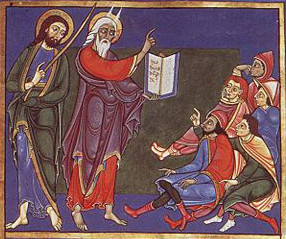
Down the crimson marble steps of the temple of Zurukh, god of blood, came a bald priest in the red robes of the Order.
“Heathens!” he cried, pointing with his holy whip at Our Heroes. “Heretics! Blasphemers! You shall bow down and worship Zurukh or burn in the fires of the Scarlet Inquisition!”
“Silence!” answered Inessa, stepping forward from the party and raising aloft her crosier. “Repent of your wickedness! The power of Adnea, Lady of the Pure Light, compels you!”
Religions are tricky to write. If you’ve delved into much fantasy, you’ve probably seen a lot of faiths that seem oddly familiar. In fact, the religions of some fantasy worlds can be charitably described as “Catholicism with the serial numbers filed off.” Even given a profusion of gods with their own temples and cults and spheres of influence, fantasy religions tend to work more like the modern monotheisms than like the actual ancient “pagan” traditions they are outwardly imitating.
How can you make your fantasy religion feel more authentically ancient? There’s no rules to it, but in this and some future History for Writers posts, I’ll share some of what we know about historical beliefs from around the world that may help you imagine a religious worldview that feels less modern.
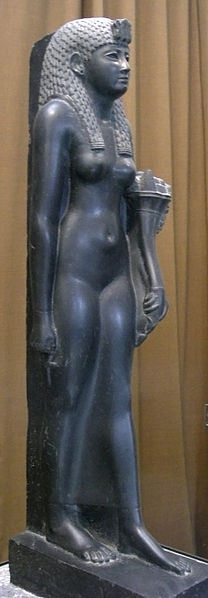
In this age of selfies and Instagram, we are very aware of how consciously we all create the image of ourselves that we show to the world. The people of antiquity were no less self-conscious about their public image. Look at these two sculptures of Cleopatra VII.
Cleopatra VII Philopator is the famous Cleopatra, Queen of Egypt and lover of both Julius Caesar and Marcus Antonius. She was the last of the Ptolemaic dynasty in Egypt, founded by Ptolemy I, one of the generals of Alexander the Great. The Ptolemies ruled Egypt for almost three hundred years, arguably the first European colonial state in Africa. Like other Macedonian dynasties in the relics of Alexander’s short-lived empire, Ptolemy and his heirs took a pragmatic approach to ruling over a large population that did not share in their Hellenized Macedonian culture. They embraced a kind of cultural bilingualism in which they presented themselves in very different ways to different audiences.
Portrait head of Cleopatra VI, photograph by Louis le Grand via Wikimedia (Altes Museum, Berlin; 40-30 BCE; white marble)
This marble head of Cleopatra is sculpted in a Hellenistic style and presents the queen in a Greek cultural context. White marble was favored for sculpture in the Greek world because it reacts to light in ways similar to human skin, making marble sculpture appear more naturalistic. Details like the soft rendering of the mouth, the detailed delineation of the hair, and the slightly off-center tilt of the head are drawn from the artistic repertoire of late Classical and Hellenistic portrait sculpture. This statue asserts Cleopatra’s Greekness and her participation in the broader Mediterranean cultural world. It was probably displayed in Alexandria, the Ptolemaic capital, which had a cosmopolitan population largely made up of Macedonians and Greeks, along with substantial Jewish and Persian communities and a variety of other peoples, but few ethnic Egyptians. It was meant to be seen by an audience that would recognize and appreciate the way this portrait fit into the larger history of Hellenistic ruler portraiture.
Statue of Cleopatra VII photograph by George Shuklin via Wikimedia (Hermitage Museum, St. Petersburg; late 1st c. BCE; basalt)
This basalt statue of Cleopatra uses not only an Egyptian artistic style, but an almost entirely Egyptian iconographic vocabulary. Many different stones were used for Egyptian portrait sculpture, but basalt was a popular one since the stone is very hard and durable, giving a sense of permanence especially to royal portraiture. Cleopatra is presented here as an Egyptian pharaoh. She wears a wig adorned with the royal uraeus and carries an ankh in her right hand. The cornucopia in her left hand is a Greek symbol, but its connotation of bounty is similar to the ankh’s symbolism of life. Also note that one of her feet is advanced. Egyptian women were typically depicted with feet together and men with one foot advanced, but the adoption of masculine traits to represent a ruling queen is also traditionally Egyptian. This statue was intended for an Egyptian audience and meant to convey Cleopatra’s commitment to ruling over her Egyptian subjects through the forms and structures that they had long been accustomed to.
The Ptolemaic monarchs were aware that their power rested on two precarious premises: that the people of Egypt would accept rulers who were not themselves ethnically Egyptian and that other Mediterranean, African, and Asian powers would respect as equals a royal house of comparatively recent vintage. These sculptures show the confidence with which Cleopatra balanced those two needs and reinvented her image for two different audiences.
The Visual Inspiration occasional feature pulls the unusual from our world to inspire design, story-telling, and worldbuilding. If stuff like this already exists, what else could we imagine?
The Martian got me thinking about Tolkien (and not just because of the Council of Elrond reference, although I loved that bit). On a basic level, The Martian is about the same thing that The Lord of the Rings is about. No, Mark Watney doesn’t have to destroy a magic ring and Frodo and Sam weren’t planting potatoes in Mordor, but the question that both works keep coming back to is the same: how do you make good decisions when you don’t have the information you need?
I was thinking about The Lord of the Rings recently after listening in on a conversation between a couple of fantasy geeks about why they don’t like Tolkien. Their complaints were that Tolkien’s writing moves slowly, people talk about things instead of doing them, and most of the action doesn’t even happen on the page. These are all perfectly valid points, and if you prefer action to talking, they are good reasons to read something else. We all like the things we like and there’s no right or wrong about it. What struck me, though, was that the things they didn’t like about Tolkien are precisely the things I love.
There is a rich vein of fantasy literature all about heroes who charge boldly into the thick of battle and remake the world by sheer force of their will. Tolkien’s heroes are not of this kind. For him, what makes a hero is slowing down, thinking carefully, and making the best decision you can, even when you can’t be sure your choice is the right one.
My favorite part of The Lord of the Rings is the Council of Elrond. I know that I am in a minority in this and that even many people who love Tolkien find the whole chapter tedious. I understand the objections, but I can’t help loving the fact that dealing with the ring is something the heroes have to puzzle over and work out. Some fantasy writers would just slip in a helpful ancient prophecy or have Elrond drop a little exposition on the party and get the Fellowship on the road as soon as possible. (Peter Jackson, working within the constraints of film, understandably comes pretty close to this.) But Tolkien lets them take their time, piecing together scraps of information that are all fragmentary and biased. What they end up with is not a perfect answer but the best they can do with what they have. The courage of Tolkien’s heroes is less about facing the danger of Sauron and more about facing the fact that the best decision they can make might still be wrong.
And that’s what I love about The Martian. Mark Watney is a Tolkienian hero. He has to make the best decisions he can even when he can’t be certain what NASA is doing a planet away, or if anyone even knows he’s still alive. He survives not by strength or force of will but by slowing down, thinking things through, and facing the inescapable uncertainties of his predicament. He does the best he can with what he has. Or, as he puts it: sciencing the shit out of things.
I could use a few more heroes like this. We have enough heroes who swing swords, shoot guns, drive cars, and punch things. Let’s have more heroes who plant potatoes. Sam Gamgee would approve.
This is a very, very, very basic introduction to the question of race from a historical perspective. If you’ve studied any world history, human genetics, or even just had your eyes open in the past decade, there’s probably nothing here you don’t already know. Everything I have to say has been said before, so why say it again? I have two reasons.
First, there are some more obscure and complicated things I want to talk about concerning race and history and it would be useful to have some basic points covered for future reference.
Second, there are some people who don’t know the basics of race, even some very intelligent people (even some Supreme Court justices), so it can’t hurt to say these things again.
What happens when the World of Warcraft meets Game of Thrones? Wonderful, wonderful things. Check out Marc Ottensmann’s beautiful intro to Azeroth, GoT-style.
Game of Thrones Intro: World of Warcraft (World of Thrones) via Marc Ottensmann
Thunder Bluff is my favorite (but then Thunder Bluff has always been my favorite city in WoW).
Hey, look! We found a thing on the internet! We thought it was cool, and wanted to share it with you.
The wisest thing I ever heard said about the Muppets (and just how often do you get to use that phrase, anyway?) came from a college classmate. This was back in the heyday of Muppet movies based on classic literature: you know, Muppet Treasure Island, Muppet Christmas Carol, Muppet Wizard of Oz, and the like. One evening over zucchini and pasta in the dining hall a bunch of us were complaining about how the contemporary Muppet oeuvre was so disappointing to those of us who had grown up watching the original Muppet Show on tv.
“I don’t want to see Muppets be actors,” someone said. “I want to see Muppets be Muppets.”
Well, there’s a new Muppet show on tv this fall. I haven’t seen any episodes, but here’s the trailer for the show.
I know a lot can happen between the proof-of-concept pitch for a show and when it actually goes on the air, but to me this looks like Muppets being actors. It’s Muppet The Office. Muppet 30 Rock. That’s not what I’m interested in watching.
Now, to be fair, the old Muppet Show was far from perfect. We’ve been rewatching some of it via Netflix lately; a lot of the material was already dated at the time and it hasn’t aged well. On the other hand there are things that transcend time and shine as brightly now as they did forty years ago. Mahna Mahna, for instance, is one perfectly formed comic gem.
Check out this Hugga Wugga sketch and watch how even a fuzzy purple alien can experience pride, anger, confusion, exasperation, smugness, surprise, fury, and shock.
The Muppets just aren’t what they used to be, but don’t despair. There are other places to find the three keys of Muppetociousness. Here are some of the true heirs to the Muppet mantle:
Community
Ostensibly a sit-com about community college students, Community flirts with chaos and pushes the boundaries of what a sit-com can do while staying grounded in the emotional reality of the characters. Here’s how a friendly game of paintball goes down at Greendale Community College.
The claymation studio that brought us Chicken Run and The Curse of the Were-Rabbit knows how to make wonderful comedy out of such ordinary things as a dog who’s at the end of his rope trying to deal with mischievous little bunnies.
I don’t think all of Pixar’s work quite measures up to the best of the Muppets, but sometimes they can really deliver the goods. Here’s one to take you all the way back.
Well, no I don’t actually want one. I don’t have room for one to begin with, and I don’t live in the right climate anyway. That doesn’t change the fact that iwans are cool. Literally.
An iwan is a large room with a vaulted ceiling that has walls on three sides and the fourth side open to the air. They were built in the heat of Mesopotamia to create large shady spaces that were still open to light and air. The earliest iwans are thought to have been constructed under the Parthian empire in the first or second centuries CE. One of the earliest examples to survive into modern times was at Ctesiphon on the Tigris River, built by the Sasanian empire in the sixth century CE. Unfortunately, the building fell into poor repair over time and was destroyed by wars in the twentieth century, but in these old photographs you can still see enormous vaulted space.
Sasanian iwan, from Wonders of the Past vol. 2 via Wikimedia (photograph 1864). Note the people standing on top of the roof vault for a sense of scale.Photograph of the same iwan from half a century later showing ongoing decay via Wikimedia (photograph currently San Diego Air and Space Museum)
The only living Judean date palm, at Kibbutz Ketura, Israel, photograph by Benjitheijneb via Wikimedia
The Judean date palm was a plant of great economic and cultural importance in the ancient Mediterranean. It grew extensively in Judea where it provided shade for people and livestock and its fruit was used for food and medicine. By the modern period, devastation in war and a changing climate had wiped out the trees. Then in the 1960s a two-thousand-year-old seed cache turned up in excavations at the palace of Herod the Great. The seeds sat in storage for another forty years until an attempt was made to cultivate some of them. Amazingly, one of the seeds germinated and grew. In a few more years, we get to find out what ancient Judean dates tasted like. If further efforts to breed the Judean palm with some of its nearest living relatives are successful, modern Judean date palms could return to the Mediterranean.
This story is a few years old, but I only stumbled across it recently. It’s wonderful that some things we once thought lost can come back.
Geeks eat, too! Second Breakfast is an occasional feature in which we talk about food with geeky connections and maybe make some of our own. Yum!
One of my weaknesses as a writer is dialogue, particularly dialogue that needs to carry subtext. I’m not good at writing the kinds of things that people say when they’re not actually saying what they’re saying. When I need inspiration for how to write a scene in which people say one thing while really conveying something else, the place I look is the argument between Achilles and Agamemnon in book 1 of the Iliad (lines 101-244).
There are a lot of good translations of the Iliad available if you want to check it out. I’m especially fond of the Robert Fagels translation for the strength of its poetry. Richmond Lattimore’s version is good if you really want to get close to the rhythms and patterns of the original Greek. The translation on Perseus is older and less readable, but you can pick up the scene I’m talking about around the middle of this page (start after [100]). There are plenty of other choices.
To set the scene: As the Iliad opens, the Trojan war has been going on for ten years and has come to a stalemate. The Greeks are not able to breach the high walls of Troy while the Trojans cannot dislodge the Greeks from their camp on the shore. To break the impasse, the Greeks have begun trying to put pressure on the Trojans by raiding the smaller towns nearby that are allied with Troy. One of these raids carried off a young woman, Chryseis, who was awarded to Agamemnon as his prize. Chryseis’ father Chryses, a priest of Apollo, comes to the Greek camp to ask for his daughter’s return, but Agamemnon refuses and sends him away. Chryses prays to Apollo for aid and Apollo obliges by spreading plague through the Greek camp. After ten days of suffering, the Greek kings gather together to discuss the situation. The seer Chalcas reveals the cause of Apollo’s wrath.
So, you’re game-mastering a tabletop role-playing game and your player characters decide to spread out around town and see if they can pick up any useful information about their current quest. How do you handle it?
There are lots of things you can do. If there’s some info you need to dump on them, now’s the time to hand it over. Or if you want them to just head out into the wilderness and figure it out as they go, you tell them that no one knows anything. You can always just make stuff up off the top of your head. Like with most GMing tasks, as long as your players have a good time, there’s no wrong way to do it. Here’s a tool that might make your job a little easier, though: the rumor table.
When I’m planning an adventure and I know that my players are going to have a chance to snoop around and ask questions, I like to prepare a rumor table for what they might find out. The table is a mix of true and false information that is more or less helpful. I plan it for a roll of 2d6 (you can make it bigger or smaller depending on your needs, but I find a 2d6 table covers most cases). For the numbers 2-12, come up with the following tidbits of information:
2 – False, and potentially disastrous if the player characters believe it
3 & 4 – False
5 & 6 – False but with a grain of truth, such as true information that has been garbled or misinterpreted
7 – Equal parts true and false
8 & 9 – True
10 & 11 – True and probably helpful to the characters at the moment
12 – True and very important
Suppose your campaign is The Lord of the Rings and your characters are meeting for the first time at the Council of Elrond in Rivendell. (I mean, imagine a world in which The Lord of the Rings isn’t a famous novel and movie trilogy that your players already know but is your campaign that you wrote and they are playing through for the first time.)
Here’s what your table might look like:
2 – Saruman is secretly on the side of good
3 – Elves from Lothlorien have been attacking outlying villages on the borders of Rohan
4 – Moria is abandoned and free of orcs
5 – Smeagol has been sighted in Mirkwood heading east towards Dale
6 – Rohan pays a tribute of horses to Sauron for the ringwraiths to ride
7 – Denethor of Gondor has a palantir but he refuses to look into it
8 – The Dunedain rangers were searching for Smeagol not long ago
9 – Saruman has ordered the destruction of Fangorn forest
10 – Wargs have been spotted in great numbers in the wildlands south of Rivendell
11 – Theoden king of Rohan has become weak and listless and lets his advisers make most decisions
12 – A balrog lurks in the depths of Moria
There are some advantages to using a rumor table. For one thing, it takes some of the pressure off you to come up with the perfect responses in the moment. Like mapping a dungeon ahead of time, it lets you prepare in advance. It’s also a convenient way of rewarding your players for good role-playing or taking the characters’ advantages into account. If the PC has a charisma bonus and the player does a good job role-playing the asking around, you don’t have to puzzle out just how much better information they should get; it’s easy to just give them a +2 on the rumor roll.
Another good thing about using the rumor table, if your players know that you have one, is it short-circuits the “it must be important or the GM wouldn’t have told us” metagaming. Your players have to think carefully and evaluate the information they get, just like their characters would have to do.
Now, of course, it’s a tool, not a rule. Use it with discretion. If the character your PCs happen to be talking to wouldn’t know (or wouldn’t say) the answer you roll, don’t use it. Either go up or down the table or make up something different. If there are things that your characters really need to know at a given point in the adventure, then that’s what you give them. (You can always roll the dice anyway, so they don’t know when they’re getting plot-critical stuff.)
Happy rumor-mongering!
Image by Erik Jensen
Of Dice and Dragons is an occasional feature about games and gaming.
You must be logged in to post a comment.