Text as Art

Language can be beautiful. We all know this as readers and writers. But language can also be beautiful as a visual, even physical work of art. In pre-modern societies where literacy rates were low, most people who looked at written text experienced it as a work of art, not as a work of language.

Here, for example, is the beginning of the Gospel of John in the Book of Kells.

Book of Kells, folio 292r via Wikimedia (Ireland; c. 800; ink on vellum)

It may be hard at first to tell that there is even a text in the midst of this work of art, but if you know where to look you can find the Latin text: IN PRINCIPIO ERAT VERBUM (In the beginning was the word).

Book of Kells via Wikimedia, text highlighted by Erik Jensen

Continue reading

Ancient Models for Writing About Language Barriers

160718graffitoThe ancient Mediterranean was a multilingual place. Although a few languages were in common usage—Phoenician, Greek, Aramaic, Punic, and Latin, in different times and places—many other languages were spoken, including Iberian, Gaulish, Etruscan, Oscan, Hittite, Hebrew, Egyptian, and Numidian. Many people, especially in the great port cities like Carthage, Rhodes, and Alexandria, would have encountered numerous different languages in their daily lives. It is no surprise that this experience of a polyglot world was reflected in classical literature. The ways in which ancient writers represented multilingualism and language barriers offer some useful models for us as speculative fiction writers today.

Continue reading

Making Of Herbs and Stewed Rabbit

Here’s a look at how we made yesterday’s Of Herbs and Stewed Rabbit.

Dinner7 All

The menu

  • Rabbit stew
  • Hardtack leaves (lembas)
  • Blackberries

erikchef1Tolkien is very clear about not only what goes into Sam’s rabbit stew but how Sam cooks it. I’ve stuck as close as I can to that recipe.

Lembas presents more of a problem, since magical Elvish bakeries are in short supply these days, but we are helped by Gimli’s observation that lembas is like a delicious version of the Dale-men’s cram. (2.8) Cram is also mentioned in The Hobbit, which tells us: “it is biscuitish, keeps good indefinitely, is supposed to be sustaining, and is certainly not entertaining, being in fact very uninteresting except as a chewing exercise. It was made by the Lake-men for long journeys.” (H13) All of which suggests one thing: hardtack.

Hardtack has been made for centuries as a way of making grain into rations that are dense with nutrition and resistant to spoilage, both qualities that are desirable in food that must sustain travelers on long journeys.

Continue reading

The Great Walls of China

The Great Wall is perhaps the most iconic piece of Chinese architecture and the best known outside of China. It is also widely misunderstood. Border walls like the Great Wall in China, Hadrian’s Wall in Britain, and the Great Wall of Gorgan in Persia do not function the same way as the walls of a city or fortress. These walls are less about keeping people out than they are about managing, observing, and sending a message to the people entering the country or already within it.

A view of the wall from near the eastern terminus, photograph by Jack Upland via Wikimedia

Continue reading

Top Five Greek and Latin Poems that Read Like Teenage Facebook Updates

Woot! We made it! Hidden Youth has gotten funded! Thank you so much to everyone who contributed, spread the word, or expressed support over the past few weeks. I am so thrilled to be part of this anthology.

And now, as promised, I give you: The Top Five Greek and Latin Poems that Read Like Teenage Facebook Updates

5. #CRUSHINGSOHARDYOUCANTEVEN (Sappho, frag. 31)

He’s lucky as the gods,

any man who sits by you,

listening close to your

sweet voice

and lovely laugh. It just

makes my heart tremble in my chest.

When I glance at you, words

won’t come,

my tongue shatters, a thin

flame runs under my skin,

I can’t see,

my ears ring.

Sweat pours, I break out

trembling, I’m paler than a

flower. I could almost die.

But I can take it all…


4. #THATONEGUY (Horace, Satires 1.3.1-3)

The trouble with all these musical types is when you’re out with friends

and you beg them to sing, nothing will open their lips,

but when you don’t want them to sing they won’t shut up.


3. #DTMFA (Catullus, Poems 85)

I hate and I love. Maybe you wonder why I do this?

I don’t know, but I feel it happening and it’s torture.


2. #YOLO (Archilochus. Elegies frag. 232.8)

Aisimides, no one who listens to other people’s

criticisms ever gets to have a good time.


1. #BESTFRENEMIES (Martial, Epigrams 1.32)

I don’t like you, Sabidius, and I don’t know why.

All I know is: I don’t like you.


Announcements from your hosts.

Why Hidden Youth Matters to Me

There are just five days to go in the Kickstarter for Hidden Youth, the anthology of speculative fiction about marginalized young people in history. As I posted before, my story, “How I Saved Athens from the Stone Monsters,” is one of the stories in this awesome collection. I wanted to post again to thank everyone who has contributed to making Hidden Youth happen and also to say something about why this collection is so important to me, and would be even if I didn’t have a story in it.

160701frescoI teach ancient Mediterranean history at a state university. Ancient Mediterranean history is the dead-white-guy-est of all dead-white-guy history. It’s filled with the sorts of dead white guys that people make white marble statues of and that living white guys like to point to as the pinnacles of western literary, artistic, and philosophical achievement. We’ve basically had two thousand years of white guys burnishing their white-guy cred by laying exclusive claim to the legacy of the great dead white guys of the ancient Mediterranean. So successfully have they done this that a lot of people have a hard time imagining an ancient Mediterranean world that isn’t all white guys.

Now, I’m a white guy. I’ve always had the comfort of seeing myself in history. Even as a professional historian, doing my best to be objective and fully conscious of how complicated, contingent, and constructed such identities are, I can never really know what it is like to look at history and not see people who look like me. That’s a barrier I can’t cross, but I have a lot of friends who live on the other side, especially my students.

Half my students are women and a lot of them are black, Hispanic, and southeast Asian kids from working-class towns. They’ve lived their lives in the shadow of other people’s histories. They have been shown the dead-white-guy-marble-statue version of history and told—sometimes subtly, sometimes not so subtly—“This is ours. You don’t belong here.” I consider it my job to say: “Yes, you do. You were always part of this history.”

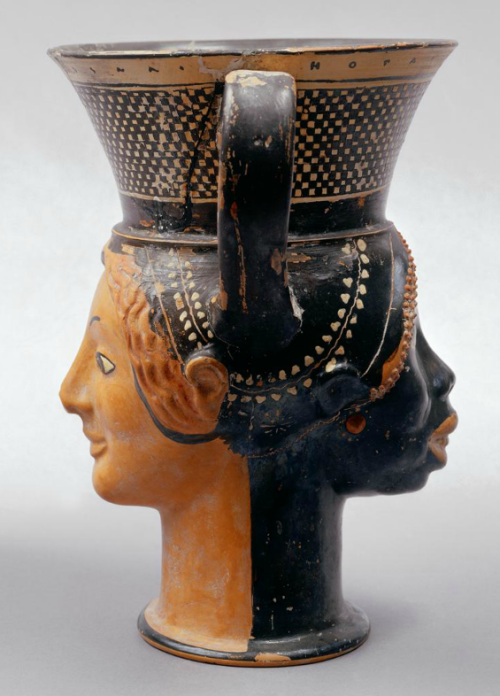
160701kantharosThe ancient Mediterranean world was multicultural, multi-ethnic, multilingual, and full of connections both within itself and to the larger world beyond. Like in my story, there were Egyptians in late classical Athens with their own Isis temple. A Sri Lankan king sent ambassadors to open diplomatic relations with Rome. And it wasn’t all a bunch of men, either. The queen of Halicarnassus was a military adviser to the Persian king. A wealthy woman of African ancestry was buried in style in late Roman York. The evidence is everywhere once you start to look for it.

The power of dead-white-guy-marble-statue history is strong and it needs to be challenged. I confront it in the classroom and my scholarly work, but we also need books like Hidden Youth out there to send the message: history is for everyone, not just people who look like me.

If you’ve already supported Hidden Youth, thank you so much. If you haven’t, please consider it. You can give as little as a dollar, and if you can’t do that, please spread the word.

On a less serious note, let me offer an added incentive to give: if Hidden Youth meets its funding goal, in honor of the collection’s theme I promise to translate and post my picks for The Top Five Greek and Latin Poems that Read Like Teenage Facebook Updates.

UPDATE: Hidden Youth got funded! Hooray! So, as promised, here you go: The Top Five Greek and Latin Poems that Read Like Teenage Facebook Updates.

Images: Bull leaping fresco (restored), photograph by Nikater, via Wikimedia (Knossos; 1550-1450 BCE; fresco). Janifrom kantharos, via People of Color in European Art History (Etruria, currently Villa Giulia; 6th c. BCE; ceramic)

Announcements from your hosts.

Paleolithic Siberian Unicorn

Besides being an awesome name for a band, paleolithic Siberian unicorn is an apt description of an animal otherwise known as Elasmotherium.

160630elasmotheriumElasmotherium was a prehistoric relative of the rhinoceros that ranged across central Asia and eastern Europe. It stood over 2 meters tall at the shoulder and its body was as long as 4.5 meters. Its distinguishing feature was an enormous horn on its face. The exact size and shape of the horn have never been determined, since no horn remains have been found, but the bony basis for the horn can be clearly seen on preserved skulls.

Elasmotherium was long thought to have gone extinct over 350,000 years ago, but recent work on a skull found in Kazakhstan has shown that the animal survived until at least 29,000 years ago. That puts living Elasmotheria in the middle of the upper (more recent) paleolithic (40,000-10,000 years ago). Humans certainly lived alongside them and may have depicted them in cave art.

Some have speculated that Elasmotheria survived even longer and may have been the inspiration for fantastical animals including unicorns, as described by eastern European legends, and the Chinese qilin. It’s impossible to verify such ideas, but they’re fun to think about.

Image: Elasmotherium via Wikimedia (c. 1920; painting; by Heinrich Harder)

Hey, look! We found a thing on the internet! We thought it was cool, and wanted to share it with you.

This Is Not the Food

When characters in fantasy fiction sit down to a meal, we have a pretty god idea of what to expect. If the setting is Europe-ish, you can count on hearty bowls of stew, roasted meats dripping with savory juices, ripe wheels of cheese, and maybe a little bread to dab up the sauce with. If the setting is Asia-ish, expect sizzling pans of vegetables and fish, skewers of meat steaming with spices both hot and sweet, and maybe a little rice to dab up the sauce with. (And I’m sure some of you out there who have read books I haven’t can tell us what food to expect in Africa-ish, Americas-ish, or other-ish settings.) The trouble with this picture of food is, historically speaking, it’s backwards. The sizzling meats, steaming vegetables, and spicy sauces are not the food. The bread, rice, and other grains are the food.

160627banquet Continue reading