Rating: Babylon 5, Season 1

Babylon 5 is something you either fondly remember or have forgotten ever existed. There isn’t much middle ground for this ambitious, expansive, flawed masterpiece of science fiction television. Here’s what we thought on our rewatch of season 1 (note that this does not include the pilot movie, “The Gathering”):

Babylon 5 season 1 DVD cover
  1. “Midnight on the Firing Line” – 5.5
  2. “Soul Hunter” – 4
  3. “Born to the Purple” – 4
  4. “Infection” – 3
  5. “Parliament of Dreams” – 8
  6. “Mind War” – 6
  7. “The War Prayer” – 2.5
  8. “And the Sky Full of Stars” – 4
  9. “Deathwalker” – 2
  10. “Believers” – 3
  11. “Survivors” – 4
  12. “By Any Means Necessary” – 7
  13. “Signs and Portents” – 6
  14. “TKO” – 2.5
  15. “Grail” – 5
  16. “Eyes” – 5
  17. “Legacies” – 6.5
  18. “A Voice in the Wilderness, part 1” – 4
  19. “A Voice in the Wilderness, part 2” – 3.5
  20. “Babylon Squared” – 5
  21. “The Quality of Mercy” – 5
  22. “Chrysalis” – 3.5

The average rating this season is a rather low 4.4. It’s a shaky start for a series that aimed to do so much, perhaps unavoidably so since the greater story Babylon 5 wanted to tell required so much background and worldbuilding. Some episodes this season end up falling flat because they were there not so much to tell an episode-long story as to fill us in on things we would need to know later. The idea of telling a connected arc story over dozens or hundreds of individual episodes was still new and largely untested in US media (apart from soap operas, which occupied a very different space in entertainment than B5 aspired to). Season 1 played it safe, probably by necessity, convincing both an uninitiated audience and a hesitant network to buy into the world of the show before striking out into such new territory. Three decades on and arcs are everywhere, even in series that don’t really need them. B5 may seem quaint now, like a Model-T car, but without it our modern television landscape might look very different.

Babylon 5 is a collection of contradictions. It is two parts Star Trek and one part Tolkien, with too much geeking out over the physics of space travel to be fantasy and too many ancient prophecies and mystical rebirths to be science fiction. It is the most Star Trek-like of all the shows that sold themselves as “not like Star Trek,” and the one that most strenuously insists on the difference. In some ways, it is timeless, telling a story that spans the lifetime of the universe and finding its narrative touchstones in everything from Arthurian legend to World War II. In other ways, it is unmistakably a product of the US in the nineties: a time when we believed competent military technocrats could solve everything, thought Russia was going to be our friend and Japan an alien menace, and bought collarless shirts and Zima.

But the contradiction that strikes us the most on rewatching is in the talents of the actors. Most of the main cast are adequate, if not inspiring. Guest roles are a mixed bag of lifeless line readings and overdone melodrama. There’s a lot of tedious under- and overacted scenes to get past if you want to watch Babylon 5 straight through. Yet amid these tepid talents are some blazing stars. Claudia Christian as the snarky second in command Ivanova owns every scene she’s in. Bill Mumy’s Lennier and Stephen Furst’s Vir, two junior diplomatic aides, are as endearingly awkward now as they were three decades ago and a delight to rewatch. But the most mesmerizing performances come from Peter Jurasik as the louche, cynical Centauri Ambassador Mollari and Andreas Katsulas as the canny, passionate Narn Ambassador G’Kar. Every scene with either one of them is elevated by their presence, and the scenes with both positively crackle with energy. Watching the two of them dance around one another like knife fighters, first as mortal enemies and later as fire-forged allies if not exactly friends, is as thrilling now as it was the first time around.

Babylon 5 is a parade of strengths and weaknesses, and it is in some sense to its credit that the two do not cancel each other out. Not surprisingly, the worst episode of the season falls under the weight of a lot of these weaknesses, and the best soars with the strengths. At the bottom of the heap we have “Deathwalker,” in which a war criminal from Narn’s past reappears offering the secret to eternal life. We rated it a 2. On rewatching, you can see that this episode helps set up the tensions between the galactic powers and the controlling hand of the Vorlons, but that comes at the expense of any meaningful development or resolution of the immediate conflict raised in the episode.

At the other end, the best episode of this season is “The Parliament of Dreams,” rating an 8. So much of what was great about B5 is on display in this episode. The main storyline, about a cultural exchange of religious traditions among the assembled ambassadors, gives depth and richness to the alien races while the secondary story, about an attempt on G’Kar’s life, gives the character some of his first opportunities for growth.

Do you have any special memories of the first season of Babylon 5? Let us know!

Image: Season 1 DVD cover of Babylon 5 via IMDb

In the Seen on Screen occasional feature, we discuss movies and television shows of interest.

Flexible Roman Glass?

Did an ancient Roman inventor come up with flexible glass? That’s one possible interpretation of a curious anecdote told by several Roman sources.

A Roman drinking glass

The evidence

There is no archaeological evidence for flexible Roman glass; nothing like it has turned up in any excavation. All the evidence we have is literary, three mentions from various sources. Here is what we have (my own translations):

In the reign of Tiberius, a kind of glass was invented that was concocted in such a way that it was flexible, but the entire workshop of its inventor was destroyed so that the price of bronze, silver, and gold would not be brought down (a rumor that has for a long time had more repetition than credibility).

Pliny, Natural History 36.66

There was once an artisan who made a glass drinking up that was unbreakable. When he was given an audience with the emperor to show off his invention, he made the emperor hand the cup back to him, then hurled it to the stone floor. The emperor could not have been more alarmed. The man picked the cup up off the ground, and it was dented just like a bronze cup, but he produced a small hammer from his pocket and with very little effort he made the cup good as new. With this performance, he thought he was in the throne of Jupiter.

The emperor then asked: “No one else knows how to make glass like this, do they?”

Now, look what happened. When the man answered “No,” the emperor ordered him beheaded, because if knowledge of this invention got out, we would treat gold like mud.

Petronius, Satyricon 51

[An engineer comes up with a novel way of renovating a collapsing building, for which the emperor Tiberius jealously exiles him.] Later this man came to the emperor as a supplicant and deliberately let a glass drinking cup fall to the floor in front of him, and although the cup was somehow damaged, after rubbing and beating it with his hands on the spot he showed the emperor that it was unbroken. He was aiming to get himself a pardon, but the emperor ordered him executed.

Cassius Dio, Roman History 57.21

Could it be true?

There are a few reasons to think these stories might be true, if not in all details then at least in the most interesting one: that some Roman crafter figured out how to make a material that looked like glass but didn’t shatter like it.

The fact that we have this story from three different sources gives it some credibility, especially since two of those sources, Pliny and Petronius, are roughly contemporary with the emperor Tiberius under whom the unbreakable glass was supposed to have been invented.

Flexible kinds of glass exist today, but they are recent developments. It is unlikely that a Roman glassmaker, even if they had stumbled on the right chemical formula, would have had a furnace capable of high enough temperatures with precise enough control to have achieved the same result. It is more possible to imagine that a Roman artisan came up with something like modern plastic. Early plastics developed in the 1800s used materials that would have been available to the Romans, such as cellulose from wood, the resin of the sweetgum tree, and proteins derived from milk, eggs, and blood. Some of the plastics derived from these materials are translucent and flexible, and might have appeared to onlookers unfamiliar with their source as flexible glass.

Despite these considerations, though, there are much stronger reasons to think that nothing like flexible glass was ever created in antiquity.

Probably not

First of all, we have to look at our sources critically. None of them is very good as evidence. Pliny straight out tells us that he doesn’t believe the story he is relating. Petronius puts the story into the mouth of a boorish and narcissistic fictional character, far from a reliable narrator. And Cassius Dio was writing about two centuries later and seems to have garbled this story with the tale of a later emperor, Hadrian, and his jealousy of a famous architect. Although it is interesting that we have versions of this story from three different sources, all that means is that, as Pliny notes, it was a tale widely told, not necessarily that there was any truth to it.

The fact that this story is connected with Tiberius also points to it being unreliable. Pliny, Petronius, and Cassius Dio were all part of the Roman elite, who generally disliked Tiberius. As the second emperor of Rome after the beloved Augustus, Tiberius had big sandals to fill and little of his predecessor’s charisma and social grace. The accounts of Tiberius as emperor that have come down to us describe him as tactless, cynical, cruel, and prone to paranoia. He also ruled Rome during a time of economic hardship, and his pragmatic concern for financial stability (including worrying about things like the prices of commodities and the steadiness of the gold and silver supply) came off as small-minded stinginess to the rest of the Roman upper crust. The idea of Tiberius responding to a wondrous new invention by destroying both it and the inventor appealed to existing prejudices about him, which helped the story spread. Romans like Pliny and Petronius already believed that Tiberius was cruel when he should have been magnanimous, tight-fisted when he should have been generous, and quick to apply violence to those who did not deserve it. The story of the wondrous glass cup not only made these qualities manifest, it served as a cautionary tale about the foolishness of such behavior. It was, in short, a good story, and good stories spread easily even when they aren’t true.

If there is any kind of truth behind the tale, it may be something less revolutionary. Glassmaking is a skilled art, and in antiquity it practitioners carefully guarded their secrets. To an uninitiated observer, the malleability of hot glass in a glass-blower’s workshop may have seemed quite wondrous, and the story may have spread from there without the crucial understanding that glass only flows so easily when it is fresh from the furnace. Additionally, around the time of Tiberius, new kinds of mold-blown glass were coming onto the Roman market that imitated the shapes of metal vessels. To the average Roman aristocrat shopping for luxury housewares, the idea that a material might exist combining the translucency of glass with the malleability of metal might not seem so far-fetched. If these ideas were already circulating in Roman literary circles, it is not strange to imagine that someone put them together with the existing negative perceptions of Tiberius and concocted a “What if” story that took on a life of its own as gossip and political mudslinging.

In the end, it is unlikely that any Roman artisan ever figured out how to make flexible glass. As interesting as the story is, it tells us more about the perception of Tiberius than it does about any fabulous ancient discoveries.

Further reading:

Champlin, Edward. “Tiberius the Wise.” Historia Bd. 57, H. 4 (2008): 408-425

Keller, Vera. “Storied Objects, Scientific Objects, and Renaissance Experiment: The Case of Malleable Glass.” Renaissance Quarterly 70, no. 2 (2017): 594-632.

Stern, E. Marianne. “Ancient Glass in a Philological Context.” Mnemosyne 4th ser. 60, f. 3 (2007): 341-406.

Image: Roman drinking glass (not flexible), photograph by Marie-Lan Nguyen via Wikimedia (Domvs Romana, Mdina, Malta; 1st c. BCE-2nd c. CE; glass)

History for Writers looks at how history can be a fiction writer’s most useful tool. From worldbuilding to dialogue, history helps you write.

They’re Good Dogs, Xenophon

The ancient Greek author Xenophon is best known for writing about the life of the philosopher Socrates and his own experiences in a company of mercenaries in the Persian Empire, but he also wrote a handbook on hunting, full of practical advice for youngsters taking up the sport. He devotes a fair amount of time to the proper care and handling of hunting dogs. Here’s his advice on keeping your dogs in good shape:

It is a good idea to take [dogs] into the mountains frequently, but not so much into farmed fields, for in the mountains they can hunt and track game unimpeded, but fields are not good for these exercises because of the paths. It’s good to take your dogs into rough ground even if they don’t find a hare, for this sort of terrain helps develop their feet and bodies. In summer, let them run out until noon, in winter throughout the day, any time apart from midday during the autumn, and in the evening in the spring, since this is when the temperatures are moderate.

Xenophon, On Hunting, 4.9-11

(My own translation)

Having grown up with a dog and having a number of friends who keep dogs, even if we never used them for hunting, I can’t argue with this advice.

Serving exactly what it sounds like, the Quotes feature excerpts other people’s thoughts.

How Wars Begin: The View from Ancient Greece

Explaining why wars begin is an urgent question for a lot of people: if we knew how they started, maybe we’d figure out how to stop them. It is also an important question for a lot of writers. Many works of fantasy literature are set in times of war, and even if the main characters don’t know or understand how it all started, in order to build the world around the story effectively, the author should have some idea of how and why it began.

Greek vase showing hoplites fighting

In European literature, interest in the causes of wars goes back as far as the literary tradition itself. The first major work of literature written down in the West, the Iliad, is about characters caught in the midst of a war whose origins are so remote as to be beyond human knowledge. Much of the tragedy of the Trojan War myths comes from seeing how people suffer because of the capricious rivalries of the gods. Many other stories of Greek mythology have to do with the causes of war, such as the legends of the “Seven Against Thebes,” which follows the tragic fortunes of Oedipus’ family as they suffer the consequences of his rash and misguided actions as a young man. Works grounded in mythology tend to place the causes of wars in the hands of individuals, whether human, divine, or in between. The mischievous spite of Eris caused the Trojan War, and Oedipus’ hotheadedness embroiled generations of his family in conflicts around Thebes. Many Greeks were happy to apply this same kind of mythical thinking to their own history: the playwright Aeschylus’ account of the Persian king Xerxes’ invasion of Greece in 480, The Persians, focuses on Xerxes’ personal arrogance and irresponsibility.

Early historians shifted their focus away from the personal to look at larger causes. Herodotus, attempting to explain the wars between the Persian Empire and some of the Greek cities, continued to make much of personal motivations, especially when it came to Xerxes. Herodotus expanded on Aeschylus’ portrait of the king, adding more nuance to the image of an overbearing, capricious monarch. At the same time, he was also interested in deeper forces. Herodotus was interested in the idea of balance and reciprocity, and ultimately saw the Persian invasion of Greece as balancing the cosmic scales for the legendary Greek invasion of Troy. He was also interested in how the choices of individuals interacted with and were shaped by the political structures in which they lived, pointing out that Xerxes’ arrogance had such devastating consequences because in a monarchy there was no one who could step in and prevent him from making rash decisions.

Herodotus’ younger contemporary Thucydides witnessed his home city of Athens go to war with Sparta with terrible consequences for both. He dismissed anything that smacked of myth and instead sought explanations in the hard realities of power. Athens, he argued, was becoming more powerful while Sparta was becoming weaker. It was these forces—the results of human actions, but in themselves impersonal and abstract—that led to the conflict, he argued: the Athenians fought out of a desire for more power and wealth, the Spartans out of the fear of losing what they had.

Some centuries later, the historian Polybius, writing at a time when Greece was a newly-conquered province of the Roman Empire, examined the causes of wars with more nuance, using Alexander the Great’s invasion of the Persian Empire as an example. Polybius distinguished three different elements: what he called the beginning, the cause, and the pretext. The beginning was the first event of a war; when Alexander crossed into Anatolia with his army, that was the beginning of the invasion. It is useful for historians to identify the beginning of a war, Polybius argued, but the actual cause must come first: what was it that led people to decide to take that first action? In Alexander’s case, it was a century of Greek experience on the fringe of the Persian Empire which showed that the Persian position in Anatolia was poorly organized and vulnerable to attack. The third element is the pretext, the statements that people put out in public to justify the actions they have already decided to take. In Alexander’s case, the pretext was revenge for the Persian invasion of Greece generations earlier; Alexander’s own actions later showed that his anti-Persian stance was never more than a front to keep his mostly Greek army unified.

How you approach explaining the origins of the wars in your stories depends on what kind of story you want to tell. If yours is an epic tale about the desires and passions of larger than life heroes, then let mythology guide you: have a war that starts because someone didn’t get invited to a party, or because someone got road rage and picked a fight with the wrong person. If your story is more grounded, but you still want some epic flavor, Herodotus may be a good model: let your war start because of the personal, human decisions made by your characters in the context of grand forces beyond their control. For a gritty, hard-edged story of war, follow Thucydides: people start wars because they think they can get something out of it, or because they’re afraid of losing what they have. In any case, remember Polybius: how people start fighting, why they decided that fighting was worth it, and what they said to justify it are three different things.

Image: Vase painting of hoplites fighting, photograph by Bibi Saint-Pol via Wikimedia (Staatliche Antikensammlung, Berlin; c. 560 BCE; painted pottery; by the Fallow Deer painter)

History for Writers looks at how history can be a fiction writer’s most useful tool. From worldbuilding to dialogue, history helps you write.

Placing Heaven in a Bowl

Bowl enameled in green and purple with intricate metalwork
Modern minakari bowl, photograph by Interesting009 via Wikimedia

This gorgeous bowl is an example of a style of enamel work known as minakari (also spelled meenakari or mina-kari), which literally means “to place heaven into an object.”

The style was developed in Persia under the Safavid kingdom in the sixteenth and seventeenth centuries CE. Artists of that time took enameling techniques from Europe and China and used them to create works whose intricate designs and vivid colors drew on the rich legacy of Persian and Islamic art.

Minakari works are still being produced today, especially in and around the city of Isfahan. “Placing heaven in an object” seems like a good enough description to me.

Out There is an occasional feature highlighting intriguing art, spaces, places, phenomena, flora, and fauna.

A Contradictory Coin

Two faces of an ancient Roman coin, one showing a bearded man wearing a radiate crown, the other showing a young men wearing a wreath.


Palmyrene Antoninianus, photograph by Classical Numismatic Group via Wikimedia (270-272 CE; bronze and silver)

What’s so contradictory about this coin? Well, there’s a story behind it.

In the third century CE, the Roman Empire wasn’t doing well at all. Between 235 and 284, the empire suffered civil war and political chaos as numerous general claimed the imperial title with the backing of their troops, only to be assassinated and replaced with another general. At the same time there was an economic collapse and an outbreak of deadly disease that depopulated the great cities of the Mediterranean.

In this fifty years of crisis, the emperors were mostly concerned with securing their own power and fighting off rivals. People looked to more local powers to handle the ordinary business of governance. With such chaos and weakness at the top, some of these local powers began to operate as effectively independent states.

One such state was the empire of Palmyra. Palmyra was a city in the eastern Mediterranean, in what is today Syria. It had long been an important stop on caravan routes that connected the Mediterranean with Mesopotamia and India beyond. The Palmyrene noble Odaenathus helped to support the Roman position in the region during a flare-up of conflicts with the Parthian Empire to the east. With weakness at the top of the empire, Odaenathus began to rule Palmyra with more and more independence over the course of the 260s. After his death in 267, his wife Zenobia, ruling on behalf of their young son Vaballathus, began an ambitious campaign of conquest that made Palmyra the ruling city of a de facto empire covering much of the Roman East.

While effectively operating as an independent power, Palmyra maintained a show of loyalty to the Roman Emperor at the time, Aurelian. In the early 270s, Zenobia issued coins like this one, bearing the image of Aurelian on one side and Vaballathus on the other. The text of the coin names Aurelian as emperor and calls Vaballathus only a general of the Romans. Since coins could circulate more widely than most other works of public art, these coins represented one of Zenobia’s best efforts to convey the message to Aurelian that she and her son were still loyal.

But the very existence of these coins belies the message they send. The minting of coins was an imperial prerogative, one closely tied to the power of the emperor himself. Rome allowed some of the cities under its rule to mint their own low-value bronze coinage for local trade, essentially small change to make it easier for people to do their day-today business in the market. Palmyra evidently had the right to mint such coins, although surviving evidence suggests that the Palmyrenes had never exercised that right on any large scale.

This coin is different. It is the type of coin known to scholars today as an “Antoninianus.” (We don’t know what, if anything, ancient people called them.) An Antoninianus was a high-value coin typically made of a combination of bronze and silver. Its face value was equivalent to several days’ pay for a legionary (although extreme inflation in the third century seriously eroded the coins’ actual value), and they were largely minted by the emperors to pay the troops who had put them into power. Coins of such value had a strong historical connection to the recruitment and pay of armies.

By minting coins of this type, Zenobia effectively declared her intention to lead armies independently of the Roman emperors. No matter what image she put on the coins, the very act of minting them was tantamount to announcing a rebellion.

Aurelian was not fooled by the display of loyalty. In 272 he attacked Palmyra, captured Zenobia, and reconquered the territory she had claimed. After another outbreak of rebellion in Palmyra the next year, Aurelian captured the city and destroyed it.

An object as seemingly simple as a coin can have complicated and even contradictory intentions behind it.

History for Writers looks at how history can be a fiction writer’s most useful tool. From worldbuilding to dialogue, history helps you write.

Worldbuilding for Democracy

Whether playing a game of thrones or awaiting the return of the king, fantasy literature tends to have a lot of monarchies. This is true in part because the genre grew out of literary traditions created to justify the power of kings and aristocrats and in part because royal families lend themselves so well to drama (it seems to be the only job the British royals have left, for one example).

It doesn’t have to be that way, though. There’s plenty of room for fantasy to explore societies without kings or thrones. Many cultures in the past have had alternatives to monarchy. Most famous may be the democracies of ancient Greece, but other ways of sharing power out among multiple individuals, families, or factions can be found around the world, in places like the early city-states of Sumer, the medieval cantons of Switzerland, and the Haudenosaunee (Iroquois) Confederacy in North America. Not all of these societies operated in ways we would recognize as fully democratic today (for instance, Greek democracy excluded women, immigrants, and slaves), but they all represent functional alternatives to a monarchy or entrenched aristocracy.

These forms of governance came about as the result of particular social, historical, and geographic circumstances. If you want to build a democratic society (even in such a loose sense) into your fantasy worldbuilding, here are a few approaches to consider.

Friends don’t let friends start monarchies

Small-scale societies are usually egalitarian and tend to resist individual claims to power. In societies small enough that people all know each other or are bound together by ties of family and friendship, personal relationships matter more than formal structures of power. One person trying to put themselves above others in such a culture is a threat to the stability of those relationships and can expect little support. With the rest of society so closely bound together by ties of kinship and affection, resistance is easy to organize. Monarchies only work in societies large enough that most people are strangers to one another.

Poor lands make poor kings

One of the defining features of monarchy is that it consolidates wealth in one or a few people’s hands. This isn’t just a perk of the job (although, as Mel Brooks said, it’s good to be the king), it’s necessary for keeping a monarch in power. Kings justify their power in many ways, sometimes by providing the benefits of stability and order to the people they rule over, sometimes by cloaking themselves in religious ideology, but at the base of it all is a threat: do what I say or my soldiers will come burn your house and take your stuff. That threat only works if the soldiers will actually back it up, and while a good king may earn the personal loyalty of his troops, you can’t eat loyalty. An army big enough to keep a monarchy in power will fall apart if it doesn’t get paid, and maybe even turn on the monarch themselves. A monarchy can only sustain itself in a place where it can command enough economic resources to be sure of being able to pay its army in a crisis. In regions that don’t have that kind of wealth, or whose wealth is difficult for any one faction or family to control, monarchies tend not to last long.

The divided are hard to conquer

“Divide and conquer” is all well and good, but when the landscape itself divides people, it is hard for even a conqueror to maintain control. Fragmented landscapes that limit the movement of troops and supplies make it hard for would-be rulers to assert control. They also tend to foster a strong sense of local identity that limits a monarch’s ability to command the people’s loyalty. Many different kinds of landscape can have this quality, such as those divided into many small islands or mountain valleys, or lands broken up by marshes and forests. Wherever people are used to being isolated and having to rely on themselves and their neighbors, they tend to create societies that distribute power rather than relying on a distant and unfamiliar king.

We are struggling together

The points above have a common thread: the smaller a society is, the more likely it is to be democratic. The bigger a society gets, the weaker the forces keeping it egalitarian and the more likely that someone will succeed in establishing a durable monarchy. Large-scale democracies tend to arise from a particular historical experience: when lots of small societies find themselves having to work together. When several tribes, clans, islands, or cities of comparable wealth and power have to coordinate their efforts, such as to resist pressure from an invading empire or to control valuable natural resources, compromises have to be made. A single leader is unlikely to get everyone on board without making concessions to ensure the sharing of power and resources. These arrangements can take many forms, such as governance through a council representing all members or rules of succession that guarantee no single family line has a lock on power.

Many different forces can be at work at once in any given culture. Small mountain villages that are egalitarian because of their small size and poverty may band together in a democratic league to coordinate their response to pressure from a nearby kingdom in the lowlands. Once that league is well established, it might expand to take in some of that kingdom’s outlying cities, even pull together an army to conquer the flatlands for itself while still preserving its democratic basis. What happens to such a democracy when it comes to rule over people accustomed to the claims of monarchy? How do people used to being ruled by kings adapt to being part of a league where they have a voice of their own? There are lots of good stories to explore in fantasy that don’t revolve around kings and crowns.

History for Writers looks at how history can be a fiction writer’s most useful tool. From worldbuilding to dialogue, history helps you write.

Quotes: I Wouldn’t Want to Suddenly Make a Fool of Myself

How nice that you feel so sure of my affections.

I wouldn’t want to suddenly make a fool of myself

Go ahead, chase that cheap, wool-spinning

whore rather than Servius’ daughter Sulpicia.

I have people who care about me, and their greatest worry

is that I might fall into bed with some worthless nobody.

– Sulpicia, Poems 4

(My own translation)

Sulpicia is among the few female writers whose work has come down to us from antiquity. She was a Roman poet writing in the late first century BCE. Her surviving poems chart a tempestuous love affair with one Cerinthus. Like the lovers described in poetry by her male contemporaries, we cannot be sure whether Cerinthus was a real person or just a literary invention.

Sulpicia’s poetry relates in interesting ways to the major philosophical movement among Romans of her time: Stoicism. Stoicism was an originally Greek school of thought that emphasized emotional steadiness through the ups and downs of life. This idea appealed to Romans, who traditionally valued discipline and dispassionate self-control. Many Romans among the elite espoused versions of Stoic philosophy as a guiding principle.

Controlling one’s emotions first requires observing and understanding them. This is where Sulpicia’s poetry fits in. Her poems are like little gems of precisely observed emotion. This one captures the cold, controlled anger that comes of holding in a rage that is about to explode. Another poem expresses the exasperation of a young person at well-meaning but clueless relatives.

While other Romans were exploring Stoicism as a philosophical idea, Sulpicia was turning it into art.

Serving exactly what it sounds like, the Quotes feature excerpts other people’s thoughts.

Even Heroes Take Time Off

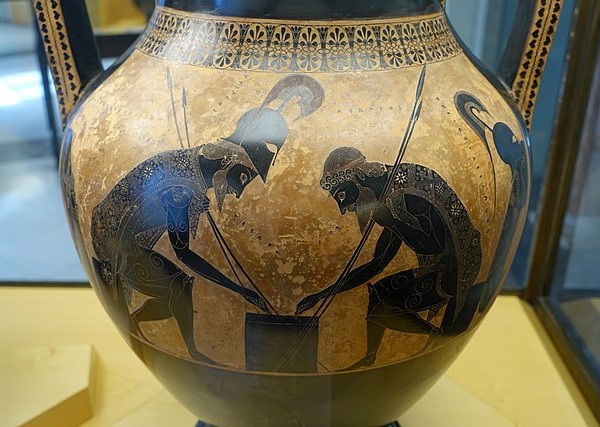
Heroes don’t spend all their time being heroic. They need time off, too. That was the idea behind this beautiful vase by the ancient Athenian painter Exekias.

On one side, we see Achilles and Ajax, two of the great Greek warriors of the Trojan War, putting aside most of their armor for a while and playing a board game. Achilles is winning, as Exekias lets us know because he has given us the score: beneath Achilles’ head is the word “four,” beneath Ajax’s, “three.” According to literary tradition, Achilles’ tent was at one end of the Greek line, Ajax’s at the other, so this was not just a casual pick-up game; one or the other of the heroes must have crossed the entire Greek camp so they could play.

Amphora, Achilles and Ajax playing a game, photograph by Daderot via Wikimedia (Athens, currently Vatican Museums; c. 540-530 BCE; black-figure pottery; by Exekias)

On the other side of the vase, the twin heroes Castor and Pollux return home. They are welcomed by their parents, Tyndareus and Leda. On the left, Pollux leans down to greet a dog who jumps up, excited to see him.

Amphora, Castor and Pollux return home, photograph by M. Tiveros via Classical Art Research Centre (Athens, currently Vatican Museums; c. 540-530 BCE; black-figure pottery; by Exekias)

Exekias was an innovative artist. He was one of the first vase painters to show mythic heroes not in the midst of action but at ease, among the familiar surroundings of everyday life.

If you’ve been feeling the weight of the past year, take some inspiration from heroes: play a game, say hello to family, play with a pet. If it’s good enough for Achilles, Ajax, Castor and Pollux, it’s good enough for you, too.

Out There is an occasional feature highlighting intriguing art, spaces, places, phenomena, flora, and fauna.

Medieval Huntresses

Here are some ladies enjoying a good stag hunt, from an illumination in a copy of “The Letter of Othea to Hector” by Christine de Pizan. The image represents the mythical huntresses of the goddess Diana, as imagined by a medieval artist. We see one lady driving game by beating the bushes and another taking aim with her bow while two more blow the hunting horn and manage the dogs.

Hunting scene from the “Letter of Othea to Hector” via Wikimedia (Bibliothèque nationale de France, Paris; 1407-1409; paint on parchment; by the Master of the Letter of Othea)

Out There is an occasional feature highlighting intriguing art, spaces, places, phenomena, flora, and fauna.