Gold and Silver in Fantasy Coinage

Are your fantasy characters in the market for a loaf of bread? A new suit of armor? A mercenary army? Then it’s time to think about how people in your world buy and sell things. Of course, the beauty of fantasy is that you can do anything. Do you want to write a world where the common currency is bolts of silk and songs of youth? Go for it! But if you want your world to be more grounded in the familiar, coins stamped out of gold and silver are both historically accurate and staples of the genre.

Gold and silver are both relatively soft metals that were easy to work using pre-modern technology. They are unreactive and resistant to corrosion, so coins will not lose weight over time and use. They are also metals that are rare and highly valued for creating objects of beauty and prestige, which gives coins struck from these metals intrinsic value not dependent on confidence in the state that issued them, unlike modern paper money. Gold and sliver coins were worth something no matter where you carried them, even if just to be melted down as bullion.

In the modern economy, with prices driven by industrial demand and market speculation, the relative values of gold and silver can vary widely. In pre-modern times, the values of these metals was more stable, shaped by the productivity of mining and refining on one hand and cultural demand on the other. Geological research has found that silver and gold ores occur naturally at a ratio of about 19 to 1, which is to say that for every 19 grams of silver in the earth waiting to be dug up, there is about 1 gram of gold. Ancient mining techniques were of limited efficiency, however, and it is likely that the ratio of metals actually put into use was closer to 10 to 1. Where we are able to compare the historical values of gold and silver coins in use by the same culture, we tend to find them falling within these brackets: one gold coin was typically worth 10 to 20 times its weight in silver coins. Bear in mind also that gold has about twice the density of silver, so a gold coin will weigh about double what a silver coin of the same size weighs. When gold and silver coins are struck at the same size, that means that we would expect one gold coin to have a value of anywhere from 20 to 40 silver coins.

Assigning an actual value to an individual coin is a trickier proposition. Pre-industrial economies are hard to compare directly with the modern world. Some things are much cheaper in real terms for us today than for our ancestors, like clothes and books; others are much more expensive, like labor. We rarely have good, comprehensive evidence for what a given amount of money could buy in any historical context (and when we do, it is often hard to tell whether the values and prices quoted are realistic or an expression of what someone in authority thought things ought to be worth).

In many cases, our best way of estimating the worth of a coin is to put it in terms of daily wages for a soldier. Military pay was a pressing matter of state finance that was important to get right—you definitely don’t want to forget to pay the people hanging around your castle with swords. That leaves us with reasonably good evidence for soldiers’ pay in many historical contexts (of course, not all soldiers are paid in money).

Gold coins are classic standbys for fantasy currency, but historically gold was too valuable for everyday use. The value of any specific coin depended on its weight, with heavier coins naturally worth more, but even a small gold coin was typically worth a great deal. Examples like the Persian daric or the Roman aureus had a value of approximately a month’s wages for a soldier or a skilled crafter. Most people in their daily lives would never even have seen a gold coin, let alone had occasion to spend one.

Silver was the standard metal for coinage in most places and times. Silver, like gold, could be minted at whatever weight the issuing state wanted, from large, high-value coins to tiny small change. Often, however, the basic silver coin in circulation, like an Athenian drachma or an early Islamic dirham, amounted to about a soldier’s daily wage.

The difference in value between gold and silver helps explain why gold coinage was rarely debased (issued at lower purity by mixing precious and base metals or applying a precious coating over a base metal core), but silver sometimes was. Gold coins were used for major state expenses and usually only came into the hands of people who could cause real trouble if they felt stiffed; silver was used for routine purchases and changed hands among people with limited recourse except to treat their debased coins as being worth less than face value.

Now, if you remember your classic Dungeons and Dragons coin charts, you may be wondering “What about platinum, electrum, and copper?” All of those metals do appear in pre-modern coinage, but they all have their limitations.

Platinum is extremely rare and hard to work by pre-industrial means. At least in the eastern hemisphere, it was not identified as a distinct metal until the 1500s. There is some evidence that metalworkers in pre-Columbian South America created alloys of platinum and gold, but the process is poorly understood, and they weren’t making coins with it. Traces of platinum are found in some ancient and medieval gold coins, but only as impurities not refined out of the metal. Moneyers in any pre-industrial world are unlikely to have the technology to deliberately produce platinum coins, and even if they did, the expensive and labor-intensive process would make it impractical.

Electrum is an alloy of gold and silver, either naturally occurring or produced by smelting. Some early coins were minted out of electrum, but a problem arose: because the ratio of gold to silver in a particular batch of electrum coins could vary, it was hard to be confident of its real value. Too much silver in the mix, and people might be reluctant to accept a coin at its stated value; too much gold, and it would be more profitable to melt coins down for their bullion value than to spend them. Most monetary systems moved away from electrum to pure gold and silver for the sake of stability.

Copper, usually in alloyed form like bronze or brass, was used for low-value coinage in many places. These coins could be useful for paying wages to ordinary workers or buying everyday goods like a mug of ale or a loaf of bread. Since copper is a much more common metal than silver or gold, its intrinsic worth was much less by weight. As a result, for copper alloy coins to have enough worth to be useful, they had to either be made much larger and heavier than contemporary silver and gold coins or else be issued at a face value significantly higher than their worth as raw metal. Most states that issued copper alloy coinage chose the latter route, making their copper coinage essentially a token whose value was guaranteed by the state’s promise to accept it at the issued value for taxes and fees rather than its metal content. For this reason, copper alloy coinage rarely circulated beyond the reach of the state that originally issued it, while gold and silver were useful as international means of exchange.

As always, you have the flexibility in building your own worlds to make the money work however you want, but for historical verisimilitude you can’t beat gold and silver for your coinage.

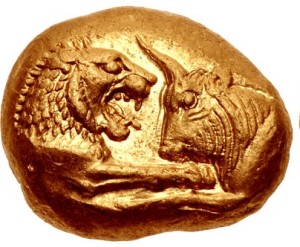
Image: Lydian gold Croessid, obverse, photograph by Classical Numismatics Group via Wikimedia (minted Sardis; 564-539 BCE; gold)

History for Writers looks at how history can be a fiction writer’s most useful tool. From worldbuilding to dialogue, history helps you write.

The Obligatory Male Protagonist

Tv shows or movies with an ensemble cast will nearly always have a man as de facto main character. (Studios, networks, and advertisers have apparently not yet caught on to the fact that people who aren’t 18-35-year-old white men also watch tv and go to the movies.) These obligatory protagonists come in a few different varieties. Here’s a spotter’s guide for some of the major types (mind you, more than a few characters cross the lines from one category to another).

Captain Competence

James Kirk from Star Trek via IMDb; Gil Grissom from CSI via CSI Fandom; Gregory House from House via IMDb

He’s better than everyone at everything. He always has the right answer. While other characters may have their particular areas of expertise, he’s always the one to solve the real problem. To be frank, the only reason there are other people on the show is so that he has someone to be better than.

The Fixer-Upper

Nate Ford from Leverage via IMDb; Mal from Firefly via IMDb; Jeff Winger from Community via IMDb

He’s a damaged, bitter, broken man, but that doesn’t stop him from being the center of attention. Expect the women in the cast to do a lot of emotional work for him, such as holding his hand while he cries, calming him down when he lashes out, and making excuses for him to the people he hurts. He may pull himself together over time. Then again, he may not.

The Overgrown Child

Phil Dunfy from Modern Family via IMDb; Castle from Castle via IMDb; Jake Peralta from Brooklyn 99 via IMDb

This guy just never grew up. He lives his adult life with the blissful joy of a child, which would be fine except that it also means he never takes responsibility for anything, is clueless about how his actions affect the people around him, and gets pouty and petty when things don’t go his way. The women in his life usually fall into the role of surrogate mother, saying “no” to his worst ideas and cleaning up his messes when he does them anyway.

The Plot-Jacker

Peter Quill (and Gamora) from Guardians of the Galaxy via IMDb; Emmet (and Wild Style) from The Lego Movie via IMDb; Owen (and Claire) from Jurassic World via IMDb

(Also known as the “Chris Pratt Special.”) There’s a female character in the cast who not only has the knowledge, skills, and background to be the hero of the story, but also has a good reason to take on the mission or challenge the big bad. Then this guy wanders in out of nowhere and takes over, doing better by sheer guts and grit than she did with all her knowledge and skill. Expect her to fall into his arms at the end.

If you spot any of these types in the wild, you know what to expect.

In Character is an occasional feature looking at some of our favorite characters from written works and media to see what drives them, what makes them work, and what makes us love them so much.

Quotes: No Call for Nastiness

The Roman orator Quintilian has a thing or two to say about making jokes at the expense of groups of people:

I have already noted, when talking of jokes, how unworthy it is to go after someone’s circumstances in life, and there is no call for nastiness against classes, ethnicities, or nations, either.

Quintilian, The Institute of Oratory 11.1.86

(My own translation)

Now, Quintilian is specifically speaking here about how to comport oneself as an advocate in court, and he goes on to say that if your opponent comes from a group whose moral qualities might seem dubious to a Roman jury, like soldiers or tax farmers, it may sometimes be appropriate to make a joke at their expense. His advice is tactical, not moral: this is how you sway a jury and win your case. Still, it’s good advice in general that “just joking” about people’s ethnicities, origins, or life circumstances is not a great way to get people on your side, in ancient Rome or today.

Serving exactly what it sounds like, the Quotes feature excerpts other people’s thoughts.

The Unspoken Messages of an Unswept Floor

This floor mosaic comes from the dining room of a Roman house. The central parts of the floor have been lost, but the edges of the room were decorated to look like the untidy remains of a banquet. We can identify leaves, fish and poultry bones, nut shells, bits of fruit, and the shells of a wide variety of shellfish. This may seem like an odd choice for home decoration, but mosaics in this style were popular in well-to-do Greek and Roman households. To contemporary guests, mosaics like this sent a number of messages about the people who dined on them.

On one level, this mosaic simply reflected the reality of the room it was in. Diners at an ancient banquet could toss their refuse on the floor with abandon because they were not the ones who had to clean it up. The widespread use of enslaved labor for domestic service meant that the rich could lob greasy chicken bones and half-eaten olives around the place without caring about the time and effort involved in cleaning up afterward. In that sense, this mosaic identified the owners of this house as the sorts of people who had other people to do the cleaning up after them.

On the other hand, the evident abandon with which the detritus is strewn around the room is deceptive. The individual pieces are precisely placed so that there the space between them is relatively even. Larger items are spread out with smaller ones between them. They are positioned in loose diagonal lines with a subtle aesthetic regularity; similar objects repeat to help unify the image, but are spaced out and given different orientations to avoid any sense of pattern. This mosaic is an extremely fine one made of very small tesserae in many different shades that must have taken a substantial amount of work by a skilled mosaic artist and a team of workers. The details of this Roman mosaic also imitate a famous Greek predecessor created by the mosaic artist Sosos of Pergamum. The effect was meant to project wealth and power: only the very rich could afford to put so much care into looking so careless.

The choice of food to show in this mosaic is also significant. Meat had a religious, even moral, significance in Greek and Roman culture. Large land animals like cattle, sheep, and pigs were typically eaten as part of a communal religious sacrifice, and religious custom dictated how they could be cooked and served as well as who should partake in the feast. Fish, shellfish, and poultry were not constrained by similar rules and could be eaten when, how, and in any company one liked. As such, this sort of food was associated with indulgence, even decadence. To say that a fellow Greek or Roman dined on fish had a sting of moral judgment akin to declaring that someone today enjoys champagne and caviar. The variety of fish bones, chicken claws, and shells in this mosaic makes a statement that this room is not one for solemn sacrificial meals but a place where the diners can indulge in their favorite delicacies free of any religious scruples or moral condemnation.

A great deal of meaning is packed into a mosaic of an untidy floor. These were messages that the original guests in this dining room would have implicitly understood in same way that we today grasp the status-signaling meaning of a four-car garage or a water view.

Image: Detail of unswept floor mosaic, photograph by Yann Forget via Wikimedia (currently Gregorian Profano Museum, Vatican; early 2nd c. CE; glass tessera mosaic; by Heraclitus, copied from work by Sosos of Pergamum)

History for Writers looks at how history can be a fiction writer’s most useful tool. From worldbuilding to dialogue, history helps you write.

DM-ing Past an Impasse

One of the difficult situations you can find yourself in when acting as Dungeon Master / Game Master for a tabletop role-playing game is when your players find themselves stuck. An adventure is about forward movement, whether it’s fighting the next band of goblins so you can take their loot, discovering the secret door that leads into the hidden underground facility, or navigating through the asteroid field to get to safety. When your players feel like their characters aren’t making progress, that can sap the fun out of your game. What can you do as a DM to help your players get past an impasse?

Sometimes, you don’t have to do anything. Remember that your players are not the same as the characters they play. Being on an adventure is often not a lot of fun for the characters as they face danger, uncertainty, and the possibility of death. Sometimes even though the characters may be stuck, the players are still having a good time. They may be relishing the chance to role-play how their characters deal with failure or enjoy the prompt to think outside the box and come up with wacky new schemes so crazy they just might work. Some players want a game that plays strictly by the rules, even if that means they “lose.” When the characters run into trouble, watch how your players react. If they’re still having fun, you can just let them keep at it, but if the characters’ frustration leads to your players being frustrated, then it is time for you to step in as DM. In that case, here are some things to think about.

Break the DM Wall

As DMs, we have a barrier between us and the players, not just the physical barrier of the DM screen (for those who use them), but the distance between ourselves, who know all the secrets of the adventure, and the players, who do not. When your players are feeling stuck, it can help to open that barrier a little.

Suppose your players’ characters are trying to get into a castle to stop the evil duke from doing an evil ritual with an ancient artifact of evil. They try to get through the front gate and are stopped by the guards. They decide there are too many guards to fight, so they try to bluff their way in. The bluffing doesn’t work, but the players are committed this plan and keep trying to argue and make rolls to get through the gate.

Try saying something like: “I’m stepping in as DM to let you know that the guard just isn’t going to budge, no matter what you say or how well you roll. You’ll have to find another way in.” Giving the players this out-of-game information can help in several ways. It lets the players know that they weren’t on the right track so they can focus their energies on something else. It reassures the players that you are playing fair with them—they didn’t do something wrong, this approach was just never viable, and there is a way forward if they can figure it out. It also helps everyone take a step back from the characters’ frustrations to refocus on the fun of the game.

If your players like to actively role-play their characters and speak for them, it can help to shift perspective and speak about them instead. If you can get your players from “I’ve tried everything I can think of, but this guard captain is just stonewalling” to “Whiteleaf the bard is feeling frustrated and at a loss because her skills aren’t helping her group accomplish their mission,” that can help your players reframe their problem and work toward a solution.

No, but

You may have heard of the rule that in improv you always want to say “Yes, and.” “Yes, and” means you accept whatever ideas someone else brought to the scene and add your own contribution to develop it further. DM-ing is a kind of improv, but an adventure is also constrained by rules, rolls, and the story you have built for your players to explore. Sometimes the best thing to do is just throw out the other stuff and go with your players’ ideas, but if you always ignore the rules and the story, then you leave your players without a structure to work within. So there’s a corollary to the “Yes, and” rule: the “No, but” rule.

“No, but” means that when you say no to something your players want to do, you nudge them toward an alternative. This could be anything from a subtle hint on how to sway the current encounter successfully to a neon arrow pointing at the next plot point.

In the example above, you could “No, but” as you play the castle guard with a grouchy reply: “Look, His Grace said no one gets into the castle but Merchant Severan’s crew with the monthly wine shipment. I don’t see any wine barrels, so you’re not getting in here.” Alternatively, you could step out of character and say: “As you continue to argue with the guard, you notice that the northern wall of the castle overhangs a sheer cliff; there are no guards there, for obvious reasons.” These options give your players a hook for a way forward without interrupting the scene.

It’s up to your players to pick up on the “No, but” and figure out how they want to take advantage of it, but it allows you to steer them out of a dead end and back into the adventure without breaking the immersion of the game.

Change something

If your players just keep trying something that won’t work, you have the option as DM to change the rules and make it work. If necessary, you can always just say: “Okay, ignore that last roll. You succeeded. Move on,” but it’s better if you can fit the change into the story. If the situation the players’ characters find themselves in is a deadlock, you’ll want to either add something or take something away to break the stalemate.

Adding something may mean a new character comes on the scene, an event occurs to disrupt the current stalemate, or the characters get new information that gives them a way forward. For instance, perhaps the evil duke himself comes out to see what the fuss is and decides to invite the characters in so he has someone to gloat at as he does his evil thing. Perhaps a band of marauders swarms out of the nearby woods, giving the castle guards something more important to focus on and letting the characters take advantage of the chaos.

Instead of adding something, you might take away one of the things causing the impasse. Perhaps the guard captain gets frustrated and walks away to let her subordinate handle the characters, and that subordinate turns out to be much more gullible or a secret ally to the party. Perhaps several of the guards get called away to handle another problem elsewhere in the castle leaving a smaller number that the player characters can take in a fight.

In the end, remember that a role-playing game is a collaboration between players and DM. The most important thing is that everyone, including you, gets to have a good experience. Sometimes your players are going to get themselves into places where they aren’t having fun, but as a DM you have options for helping them get out.

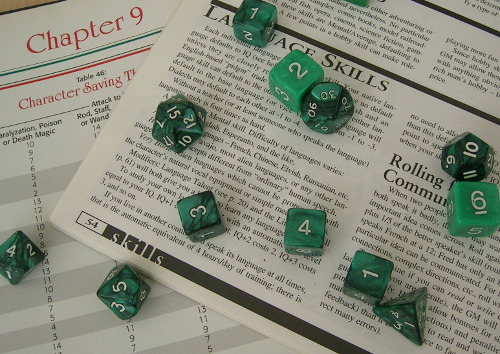
Image by Erik Jensen

Of Dice and Dragons is an occasional feature about games and gaming.

Hipposandals

This strange-looking contraption is a Roman hipposandal, a forerunner of the horseshoe (from the Greek word “hippos,” meaning horse). It could be applied to a horse’s hoof, with the side pieces bent around to hold it in place or tied on with leather straps. Hipposandals like this one were known in the ancient Mediterranean (examples have been found in Greece and Italy), but archaeological evidence for them is concentrated in Roman contexts in northwestern Europe.

The function of hipposandals has been debated. They were not practical for long-term wear and were designed to be temporary and removable. One use may have been to protect injured hooves from further deterioration while healing. Some versions were also made with spikes on the bottom that could have given a horse extra traction while walking on loose or icy ground. Either use might explain why they appear to have been more common in the colder, wetter parts of the Roman world. In places like Britain and the Gaulish Alps, horses were exposed to soft, wet ground in summer and frozen roads in winter, which took a greater toll on their hooves than the hard, dry ground more typical in the Mediterranean.

One reason we are so uncertain about how exactly hipposandals were used is because no ancient source talks about them in any detail. Hipposandals are one little piece of material culture that would have been part of the everyday experience of people in the past, so mundane and unremarkable that nobody thought it was worth writing down just what they were for or how they were used. This is one more example of the paradox familiar to historians: the more typical and ordinary a thing was for people in the past, the more mysterious it is likely to be to us.

Image: Roman hipposandal, photograph by G. Garitan via Wikimdia (currently Musée de Saint-Remi; Roman period; iron)

History for Writers looks at how history can be a fiction writer’s most useful tool. From worldbuilding to dialogue, history helps you write.

Herodotus and the Upside-Down World of Egypt

The ancient Greek traveler and historian Herodotus was impressed by many of the things he saw in his visit to Egypt. He wrote about ancient monuments like the pyramids (already thousands of years old by the time he saw them), great temples, and the works of kings. But he was equally interested in the habits and daily life of the people around him. He noted a number of things in the daily life of Egyptians that struck him as unusual.

Just as the Egyptians have a unique climate, and the nature of their river is unlike any other, they have established customs and norms that are different from any other people. Among them, the women haggle in the market while the men stay home weaving. While other peoples weave by pushing the weft up, the Egyptians push it down. Men always carry burdens on their heads, women on their shoulders. Women pee standing up, men sitting down. They relieve themselves in their homes but eat outside in the street, saying that what is embarrassing but necessary should be hidden away, but what is not shameful may be done in the open. No woman serves as priest either for a male or a female deity; men serve each and every god. No son is obliged to care for his parents if he does not wish to, but daughters must whether they wish to or not.

Herodotus, Histories 2.35

(My own translation)

Herodotus’ perspective on Egypt was shaped by his background as a Greek. These details he lists are things that were the reverse of typical Greek habits: in Greece, men usually went out to the market while many women stayed in the home doing textile work. Greeks customarily ate their meals inside their homes but went outside to relieve themselves. In the Greek world, women served as priests of female gods while men served as priests of male gods.

Two factors are at work in Herodotus’ perception of the Egyptians, factors familiar to anyone who has spent time in a foreign culture. In the first place, we tend to notice things that are different more than things that are the same. When you visit a new place, you tend to notice that people speak differently than you are used to or eat foods you haven’t tried before, not all the little things that are just like at home. Secondly, when we notice these differences, they tend to blow up to exaggerated proportions in our minds. We may come home from a vacation thinking “Wow, everybody there likes to sing a lot,” when the reality was that it was one or two people who busted out a song at a time you just weren’t expecting it.

Some of Herodotus’ observations actually do align with our evidence for ancient Egyptian culture in the period when he visited. For example, it seems it was not unusual for Egyptian women to do business outside the home or for men to work as weavers. Some are simply false: at least some Egyptian women did serve as priestesses. Others are harder to pin down—no one has yet come up with evidence for Egyptian women habitually standing up at the toilet, but it’s not the sort of thing we have much documentation for at all.

Herodotus was a sharp-eyed observer of culture, but even so he wrote from a partial and biased perspective, not just as a foreign visitor trying to make sense of an unfamiliar world, but as an educated Greek who knew something about history and literature. Greeks had a long tradition of writing about Egypt as an alien world, a kind of magical Neverland where nothing was as it was in Greece. We credit Herodotus with inventing the genre of history in the Western tradition, but he saw himself as following in the footsteps of epic poets like Homer. In the details he provides about his time in Egypt, we see how he both tried to ground his account in the facts he observed and also fill out an existing Greek picture of Egypt as an upside-down world where everything was different.

History for Writers is a weekly feature which looks at how history can be a fiction writer’s most useful tool. From worldbuilding to dialogue, history helps you write.

History for Writers: 2021 Compendium

History for Writers explores history to offer ideas and observations of interest to those of us who are in the business of inventing new worlds, cultures, and histories of our own. Here’s what we’ve been talking about in 2021:

Worldbuilding exercises

Organizing society

Thinking about history and justice

The details that make a different world

Join us in 2021 for more history from a SFF writer’s perspective.

History for Writers is a weekly feature which looks at how history can be a fiction writer’s most useful tool. From worldbuilding to dialogue, history helps you write.

Socks with Sandals, Ancient Egyptian Style

This amazingly preserved sock comes from the late Roman period of ancient Egypt. The colors of the stripes give us some idea of how bright and cheerful this sock must have been when it was new.

The notch at the end separated the big toe for wearing thong sandals. The question of whether this means “wearing socks with sandals has an ancient and honorable pedigree” or “ancient Egyptians could be huge dorks, too” is left as an exercise for the reader.

Image: Sock via National Museum of Scotland (currently National Museum of Scotland, Edinburgh; 4th-5th c. CE; wool)

Out There is an occasional feature highlighting intriguing art, spaces, places, phenomena, flora, and fauna.