A Greco-Scythian Gorytos

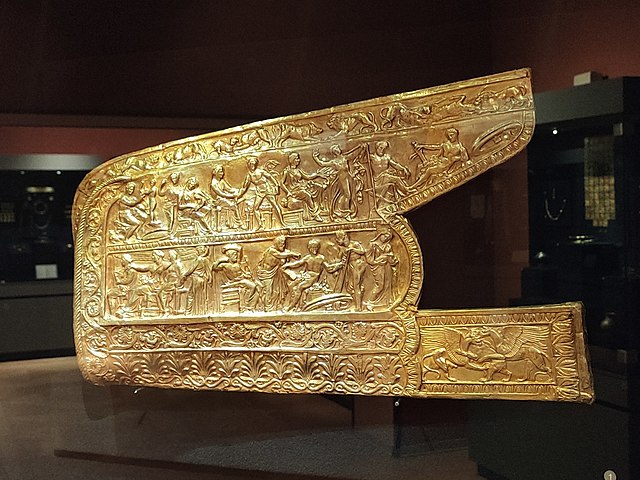
Here’s a beautiful work of art. This is a golden decorative panel from a gorytos, a combination quiver and bowcase that was used widely among ancient peoples of the steppes and the Iranian plateau. This example was found in Melitopol in southeastern Ukraine.

Gorytos, photograph by VoidWanderer via Wikimedia (found Melitopol, currently Kyiv; 4th c. BCE; gold)

Scythian artisans were expert metalworkers, and the Scythian elite valued high-quality metalwork, especially in gold, as emblems of status. This panel was made by Greek crafters serving the Scythian market. The central panel shows scenes from the life of Achilles, a Greek hero whose legends were sometimes associated with Scythia and whose warrior prowess was appealing to Scythian tastes. The outer panels feature decorative scenes of animals hunting, a popular motif in Scythian metalwork.

This piece is not just a beautiful work of art, it’s also an example of how art and artisans in antiquity crossed boundaries and bridged cultures.

Out There highlights intriguing art, places, phenomena, flora, and fauna.

Cha Cha Cha in English

This week Käärijä is represening Finland in the Eurovision Song Contest with Cha Cha Cha. Here’s his performance at the Uuden musiikin kilpailu (New Music Competition) where the song was chosen.

Käärijä – Cha Cha Cha | Finland | National Final Performance | Eurovision 2023 by Eurovision Song Contest via YouTube

Here’s a link to the Finnish lyrics. I’ve tried my hand at translating them into English in a way that fits the rhythm and rhymes of the song:

What a week it’s been, the days behind have just been crawling.

Pina coladas and the open road are now calling.

The night is young, so listen, it’s time to get plastered.

This frozen shell around me has got to get shattered.

Grab my drink with both hands and get loaded, I’m like

cha cha cha, cha cha, cha cha!

Blow off tomorrow, just go out and get totaled, I’m like

cha cha cha, cha cha, cha cha!

I wanna lose my mind, forget all my cares, I’m like

cha cha cha, cha cha, cha cha!

And I’ll keep going til I’m out of my chair, I’m like

A couple pina coladas are down already.

Still my face is like a mask, unmoving and steady.

The night is young, so listen, it’s time to get plastered.

This frozen shell around me has got to get shattered.

The floor is calling me, my inhibitions need numbing.

I’m like cha cha cha, watch out, I’m coming!

Grab my drink with both hands and get loaded, I’m like

cha cha cha, cha cha, cha cha!

Blow off tomorrow, just go out and get totaled, I’m like

cha cha cha, cha cha, cha cha!

I wanna lose my mind, forget all my cares, I’m like

cha cha cha, cha cha, cha cha!

And I’ll keep going til I’m out of my chair, I’m like, woah.

And now I’m dancing free,

I’m like cha cha cha,

and I’m not afraid of this world, you see,

I’m like cha cha cha,

when I pour champagne all over me.

Cha cha cha, and it’s getting hard to see,

and now I slur my speech when I hand the keys to this other me.

Cha cha cha, and you know that I’m not like this usually,

oh no, but I am today, but I am today.

And now I’m dancing free,

I’m like cha cha cha,

and I’m not afraid of this world, you see,

I’m like cha cha cha,

when I pour champagne all over me.

I’m like cha cha cha,

cha cha cha, cha cha, cha cha-ah-ah

I’m like cha cha cha,

cha cha cha, cha cha, cha cha,

cha cha cha, cha cha, cha cha.

Here’s hoping we’ll see Käärijä go all the way to the final!

Star Wars: A Personal Reflection

Star Wars Day is coming soon (May the Fourth be with you!), so I’ve been thinking about how I got into that universe. My route in was a bit odd.

I’m a little bit too young to have been caught up by the original movies. I wasn’t even born yet for the first one. I vaguely remember when The Empire Strikes Back was a thing. Return of the Jedi is the first movie trailer I can actually remember seeing on tv. Even if I had been old enough to go to the movies, though, I wouldn’t have gone to see Star Wars then. It just wasn’t a thing I was interested in.

That doesn’t mean I wasn’t aware of Star Wars. Star Wars merchandise was all over my childhood. Friends had Star Wars lunchboxes and t-shirts. I saw the posters and the toys. Before I was reading on my own, I could recognize Darth Vader and Yoda. Some of the neighborhood kids staged a recreation of a scene from Return of the Jedi. (As the youngest of the group, I was cast as an Ewok. I had no idea what that meant, but all it required me to to was run around and scream unintelligibly, which was about the limit of my acting ability at that age.)

Star Wars lunch box (not mine). Photograph by jeffisageek via Flickr under Creative Commons

When I did discover science fiction, it wasn’t Star Wars but old reruns of the original Star Trek that lit up my young brain. I was completely hooked on Star Trek and, with the stubborn, stupid loyalty of the very young, decided that there was only room in my life for one Star franchise. For years I scoffed at the Star Wars memorabilia around me and snootily dismissed anyone else’s interest in the movies.

I was nearly in junior high before I finally decided to give Star Wars a try. Oddly enough, though, my first experience of Star Wars was not with the movies themselves. In my school library I found a set of picture books that told the story of the original trilogy movies (the only movies there were at the time) illustrated with stills from the films. My memory of the books is hazy, but at a best guess they were The Star Wars Storybook, The Empire Strikes Back Storybook, and the Return of the Jedi Storybook. I decided to give them a shot.

To my surprise, I enjoyed them, enough to hop on my bike, ride over to the local video rental shop, and check out the movies themselves. It was a weird experience. In a sense, I felt like I had always known these stories. I certainly couldn’t remember a time when I hadn’t known that there were heroes named Luke and Leia who fought a villain in a black helmet while accompanied by a couple of shiny droids. Reading the books filled in the details of a story that already felt familiar. By the time I actually saw Star Wars on screen, I knew who the characters were and what was going to happen. Watching those movies for the first time already felt like revisiting old friends.

Weirdly, one thing that wasn’t spoiled for me until I read the books was the Skywalker family tree. I can still remember the shock of finding out that Darth Vader was Luke’s father and then that Leia was his sister. That may be hard to believe in today’s world of fan sites and social media, but I made it through more than a decade of knowing who those characters were without knowing how they were related. Somehow, in all the years of my childhood, I never heard any of my friends who were into Star Wars put on a deep voice and say “Luke, I am you father.”

Star Wars has a special place in modern pop culture because it is special. It is one of the few stories we all know, even if we’ve never seen it. Whether you love it or not, and however you may feel about the prequel and sequel trilogies or any of the vast outpouring of other media in the Star Wars universe, it’s a story that we all have our own stories about.

In Seen on Screen, we discuss movies and television shows of interest.

Are You Aware of National Velociraptor Awareness Day?

Were you aware that tomorrow—April 18—is National Velociraptor Awareness Day? I wasn’t, but now I am. So, consider today National “National Velociraptor Awareness Day” Awareness Day.

In case you were worried that we would not be taking this important holiday with the seriousness it deserves, let us put those fears to rest.

And that’s all we have to say on the subject.

Cartoon by Erik Jensen

Some things are just too silly not to share!

Visual Inspiration: Steller’s Sea Eagle

Here’s a bird of prey with a different look. The Steller’s sea eagle has white bands at the front of its wings, on its legs, and on its tail. It also has a short, thick yellow-orange beak.

Steller’s sea eagle at rest on ice, photograph by Michael Pinczlits via Wikimedia

The normal range of this eagle is along the coasts of northeast Asia from the arctic to Japan, but in recent years there have been sightings as far away as Texas and Nova Scotia.

Steller’s sea eagle hunting, photograph by Julie Edgley via Wikimedia

I’d love to see more birds like this in media, not just the usual suspects like the bald eagle and red-tailed hawk.

Visual Inspiration pulls the unusual from our world to inspire design, story-telling, and worldbuilding. If stuff like this already exists, what else could we imagine?

Tolkien Reading for Tolkien Reading Day

Saturday of this week, March 25th, is Tolkien Reading Day, and what better way to celebrate than with Tolkien himself reading one of his favorite passages from The Lord of the Rings?

Before The Lord of the Rings had a publisher, Tolkien was visiting a friend who had a tape recorder and encouraged him to record himself reading a selection from his work. Tolkien chose to read one of the most powerful moments from the novel, the charge of the Rohirrim against the Orcs of Mordor at Minas Tirith. Here that recording plays over the same scene from Peter Jackson’s movie version of The Return of the King, for extra powerful effect.

Tolkien narrates the Ride of the Rohirrim by Sîdh Aníron on YouTube

This moment is one of my favorite pieces from both the novel and the film. What a rare treat to hear it in Tolkien’s own voice!

Story Time is all about story-telling and how stories work, and what makes us love our favorites.

Quotes: By Her Efforts She Learned Writing

The lives of women in history are so often invisible to us that we become accustomed to not seeing them. Sometimes even when we do see them, we don’t always realize what we’re seeing. The ancient Greek antiquarian Plutarch certainly didn’t know what he was seeing when he quoted this poem (probably composed to be inscribed on the base of a statue) by the Macedonian queen Eurydice.

Eurydice, daughter of Sirra, dedicated this to the local

Muses when she had seized her soul’s desire.

For as a mother of young men, by her efforts

she learned writing, the record of knowledge.


– Eurydice, quoted in Plutarch Moralia 1.20 (=14a-b)

(My own translation)

Plutarch praises Eurydice for learning to read in order to help educate her sons (all of whom went on to become kings of Macedon, one of them the father of Alexander the Great). But although Eurydice does mention her sons, there is much more to this poem.

Eurydice identifies herself in relation to her mother, Sirra, not her father or husband, as would have been typical in ancient Macedon. She directs her praise to the Muses, nine female divine figures, not to Hermes, Apollo, or another male deity equally connected with learning and writing. She does mention her sons, but as an attribute of herself: she does not say (as Plutarch assumed) that she learned in order to teach them, but rather positions her achievement of learning as noteworthy for someone who has undergone the rigors of childbirth and is old enough to have sons on the cusp of adulthood. Eurydice describes her learning in a context that is defined by women and women’s experiences, not men.

While Eurydice makes her accomplishment a feminine one, she uses typically masculine language to describe it. Her language in the original Greek is active, even aggressive. When she says that she accomplished her goal, she uses the same word that other writers used to describe an army capturing a city; when she speaks of her efforts to learn, her words echo those used to describe men training for battle. She positions her learning as the work of a woman surrounded by women, both human and divine, but equal to the work of the male warrior kings in her family.

Eurydice was proud of her learning, as she had every right to be. Literacy was a rare skill in antiquity, and to have learned by her own efforts as an adult shows intelligence and determination. She was doing far more than setting a good example for her sons.

Like Plutarch, traditional history is accustomed to seeing women only in the background of men’s lives, but the records of women’s lives are still there, some of them speaking directly to us if we are just prepared to listen. Many more women like Eurydice have left a “record of knowledge” for us to learn from.

Serving exactly what it sounds like, the Quotes feature excerpts other people’s thoughts.

A Writing Rabbit

There’s an interesting character in this scene from a Classic Maya vase. In the main scene, an aged underworld god is enjoying the company of a bevy of young women, but below him a rabbit scribe is keeping its eyes out and its ears perked while taking notes.

Scene from the “Princeton Vase” via Princeton University Art Museum (found Nakbe, Guatemala, currently Princeton Art Museum; 670-705 CE; ceramic with painted stucco)

None of the rabbits I’ve ever known in my life have been so practical!

Out There highlights intriguing art, places, phenomena, flora, and fauna.

A Little Martial for Those Sick of the Dating Game

If this Valentine’s Day has you feeling bitter about romance, take some heart in knowing that love has always been a rough ride. Here are a few deliciously nasty little snarks from the Roman poet Martial to laugh at over your dinner for one.

Truth Comes Out

He used to be your lover, Paula, but you said there was nothing between you.

Now you’ve married him. Can you still claim there’s nothing between you?

Martial, Epigrams 1.74

Left on Read

I wrote to Naevia. She didn’t write back. So she won’t have me.

But I think she read what I wrote. So she’ll have me.

Martial, Epigrams 2.9

Too High a Pedastal

You want to be revered, Sextus; I wanted to love you.

You’ll get what you demand, Sextus, and be revered,

but if I revere you, I won’t love you.

Martial, Epigrams 2.55

In Vino Veritas

Lyris wants to know what she does when she’s drunk? The same thing she does sober: she sucks cock.

Martial, Epigrams 2.73

Slut Era

You don’t say no to anyone, Thais, and you’re not ashamed of it.

You should at least be ashamed that you don’t say no to anything.

Martial, Epigrams 4.12

Hard to Get

Say “No,” Galla. Love gets cloying if its pleasures come too easily.

But don’t say “No” for too long.

Martial, Epigrams 4.38

Serving exactly what it sounds like, the Quotes feature excerpts other people’s thoughts.

To Crit or Not to Crit?

The next iteration of Dungeons & Dragons is in the works, titled One D&D. Proposed changes to rules and systems are being announced a little at at time. The first round of changes included some revisions to how critical successes work. These changes got a big reaction from the player base, and some elements of them were soon reverted. Still, it’s useful for players and dungeon masters alike to think about what criticals are for and how we use them in the game.

Crits

First, a quick primer on critical successes for anyone not familiar with the game. When a character attempts most anything in the game, whether it be trying to hit a monster with a sword, resist an evil sorcerer’s spell, track a band of Orcs through the wilderness, or persuade a suspicious guard to let them carry their weapons into the king’s hall, the player rolls a twenty-sided die. The number that comes up on the die, plus or minus some modifiers depending on the character’s skills and the situation, reflects how well the character pulled off what they were attempting. Unlike the confusing mechanics in some earlier versions of the game, in the current version of D&D, higher numbers are always better, which means the best roll you can get on the die in any situation is a 20.

Rolling a 20 on the die is known as a critical success, or a “crit.” In combat, a crit represents a lucky strike that hits a weak spot or catches the enemy off guard. A critical success on an attack roll can hit a target that would otherwise be mathematically impossible for the character to hit. For instance, if a character has a -1 modifier on their attack roll and the enemy they are fighting has an armor of 22, there is no roll on a twenty-sided die that, minus 1, equals or exceeds 22, but a natural 20 will always hit, even though 20-1 is only 19. The critical success overrides the normal math. Not only does a critical success in combat always hit, it also does extra damage to the target.

Combat crits

Critical hits in combat bring both positive and negative things to the game. The positive is that they allow for surprise. A character who rolls a natural 20 can pull off an attack that should be impossible or deal a foe an unexpectedly powerful wound. A monster that gets a critical hit can wound or even kill a character who thought they were invulnerable. For players who lean more into the storytelling aspect of the game, these moments of sudden reversal are great opportunities to describe how their character got a lucky shot at the dragon’s weak spot or play out how the party deals with losing a friend and companion. For players who are more interested in the game as a tactical simulation, the possibility of the unexpected adds variety and challenge to the game.

On the other hand, the surprise factor that crits bring to combat is also a negative. The unpredictability of combat has proven to be a problem in current D&D. When the amount of damage player characters and monsters can do to one another is unpredictable, it is hard to calibrate fights so that they present a challenge to the players without overwhelming them. Challenge rating (CR), the tool that is supposed to help DMs plan appropriately difficult fights, has proven to be both difficult to use and unreliable in its results. Crits make it harder for DMs to know how to challenge players without risking outright destroying the party.

The proposed rule changes in One D&D would have kept combat crits for players but made them less powerful while eliminating them entirely for monsters. Many players balked at this proposal, and their reaction led to its reversal. You can have your own house rules about combat crits, though, and many of us do. For instance, in my games I don’t allow monsters to do extra damage with critical hits. Player characters and monsters trading damage is the core of D&D combat, but just doing more damage is the most boring way a monster can threaten a PC. Instead, I try to give monsters interesting abilities that change the flow of battle and make the players rethink their tactics. A monster that can turn invisible, fly, emit a cloud of poison, attempt to control a PC’s mind, or heal an ally presents a more interesting challenge than one who just sometimes hits extra hard.

There were also some players who objected to the proposed rule changes because they didn’t like the idea that player characters would be less likely to be killed in combat. To these folks, I have some words from behind the DM screen: killing PCs is easy. Monsters can hit exactly as often and as hard as I want. I can add more and bigger monsters to the encounter at any time. Did the party come out of the fight alive? I can send in a swarm of angry owlbears before they have a chance to rest up or have the Arch-Demon Xrtplzqtsk cast an unbreakable killing curse on them for its dark amusement. Earthquake. Wildfire. Lightning strike. Rocks fall, everyone dies. Killing a PC is the easiest thing a DM can do.

The question is not whether you should have monster crits in your game, it’s why do you want to do more damage to your PCs and possibly kill them? Sometimes it is the right thing to do. Maybe it fits the story. Maybe the healer wants a chance to break out the big spells and be the hero. Maybe your players like the challenge of mastering the game’s mechanics and want the threat of character death as an incentive. Maybe your players are adrenaline junkies and get bored if they know their characters aren’t in real peril. All of these are perfectly good ways of playing the game if that’s how you like to play, but that’s a conversation to have around your own gaming table. If you’re bothered by the thought that people you don’t know in a game you’re not a part of might be less likely to have their characters die, that’d be a you problem, not a game design problem.

Non-combat crits

While the proposed changes to critical rolls in combat would have made the game more predictable, the changes to non-combat crits were meant to shake things up a bit. Under the current rules, there are no crits outside of combat. When a player is rolling for their character to pick a lock or identify ancient magical runes, a natural 20 is just a number. A clumsy character with a -1 modifier to their roll trying to pick a lock with a difficulty of 20 won’t succeed no matter what. A roll of 20 on the die just turns into a 19, which isn’t enough. Even a more skilled character with a +1 who rolls a 20 on the same task just succeeds; there’s no extra benefit like the bonus damage that comes with a combat crit.

Allowing crits outside of combat, whether by new rules or house rules, can have some interesting effects on the game. It encourages players to try things they might not otherwise try, since there’s always at least a 5% chance of success. An unexpected success in the non-combat parts of the game can be just as thrilling as getting in a critical hit in a fight. Good DMs and players can always invest as much emotion as they want into the game’s storytelling aspects, but it can help to have the mechanics of the game give some support to the idea that what your characters do off the battlefield can be as exciting as what they do on it.

Letting players roll crits outside of combat can lead to some problems, though. DMs already have to deal with a subtype of player who thinks that their character can do anything if they roll well enough, the ones who will argue that a natural 20 means they can seduce a volcano or pickpocket the scales off a dragon. Adopting the principle that a 20 succeeds on anything makes these sorts of interactions more difficult for everyone. The obvious solution is that players should only roll when the DM tells them to, and the DM shouldn’t let players roll for things that are impossible, but in practice that’s a hard rule to enforce. Players like rolling dice, and many are impulsive enough to go ahead and roll as soon as they announce what they are trying to do. It sucks to be the DM who has to tell your players that the 20 they just rolled doesn’t count, and it equally sucks to be the player who has to hear it.

There are also times when, as a DM, you want to let your players roll for something even if they have no chance of success. If one door in the dungeon has an unpickable lock that can only be opened with a magic key, you may want that discovery to unfold as part of the story, and if that’s the only door you won’t let the rogue roll to pick, it calls more attention to the door than you may be ready for. Not letting players roll for something the players have every expectation of being able to roll for is too much like a neon sign saying “This Way to the Plot.” Letting the players try and fail, no matter how good their roll, helps keep the suspension of disbelief intact.

In my games, I don’t exactly have a house rule allowing critical successes outside of combat, but I run with a principle that a 20 should give a favorable result, and an interesting one if possible. When players roll a 20 for something they are capable of doing, the result should add something to the narrative that an ordinary success wouldn’t. If a player tries to get some information out of an NPC and rolls a 20, they may get more information than they were expecting, or make a friend who’s willing to help them in other ways. A natural 20 at my table doesn’t make the impossible possible, but it can yield a result that’s helpful in some way, even if it isn’t what the character was trying for. If someone tries to pick an unpickable lock and rolls a 20, that won’t open the door, but they might get an inkling of what the key could look like or spy something interesting through the keyhole. A player who tries to seduce a volcano won’t succeed with a 20, but at least they’ll get safely away from the lava.

Crit or not?

Whatever Wizards of the Coast ends up doing with One D&D, crits are an area that’s ripe for house rules and discussion around the gaming table. If you like your fights dramatic and unpredictable, combat crits are a simple mechanic to build in some surprises. If you’d rather have a better handle on how a particular fight is likely to go, you can leave them out or tone them down. Likewise, if you like the excitement of crits in combat, bringing them to the rest of the game can be just as exciting. Bringing the thrill of the critical to non-combat encounters gives DMs more leeway to plan campaigns around more than just fighting, as long as you’re prepared to deal with some of the wackier consequences of giving everybody a 5% shot at anything.

Crits have a role in Dungeons & Dragons, and it doesn’t have to be the same role at your table that it is in the official rules.

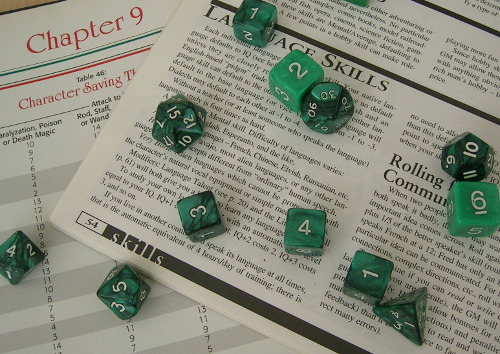
Image by Erik Jensen

Of Dice and Dragons talks about games and gaming.