There’s been some buzz—quite understandably, too, for the drone looks pretty neat—but the vehicle doesn’t seem to have been ready for the international market quite as soon as some western newsoutlets have reported. It sounds like the battery life is still rather limited, too. Fortunately the limitations of the current tech do not have to restrain a science fiction writer—just think of how much cell phone batteries have improved in the last ten years alone.
My goodness, it’s exciting to be living now! 🙂
The Visual Inspiration occasional feature pulls the unusual from our world to inspire design, story-telling, and worldbuilding. If stuff like this already exists, what else could we imagine?
Fahrenheit 451 (2018) Official Trailer ft. Michael B. Jordan & Michael Shannon | HBO on YouTube
This new movie adaptation of Ray Bradbury’s novel is by writer, director, and producer Ramin Bahrani. The flick stars Michael B. Jordan (lately appearing e.g. in Black Panther and Fantastic Four) and Michael Shannon (e.g. The Shape of Water, Batman v Superman: Dawn of Justice, and Man of Steel). It’s set to come out May 19, 2018.
My first snarky comment solely on the basis of the trailer is “Do you think this movie has something to do with fire?” and the second “My goodness, so many men doing man things—where are the women?” Then again, I know that trailers always lie, and that may be the case here. According to IMDB, at least, the cast does have a number of women, including Sofia Boutella, whom I remember from Kingsman: The Secret Service. It remains to be seen how much of a role they’re given. And I hope Michael B. Jordan is given space to show his depth.
Hey, look! We found a thing on the internet! We thought it was cool, and wanted to share it with you.
Author Kelly Robson describes the core conceit of her novel Gods, Monsters, and the Lucky Peach in an interview with Ilana C. Myer:
“The habs, hives, and hells [i.e., city state -like population centers] compete for economic power, and economic power ultimately comes from populations. A free market requires free movement of population, so everyone is free to basically vote with their feet. If they don’t like the quality of life in the hab, hive, or hell they live in, they are free to move to a different one. A hab, hive, or hell with a shrinking population knows that it better change its quality of life offerings if it wants to stop hemorrhaging people.
“It’s a dynamic world that ultimately respects humans as the only generators of value and purpose in the world. I like it.”
– Kelly Robson describing her novel Gods, Monsters, and the Lucky Peach
Aah, I like it too. 🙂 Plus, voting with your feet is a natural extension of voting with your wallet.
Due to a post-winterstorm blackout a week more than two weeks ago, I’m still catching up on my Internet reading, so I only saw these awesome, nerdy motivational postersnow after the International Women’s Day. It was worth the wait, though:
Risa Rodil on Tumblr.
“Just because something works doesn’t mean it can’t be improved.”
Referring of course to Shuri from the movie Black Panther. As another tinkerer, I wholeheartedly agree! 😀
Risa Rodil on Tumblr.
“Behind every successful woman is herself.”
The posters are by letterer, illustrator and designerd Risa Rodil. She posted them on Tumblr in honor of the International Women’s Day (March 08).
I’m not a fan of the Victorian age per se, but watching Murdoch Mysteries has piqued my interest somewhat. Here are some intriguing photographs from the later 1800s to early 1900s.
From a set of unscripted photos taken in the streets of 1890s Norway by Carl Størmer, a young woman with books:
Young woman with books, photograph by Carl Størmer via Imgur (Oslo, Norway, 1890s)
All of the subjects in this set are remarkably relaxed. Love the contrast to the stiff studio portraits of the era!
(I’ve had trouble finding a more detailed source, unfortunately. Possibly Størmer’s photos are gleaned from the 2008 book 80 millioner bilder: Norsk kulturhistorisk fotografi 1855-2005 [’80 Million Pictures: Norwegian Culture-Historical Photography 1855-2005′], edited by Jonas Ekeberg and Harald Østgaard Lund.)
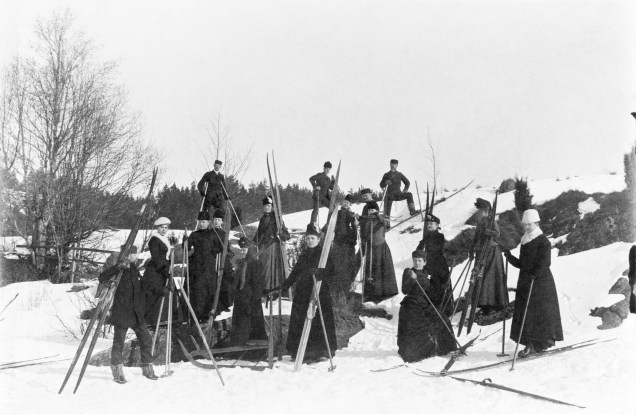
Finnish ladies and gentlemen on a ski trip in the 1890s:
Hiihtoretkeläiset ryhmäkuvassa (‘ski trip participants in a portrait’), photograph via Helsinki City Museum (Helsinki, Finland, 1890s, image number N252030, CC BY 4.0)
Judging by their attire, they are indeed ladies and gentlemen. What struck me is that, apparently, it wasn’t at all odd for the upper class to go skiing in their regular daywear.
Speaking of sports and Victorians, from 1891, here is high school dressage equestrian Selika Lazevski by Félix Nadar:
Selika Lazevski, photograph by Félix Nadar courtesy of Ministère de la Culture, France, via Black Female Equestrians (Paris, France, 1891)
What an arresting portait!
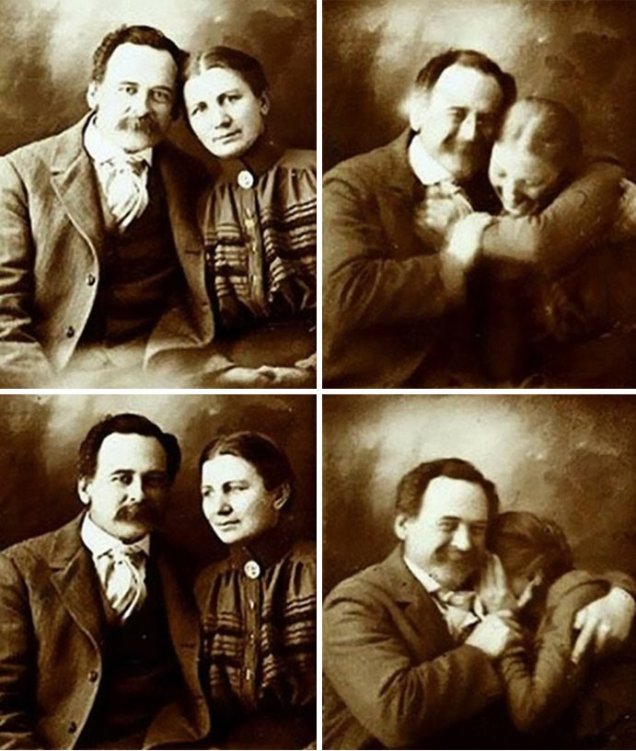
A Victorian couple from Leeds trying not to laugh while getting their portraits done in the 1890s:
Victorians certainly loved their wheels! I wonder exactly how one would’ve operated this chair—there’s clearly a handle bar connected to the front wheel, but if grabbing it with both hands, where does the propelling force come from?
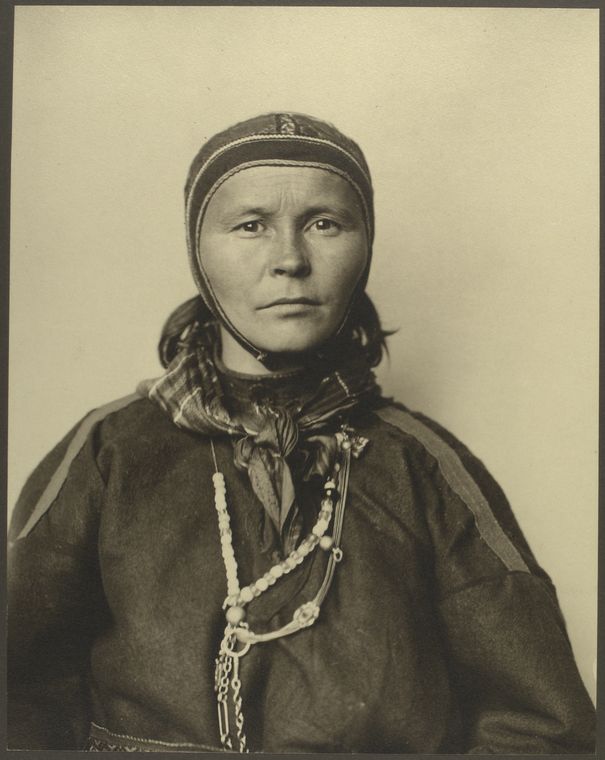
A Sami woman from Finland photographed at Ellis Island in the U.S., so presumably immigrating, around 1905-1914:
Laplander / Sami woman from Finland, photograph by Augustus F. Sherman via New York Public Library digital collections (Ellis Island, New York, NY, c. 1905-1914, image ID 418041, public domain)
I wish the portrait hadn’t cut off at the waist; I would’ve liked to see the rest of the details of her dress (the belt looks especially interesting). I know that nowadays Sami outfits (gákti) are unique. Each is made for its wearer to reflect the personal / family history and area (and possibly the people as a whole?). I don’t know, however, how far back in time that practice goes.
Anyway. These old photos give fascinating glimpses of western life only about 100 years ago. So similar and yet so, so different.
Out There is an occasional feature highlighting intriguing art, spaces, places, phenomena, flora, and fauna.
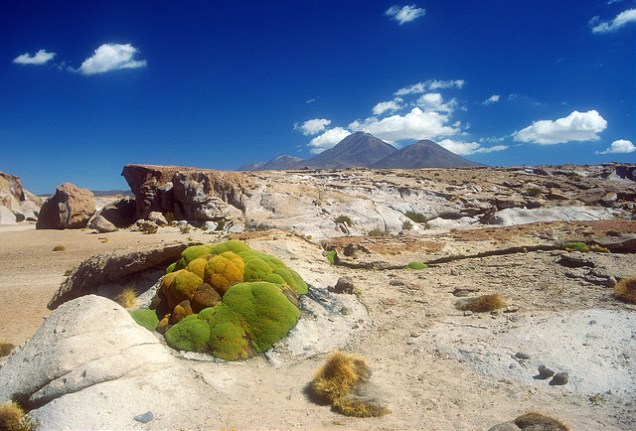
Yareta or llareta (Azorella compacta) is a low evergreen that grows in the Andes mountains in Peru, Bolivia, northern Chile, and Argentina.
Looking at the landscape where it’s found, it seems that the yareta latches onto ground or rock and grows up and out into the rounded shape over the years.
The rounded, cotton-ball-like shape reminds me of how some mosses grow. Unlike them, though, the yareta can grow in dry conditions and nutrient-poor soil, if slowly. (According to Wikipedia, their growth rate is approximately 1.5 cm / 0.6 inches per year; however, an article in Pharmacognosy Magazine cites 1 cm in 20 years.)
Apparently the Andean people used yareta since Pre-Columbian times for the treatment of colds, pains, diabetes, asthma, bronchitis, womb complaints, gastric disorders, backache, wounds, and altitude sickness (Pharmacognosy Magazine Aug 2014).
Yareta looks like a great option for speculative writers and artists looking to break out of the Eurocentric worldbuilding mold.
Images: Yareta at Ollague Volcano lookout by Miguel Vieira via Flickr (CC BY 2.0). Yareta – Bolivian Altiplano by Knut-Erik Helle via Flickr (CC BY-NC-ND 2.0)
Out There is an occasional feature highlighting intriguing art, spaces, places, phenomena, flora, and fauna.
Apart from various aspects of the story and the movie series, the exhibition covers for example illustrations, the history of real-world magic, and early sketches and notes by J.K. Rowling. In addition, on display are a number of items from the Museum of Witchcraft and Magic.
My favorite feature is perhaps the section covering the real-world history of various Hogwarts classes, closely followed by the animals and fantastical beasts section.