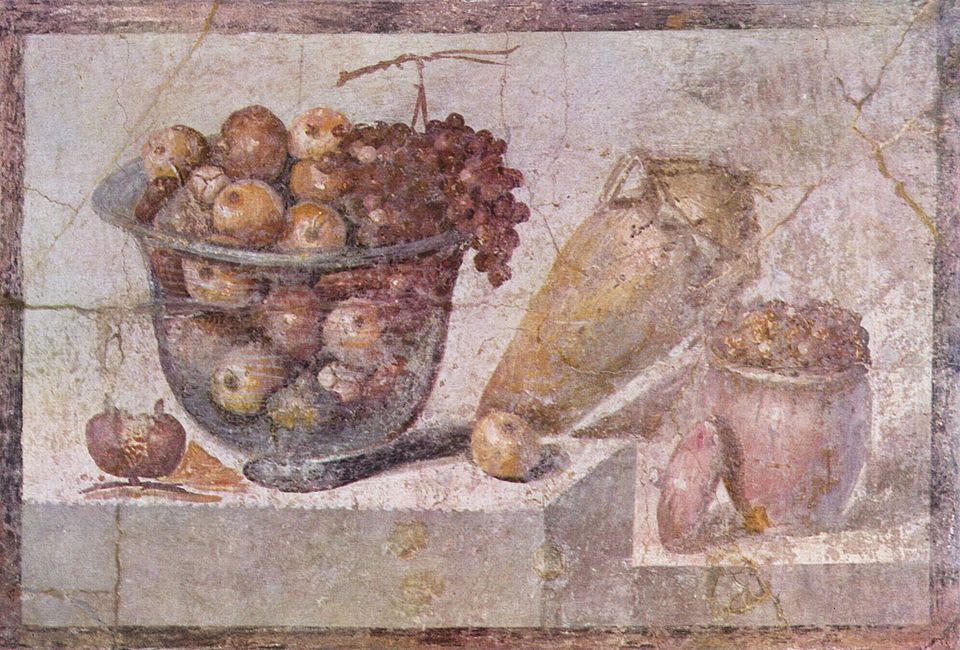
An Urban Orchard in Pompeii

We don’t usually think of cities as places where food is grown. Farmland is a rural thing, and the harvest must be brought to urban markets so that city-dwellers can eat. But urban agriculture is nothing new. The destruction of the Roman city of Pompeii by Vesuvius in 79 CE preserved the evidence of extensive food production inside the city walls. One place where ancient Pompeians could get fresh, super-local food was the house known today as the House of the Ship Europa. (The name comes from a detailed graffito on the house wall depicting a sailing ship with that name.)

This house sits among other houses on the southern side of the city. From the outside, it doesn’t look much different from the dwellings around it. On the inside, though, the house owners had made good use of the space they had for growing a variety of foods.

At the rear of the house, a large walled garden space stood open to the sky. Gardens were not uncommon in Pompeii, and many houses had open courtyards for leisure, but not all were as carefully planned as at this house. Archaeologists studied the layout of the garden, pollen deposits preserved under the volcanic ash, the types of planting pots and tools kept in the space, and even the shapes left in the ground by tree roots to determine how this garden was planted and what grew there.

The core of the garden was laid out in regular rectangular planting plots which match the ways Roman agricultural writers like Cato and Varro recommended planting grapevines. The roots of one large tree were identified as a filbert, a tree which is often planted at the edges of vineyards in modern Italy. The pollen samples from the site had an unusually high amount of grass pollen compared with other Pompeian gardens; while in other houses grasses were weeded out out flower beds or kitchen garden plots, at the House of the Ship Europa, grassy paths were allowed to grow between the grape vines.

Smaller tree roots were found in regular rows along the walls. Since young fruit and nut trees are typically grown by grafting branches from the desired species onto rootstock that may come from a different kind of tree, we cannot tell from the roots alone what smaller trees were planted in this garden. The rootstocks would have been suitable for plums, peaches, cherries, figs, olives, or almonds, and some or all of these foods may have been grown at the house. Elsewhere in the garden were a number of large perforated ceramic pots whose shape and size match the types of planting pots Roman writers recommended for growing citrons, a citrus fruit and ancestor of the lemon.

The burnt remains of filberts, grape seeds, figs, beans and dates were scattered in the layer of volcanic ash that covered the garden. Most of these plants could have been grown at the house, but date palms do not produce fruit in the climate of Italy, so the dates must have been imported. Perhaps the Europa celebrated on the wall of the house was a trading ship belonging to the family. The house may have functioned as a store selling both their own locally grown fruits and nuts and some imported produce from elsewhere in the Mediterranean.

The House of the Ship Europa gives us an idea of what kinds of foods were grown within the walls of Pompeii and were part of the diet of city’s residents. The city was not just a place of residence, but also an agricultural landscape, and we must imagine that other ancient cities were as well.

Image: Fresco of fruits, photograph by the Yorck Project via Wikimedia (House of Julia Felix, Pompeii; c. 70 CE; fresco)

The First Trailer for The Latest Odyssey Adaptation

The Christopher Nolan adaptation of The Odyssey has a trailer out.

The Odyssey | Official Trailer by Universal Pictures on YouTube

Right. The biggest thing staring at me are the colors. They are too muted, IMO—by now there’s plenty of evidence that the ancient world was awash with color. Some of it is explained by the weather in the trailer scenes, but there really should be more color. Even the glimpse of Penelope’s (Anne Hathaway) turquoise gown is left in the shadow of her head, making it appear darker.

(This is a tendency in some modern films I just can’t abide; wash-out tones like sepia have never appealed to me. History was colorful! And don’t get me started on the pervasiveness of black. Like slapping on unnecessary buckles and straps, pretensions of historicity while choosing black clothes for earlier periods has started to seriously irk me. Sure, if your film is about puritans, go for it. The antiquity? Black is certainly not as omnipresent as this!)

Otherwise, we see hints of several scenes from the epic. Perhaps too many; the whole feels jumbled, disorganized, and erratic. I am likely to want to see the movie, but unfortunately this trailer did nothing to encourage me to visit a theater to do so. Endless dark scenes of men in dark costumes glancing apprehensively around in dark surroundings, while I myself am sitting in a dark auditorium, holds no attraction for me. (For that much dark, we have Finnish winters, thank you very much.) I might as well wait for the disc and see it at home in greater comfort to offset all of that gloom.

The Odyssey will open on July 17, 2026.

Jane Austen’s Period Drama

While browsing Frock Flicks, I came across a 2024 short comedy called Jane Austen’s Period Drama.

Content note: icky female bodily fluids are depicted (faked, obviously, but nevertheless) and discussed. Beware, hereinafter there be cooties!

The short is both written and directed by Julia Aks and Steve Pinder. Furthermore, Aks stars as Miss Estrogenia ‘Essy’ Talbot. According to IMDB, the farce is introduced thus:

“England, 1813. In the middle of a long-awaited marriage proposal, Miss Estrogenia Talbot gets her period. Her suitor, Mr. Dickley, mistakes the blood for an injury, and it soon becomes clear that his expensive education has missed a spot.”

JANE AUSTEN’S PERIOD DRAMA / 2026 Oscar®-Nominated Short Film by Julia Aks on YouTube

Don’t let the film’s short duration fool you: Jane Austen’s Period Drama has very impressive sets and props plus acting and filming, but it’s the writing that takes the cake. (Chocolate cake, obviously, considering the topic.)

Reader, I laughed and laughed!

Quotes: Either to Be Bored or to Lie

Dr. Watson comments on the afternoon’s mail to his flatmate, Sherlock Holmes:

“Here is a very fashionable epistle,” I remarked as he entered. “Your morning letters, if I remember right, were from a fish-monger and a tide-waiter.”

“Yes, my correspondence has certainly the charm of variety,” he answered, smiling, “and the humbler are usually the more interesting. This looks like one of those unwelcome social summonses which call upon a man either to be bored or to lie.”

As a fellow introvert, I share Holmes’s annoyance with unwelcome social summonses. I have more than once been bored at a social occasion I was expected to attend, and I have been known to lie to get out of events I don’t want to go to.

(For the curious: a fish-monger sells fish, and a tide-waiter was a customs official who historically went aboard ships to oversee the collection of import duties and check for contraband.)

Doyle, Arthur Conan. “The Adventure of the Noble Bachelor.” Sherlock Holmes: The Complete Novels and Stories. Vol. 1. New York: Bantam Books, 1986, 388-89.

Remembering Leslie Fish

Today would’ve been the birthday of Leslie Fish, folk musician and filker. She passed away at the end of November 2025.

Decades ago when I first discovered filk, Fish was one of the names I started to soon recognize. Some of the songs I still remember include “Carmen Miranda’s Ghost”, “Signy Mallory” with Mercedes Lackey, “Space Hero” and “One Last Battle” with Vic Tyler (I believe), and “Wind’s Four Quarters” with Mercedes Lackey and Heather Alexander.

Here, as a hat-tip, is her song “Hope Eyrie”:

Hope Eyrie by Leslie Fish on YouTube

“Hope Eyrie” is the only one of hers I’ve sung in a crowd, the last time at a filk worshop at Ropecon 2024 or 2025 (or maybe both), which is an indication of her enduring influence.

RIP, Ms. Fish.

A Concordance of Polybius and What AI Can and Can’t Do for Historians

Boosters of large language models (LLMs) and other kinds of so-called artificial intelligence make big claims about what the technology can do for us, sometimes referencing the benefits brought by other inventions like the Internet or mass production. I rarely find such arguments convincing when applied to my field, history. An experience from my graduate student days may help illustrate why.

When I was a graduate student in the early 2000s, I wanted to write about the Greek historian Polybius and his idea of what constituted Italy. Polybius lived and wrote in a time when the Roman state had fought a century of wars to conquer and defend the Italian peninsula. The idea of Italy as a single thing that could be defined and found on a map was still somewhat new and up for debate. I was interested in seeing where the boundaries of what Polybius called Italy lay, as a reflection of how the Roman elite whose society he moved among thought about their empire and its place in the world.

The obvious place to start was to search the text of Polybius’ Histories for references to Italy, but remember that this was the early 2000s. Search engines for the internet were still in their adolescence, and while there were some projects under way to digitize Classical texts and make them searchable, they still had their limitations. To get the information I needed, I went to the library and found a concordance of Polybius.

A concordance is a type of scholarly reference work that was common in the days before texts became searchable. It is a list of every word used in a particular text (such as Polybius’ Histories) and the context in which it is used. To find every instance when Polybius used the word Italy (or Ἰταλία in Greek), I just had to open the volume to the letter iota, scan down to Ἰταλία, and start going through the references to find which ones were worth looking up in my copy of Polybius and which ones were not useful for my research.

The work that went into creating such a concordance was enormous. The surviving text of Polybius’ Histories runs into the hundreds of pages in a modern printing. Someone had to go through the Greek text and catalog every single word (not to mention dealing with the issues of differing texts in different manuscript traditions, scribal errors, and emendations), then compile all those references into one enormous volume. All of this work was done by hand in the days before computers. The book that I laid out on the table in front of me when I was writing that paper represented thousands of work-hours, a significant chunk of some previous scholar’s working life. (I was lucky to have chosen a research question about a well-known author whose work had been concordanced by scholars of past generations. If I had wanted to check the work of some more obscure author or uncatalogued fragments, I would have had to sit down and scan every page myself.)

If I wanted to research the same question today, I could simply load a copy of the Greek text, type the word into a search box, and have the results in seconds.

Technologies like searchable electronic text have not only changed what questions scholars are able to ask, they have changed the meaning of scholarly work altogether. The kind of rote mechanical labor that went into creating something like a concordance of Polybius used to be a staple of an academic historian’s life. While scholars have always aimed to make new discoveries and present new interpretations of the evidence, up to the late twentieth century it was understood that as a working historian, you would spend a significant amount of your productive life just reading through texts and assembling data a piece at a time, either for your own research or to make a tool for others to use.

These days, although there are still times when searching doesn’t help and you still need to just go through the text line by line, a significant amount of what historians used to do is now automated. Indexed, searchable texts with good metadata have taken the place of a lot of the more cumbersome old scholarly tools in much the same way that electronic databases have replaced the old card catalog system.

This is a change I fully approve of. I have no nostalgia for the old days. I am not shaking my cane at the clouds complaining about kids these days who don’t have to use a concordance in the snow uphill both ways. Making basic information more readily available and easier to probe in new and unexpected ways leads to better questions and more interesting arguments about history, and both scholarly and non-specialist audiences benefit from the wealth of new research that modern tools have made possible.

Now, some have tried to present artificial intelligence as a new revolution in scholarship parallel to the development of searchable catalogs and texts. Just as searchable texts allow us to skip the tedious and unrewarding work of slogging through sources word by word gathering references by hand, so an LLM can save us the tedious work of reading through the existing literature finding the answers to questions so we can spend more time focusing on our own research interest. I find this argument unpersuasive for two reasons.

First, the LLM services which currently exist and promise to perform this kind of operation are not up to the task. They may have scanned all the relevant literature that I would want to consult in my research (and there is a good chance that they have not, but let us suppose for a moment that they have), but they have no understanding of it. They do not know how to separate different threads of argument, how to weigh different theoretical approaches or contrast older and newer scholarship, or how to critically assess evidence. They do not actually know anything, they just slap together text in a way that fits the models they’ve been fed. A search engine may produce wrong results, depending on how well the text it’s searching has been coded or how accurate a search term one uses, but these errors at least point to specific data points that can be checked. An LLM produces authoritative-sounding nonsense with as much facility as truth. It saves no time or effort to use an LLM for research, since everything it produces is suspect, and it does not present its sources for checking.

Second, the tedious work of reading through existing literature is a vital part of scholarship. We have to understand the arguments made by scholars in the past and the bases on which they made them if we are going to do any better at tackling the same questions ourselves. Historical research depends on extensive reading of sources and prior scholarship, not just as a way of assembling data but in order to actually understand our subjects. It is not the same as the rote work of compiling all the words used in a text. There is no royal road to historical understanding, and this part of the research process cannot be automated away.

No one makes concordances any more, and hardly anyone uses them. Search technology saves us labor and frees up scholars’ time to do the more interesting and more important work of engaging with evidence and contemplating new questions. The human work that searches replaced was work that we could well do without. The work that LLMs promise to replace is essential, and they can’t do it for us effectively anyway.