We all know that everyday tasks aren’t really made lighter by having eye-pleasing tools to work with. But there clearly is some innate yearning in humanity to not just modify but also to decorate our environment.
Earlier we’ve blogged about Minoan mugs from ca. 1,500 BCE, a Bronze Age cup with an attempt at animation, a Minoan octopus flask, a brilliantly colored ancient Greek glass perfume bottle, a monster mosaic from a 3rd c. BCE Greek city in Italy, a statuette of girls playing knucklebones from ca. 330 BCE, and a Maya vase with a rabbit scribe, and many other examples.
Here’s one more case in point: Iranian spindle whorls from the early islamic period c. 700s-900s CE. They are made from incised bone and carved with intricate designs.
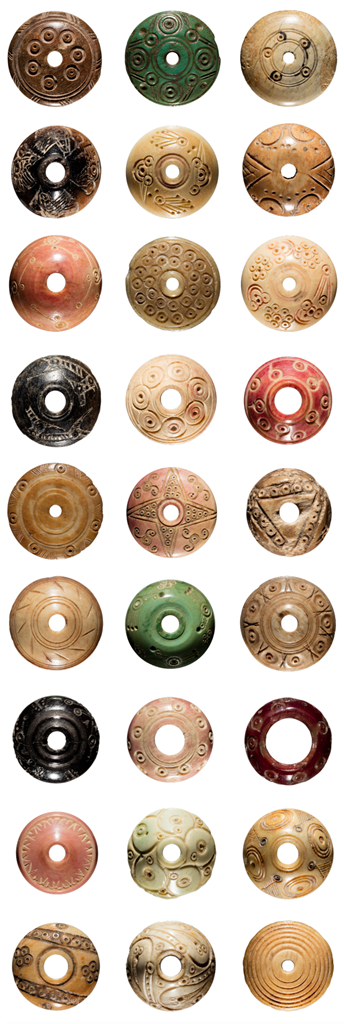
A spindle is a hand tool for making yarn, basically a long thin stick around which the freshly formed yarn can be wound. A spindle whorl is a weight attached to the bottom of a spindle. Whorls provide more torque and a longer spin time—purely functional, in other words.
Many, many spindle whorls found around the world have been carefully shaped, which is to be expected—you do want your tools not just to work, but work well for the purpose. In addition, so many of extant spindle whorls are also beautifully decorated.
You could perhaps argue that the small surface makes for a quick and easy art project. However, most whorls are round or spherical, which makes for a more challenging surface to decorate.
Spinning must have been an unending task for our predecessors. Spindles—and, by extension, spindle whorls—were the most basic, utilitarian tool you could imagine. And yet, we find innumerable people throughout history wanting to decorate their whorls. Little details like this make me love humanity all over again, despite all the awful we’re also capable of.
Images by The Cleveland Museum of Art, mashup via theinternetarchive on Tumblr
Out There highlights intriguing art, places, phenomena, flora, and fauna.
 Co-Geeking
I love the variety of colors and patterns on display here. As you said, it’s wonderful to see how people throughout history have put so much care and imagination even into the most mundane things in their lives.
LikeLiked by 1 person