Barbarian Migrations: Numbers

Barbarian migrations are a staple of popular histories of the ancient world. From early wandering groups like the Cimbri and Teutones in the late second century BCE to massive hordes of Goths, Vandals, Juthungi, and the like streaming across the map of the late Roman Empire, it seems that gathering up in huge masses and tromping around the world is just what barbarians do.

But is it? The popular image of migrating barbarian hordes comes from older scholarship, many of whose assumptions and conclusions have been challenged in recent generations. No one today doubts that people in antiquity moved, sometimes in groups, and sometimes long distances, but the idea of massive hordes pouring across the landscape is becoming less and less tenable.

To get an idea of why massive barbarian migrations are questionable, we’ll consider two interrelated issues: numbers and logistics. How large were the groups that moved long distances in antiquity? And how did those groups manage the practical problems that come with moving long distances? This post addresses numbers. In the next post, we’ll talk about logistics. Finally, we’ll see what conclusions we can draw about how and why large groups of people moved around the ancient world.

Ancient sources are notoriously unreliable when it comes to estimating the numbers of people in large groups. Greek and Roman writers trying to describe the movements of large groups of potentially hostile outsiders are especially unreliable. Even today it is difficult to estimate the size of crowds, and we have much better tools at our disposal than ancient authors did. Most writers who report figures for the movement of large groups were not eyewitnesses, and were certainly not in a position to get an accurate count.

Greek and Roman authors had reasons to exaggerate the scale of forces they perceived as hostile intruders. A large movement was more dramatic to write about, and the defeat of a large hostile force reflected more glory on the Greek and Roman armies and leaders who fought them. The literary mood of late antiquity was particularly pessimistic, influenced both by the competition for power among rival generals who needed to claim that they had triumphed over unbeatable odds and the Christian hope for an apocalyptic end of the world. The image of massive hordes of invading barbarians suited the needs of contemporary writers, but that does not mean that barbarians were actually invading in massive hordes. The same dire language was used to describe urban unrest, rural banditry, undisciplined soldiers, even overzealous monks.

Still, there was nothing new about Greek and Roman authors wildly overestimating the size of outside groups on the move. The Greek historian Herodotus in the fifth century BCE famously estimated the size of the Persian king Xerxes’ expeditionary force in Greece (army and navy combined) at a ludicrously high figure of 5,283,220; modern estimates vary, but generally put the total at less than 100,000.

Given these facts, we should be skeptical of ancient sources that breezily conjure up 80,000 Vandals, 150,000 Goths, or 400,000 followers of Radagaisus. While any of these figures could theoretically be correct, and we cannot categorically reject them, none of them is any better than an estimate by an outside observer passed through several hands and recounted by a writer with literary and political axes to grind.

So, how large were the actual groups of people moving around the ancient world? It is impossible to say with any certainty, but we can make a few suggestions. To begin with, the lower literary estimates are a workable upper bound. 80,000 is repeated by enough sources in enough different contexts that it probably represents a literary convention for “a very big number of people.” If we suppose that this literary convention is derived from actual experience of the practicalities of moving large groups of people, then it makes sense to suggest that few if any moving groups in antiquity numbered more than 80,000, and most were much smaller.

Accounts of some late antique battles give figures of approximately 10,000 fighters in the “barbarian” armies. These figures are questionable for all the same reasons described above, but they are not out of proportion to the sizes of known ancient armies. Fighting forces represent only a fraction of an entire population, conventionally estimated at an eighth, or perhaps as much as a quarter in extreme circumstances. A fighting force of 10,000 would then represent a total population of 40,000-80,000. Since the “barbarian” armies in these battles were often temporary alliances of disparate groups, the constituent groups themselves must have been smaller.

Our numbers can only be speculative, but drawing together these inferences, we are probably not terribly far wrong if we imagine most migrating groups in antiquity on the scale of 10,000-20,000 people, with some temporary alliances adding up to 80,000 or so.

In the next post, we’ll think about what it would actually take for even a group of 10,000 or so people in ancient conditions to migrate from one place to another.

Image: Ludovisi sarcophagus, photograph by Jastrow via Wikimedia (currently Museo Nazionale Romano di Palazzo Altemps, Rome; c. 251 CE; marble)

Visual Inspiration: Indian Black Narrowmouth Frog

The Indian black narrowmouth frog (Melanobatrachus indicus) is a vulnerable species endemic to wet evergreen forests in southern India.

Wikimedia Davidvraju Melanobatrachus indicus

Not much is known about them outside of academia and/or research circles (and I’m currently too sick to start combing through more in-depth sources). They seem to be quite small, though. And how cute are those tiny blue polka dots! And its face, too! At least this individual looks so smart it could easily be the model for a dungeon boss for a computer game.

Image by Davidvraju via Wikimedia Commons (CC BY-SA 4.0)

When a Walrus Shows up at Your Door

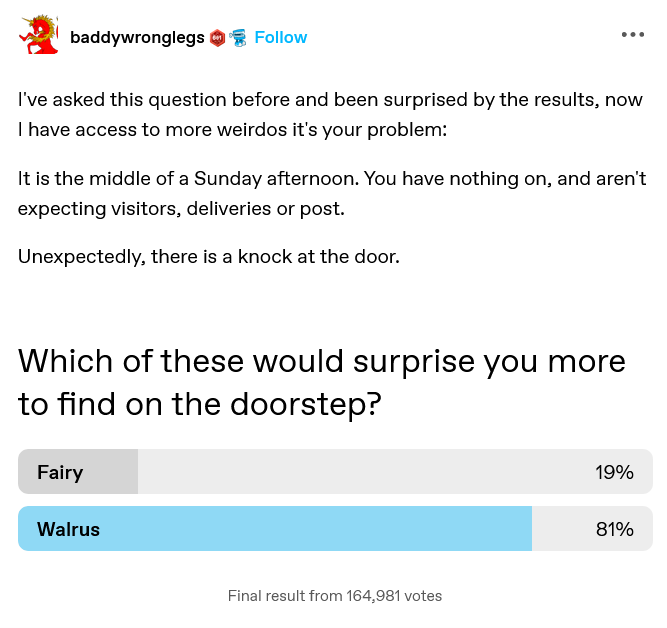
There’s been a thing going on in the past month on the Internet about fairies and walruses. If you’re not in the loop, it all started with a poll posted on tumblr by user baddywronglegs that asked respondents to consider which one they would be more surprised to find at their front door, a fairy or a walrus?

The fun of this poll is that it pits two very surprising (in most parts of the world) things against one another, but those things are surprising in two different ways. Fairies don’t exist, but if they did, it would be perfectly plausible for one to knock on your door. Walruses do exist, but the idea that one would survive the trip out of the Arctic, make it to your front door, and knock is beyond belief. What’s more surprising: the most unsurprising surprising thing or the most surprising unsurprising thing?

But, then, surprising things do happen sometimes. Like walruses showing up where they have no business being. A lost walrus found itself on the shores of southeastern Finland in the summer of 2022. It didn’t knock on any doors, but it did take a nap between some beached rowing boats, literally rolled around on someone’s yard in the grass, and posed in front of an emergency vehicle.

Yes, Finland is an Arctic country in the sense that we straddle the Arctic Circle, even though most of our land area is south of it. We do not, however, currently have any coastline in the north; all of our salt water access is to the south and west, i.e., to the Baltic Sea. Visits like this are, therefore, extremely rare. The walrus had to travel all the way around Scandinavia, through the Danish Straits (Kattegat and Skagerrak), and east along the Gulf of Finland to reach Hamina and Kotka.

(Alas, the poor thing turned out to be famished, and died in the middle of an attempted rescue en route to the Wildlife Hospital of Korkeasaari Zoo in Helsinki. It’s since been preserved and it’s on display at the Finnish Museum of Natural History.)

Wikimedia Antti Leppanen Haminan mursu

It’s quite staggering that we live in a place where, theoretically—very much in theory, but nevertheless—a walrus could turn up on the yard! (No sign of fairies, though.)

Images: Screenshot of tumblr post by baddywronglegs. Stuffed walrus in the Natural History Museum of Helsinki by Antti Leppänen via Wikimedia (CC BY 4.0).

Quotes: He Lay on top of Me Like an Enormous Stone

Saint Patrick’s Day is coming, and while some folk will be out there marching in parades or drinking green beer, I am reminded that Patrick is the source of one of the clearest early accounts of sleep paralysis and the frightening sensations that can come with it.

Patrick wrote an account of his life, called the Confession. This document was written late in his life and in response to some unknown allegations of misconduct during his mission in Ireland. Patrick’s Confession accordingly focuses on his humility and spiritual piety as it tells the story of how he was enslaved in Ireland as a young man, escaped to Britain, and finally returned to spread the Christian message. At one point in narrating his escape, Patrick recounts a frightening nighttime experience which he perceived as a demonic attack:

On that very night as I was sleeping, Satan tested me powerfully, such that I shall remember it for as long as I am in this body. He lay on top of me like an enormous stone, and I had no strength in any of my limbs. How did it occur to me, ignorant in spirit, to cry out “Elias?” In the midst of this, I saw the sun begin to rise in the sky, and as I shouted “Elias! Elias!” with all my strength, behold, the splendor of the sun fell over me and at once all the weight left me.

Saint Patrick, Confession 20

(My own translation)

Sleep paralysis is a frightening experience that happens when the brain’s processes for falling asleep or waking up are not quite in sync. In normal sleep, the body becomes paralyzed at the same time the brain becomes unconscious, and both states pass when we wake up. Sleep paralysis happens when the body is paralyzed but the brain is partially aware of its surroundings. Unable to properly process stimuli, the brain fills in the gaps with hallucinations. Because the brain is aware of the body’s vulnerability in its paralyzed state, these hallucinations often feel threatening. It is not unusual for a sufferer to scream themselves awake in response. Sleep paralysis most often happens in the evening when first going to sleep or in the early morning while waking up.

Many cultures have folk traditions that interpret sleep paralysis as the effect of hostile supernatural visitation. Old-fashioned explanations include incubi, night hags, and ghosts; more modern folktales may feature alien abduction. Patrick details a clear account of sleep paralysis—it happens at dawn, he is unable to move, he feels a weight on his body and perceives a hostile presence which he shouts away—but interprets the events in a specifically Christian context.

Patrick’s night terrors are a reminder of both the universality of human experiences, and how powerfully our own specific cultural outlook can shape our reactions to those experiences.

A Fantastical Mancave Reno

Most often, nerdy and geeky home decor is the work of enthusiastic fans channeling their love of the genre into their spaces. Sometimes, though, you do see a mainstream professional hired for the work. One such is the case of a fantasy-loving family in Finland, who hired interior designer Minna Haapakoski to plan a reno of their bland basement mancave. And she pulled out all stops.

Entry to the space is now hidden behind a tall, ornate mirror. Visitors are greeted at the door by an armor-wearing figure. In addition, decorative arches were added to divide the space into two working / gaming spaces separated by a tv / lounge area with a large built-in seat.

Meidan talo Johanna Myllymaki Mancave1
Meidan talo Johanna Myllymaki Mancave2

Both open shelving and cabinets provide storage. Surface materials have been cleverly used to change the feel of the room. Wall paneling is made from reclaimed wood, and the faux tiles are made with plaster and painted. All the lighting is on dimmers, and sound-proofing was applied to the door as well as walls.

Meidan talo Johanna Myllymaki Mancave3
Meidan talo Johanna Myllymaki Mancave4

Now, the room looks fantastic, doesn’t it? (No pun intended!) It houses not just one but two desks plus the lounging area, which is great for versatility. The design elements all work towards creating a harmonious whole, the colors are nicely balanced, and details like faux bois plant pots add to the illusion.

Even so, I’d have a hard time picking useable ideas for a potential reno of my own. First of all, many of the surface materials would be out for me for health reasons, but to each their own. Secondly, the entry with the armored dummy is merely there for looks, which means it’s basically a wasted area. (Then again, if you have a home of 200+ square meters / 2,150 sq ft or so—I’m wildly guessing here—and money to burn…)

Furthermore, there’s a pragmatic issue with the floor plan that would drive me absolutely nuts. There doesn’t seem to be open floor between the two desks. Say what?!?

While I love spaces that indicate that some thought has gone into making them look nice, I absolutely, utterly, ardently must have function first. Especially if it’s my home, it has to work for me; having to battle hindrances every single day is simply unacceptable. If this mancave were in my home, having to clamber over (or through?) the built-in lounge to get to the far side would JUST. NOT. WORK.

I guess it just goes to highlight how unique individual wants and needs can be. This family loves their new mancave, and good for them. 🙂

There is one final thing that I’d kinda like to know. The dummy seems to be from the game Dark Souls II. (If you look carefully, you can see writing on the riser below his step.) Now, where does one buy a life-sized dummy from a ten-year-old gaming franchise, and how everloving much does it take in effort and cost to a) freight it in, AND b) install it into your basement mancave? That’s some serious fan action!

Images by Johanna Myllymäki via Meidän talo