This post is a part of our Making Clothes series.
For the purposes of these posts, we are imagining an outfit that might have been made and worn in many parts of Eurasia or North Africa in the premodern period. Our imaginary wardrobe takes inspiration from a variety of sources, both archaeological and written.
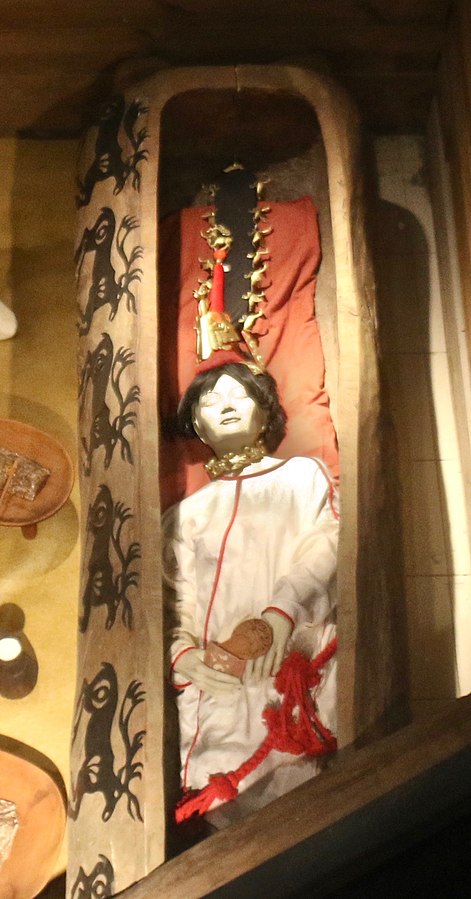
Our oldest piece of inspiration comes from the Altai Mountains in central Asia. In the fifth century BCE, a woman was buried in a tomb on the high Ukok plateau of what is today the Altai Republic in Russian Siberia. The cold, dry climate of the region helped preserve the burial until the late twentieth century when it was discovered and excavated. The woman, popularly known as the Siberian Ice Maiden, was well dressed for her burial, and her clothes were remarkably well preserved. She wore a dress of wool and camel hair, a silk shirt, and thigh-high leather boots, along with a tall headdress made of wood.
For our next historical reference, we look to the Vindolanda Tablets, an assortment of documents written on thin sheets of wood found at a Roman fortress near Hadrian’s Wall in northern Britain. Wooden tablets like these were used in antiquity for personal letters, memoranda, and other everyday documents of the kind that rarely survive for very long. These documents were written in the first and second centuries CE, and survived because they were preserved in waterlogged ground around the fortress. Among them we find the household accounts of Roman soldiers and officers detailing what sort of clothes they were spending their money on. A couple of tablets record the business affairs of a man named Gavo. We do not know who he was or what role he played in the life of the fort, but he seems to have supplied a lot of clothing and other textiles. One tablet lists some foodstuffs along with several bedspreads, a cloak, and thirty-eight pounds of wool. (Tabulae Vindolandenses II 192) Another tablet, part of whose text has been lost, listed at least ten cloaks of different types, three tunics, seventeen hooded cloaks, and some number of capes. (Tabulae Vindolandenses II 207) Yet another letter—we don’t know from or to whom—evidently accompanied a gift of underwear, socks, and sandals to some lucky soldier. (Tabulae Vindolandenses II 346)

Our last piece of inspiration comes from Egypt in the late antique period, probably the fifth century CE. It is a beautifully preserved tunic made of linen with intricate decorations woven into the fabric in dyed wool. The decorations include flowing vine motifs and depictions of the god Dionysus in surrounded by mythical sea creatures.

We’ve chosen this set of examples to inspire our fictional wardrobe for a few reasons. Between them they span nearly a thousand years of history across Asia, Europe, and North Africa. They come from a wide range of environments, from the cold, arid heights of Central Asia to the hot, dry Egyptian desert to the rainy British Isles. The Ukok woman presents us with the complete outfit of one person; the Egyptian tunic gives us a detailed look at the construction of one garment; and the Vindolanda Tablets help us see individual items of clothing in the context of a larger economic and social world.
Our Example Outfit Described
For the purposes of quantifying necessary raw materials and production time to make a single outfit, we needed a specified set of clothing.
Our imaginary wardrobe starts with a long linen undertunic or short linen underdress. (From the point of view of materials and time required, we consider a dress very roughly equivalent of pants plus a tunic.)
The underlayer is topped by a silk overtunic. For the under- and overtunics, we imagined a simple T-style cut. Many historical tunics use gores at the side and central seams to add comfort, but we’ll try to keep our numbers manageable and stick with a basic design.
In addition, we include leather shoes or boots. Finally, a good-sized, rectangular wool cloak or mantle protects the wearer from elements.
For simplicity’s sake, we postulated a dyed but otherwise unadorned outfit, since the size and amount of decorative banding, embroidery, etc., can vary so widely. Accessories like underwear, wool socks and wool legwraps, hoods and headwear, belts, pouches, bags, and the like were also left out of our example.
How It Happens looks at the inner workings of various creative efforts.
 Co-Geeking


One thought on “Making Clothes 2: Historical Inspirations”
Comments are closed.