We don’t usually think of cities as places where food is grown. Farmland is a rural thing, and the harvest must be brought to urban markets so that city-dwellers can eat. But urban agriculture is nothing new. The destruction of the Roman city of Pompeii by Vesuvius in 79 CE preserved the evidence of extensive food production inside the city walls. One place where ancient Pompeians could get fresh, super-local food was the house known today as the House of the Ship Europa. (The name comes from a detailed graffito on the house wall depicting a sailing ship with that name.)
This house sits among other houses on the southern side of the city. From the outside, it doesn’t look much different from the dwellings around it. On the inside, though, the house owners had made good use of the space they had for growing a variety of foods.
At the rear of the house, a large walled garden space stood open to the sky. Gardens were not uncommon in Pompeii, and many houses had open courtyards for leisure, but not all were as carefully planned as at this house. Archaeologists studied the layout of the garden, pollen deposits preserved under the volcanic ash, the types of planting pots and tools kept in the space, and even the shapes left in the ground by tree roots to determine how this garden was planted and what grew there.
The core of the garden was laid out in regular rectangular planting plots which match the ways Roman agricultural writers like Cato and Varro recommended planting grapevines. The roots of one large tree were identified as a filbert, a tree which is often planted at the edges of vineyards in modern Italy. The pollen samples from the site had an unusually high amount of grass pollen compared with other Pompeian gardens; while in other houses grasses were weeded out out flower beds or kitchen garden plots, at the House of the Ship Europa, grassy paths were allowed to grow between the grape vines.
Smaller tree roots were found in regular rows along the walls. Since young fruit and nut trees are typically grown by grafting branches from the desired species onto rootstock that may come from a different kind of tree, we cannot tell from the roots alone what smaller trees were planted in this garden. The rootstocks would have been suitable for plums, peaches, cherries, figs, olives, or almonds, and some or all of these foods may have been grown at the house. Elsewhere in the garden were a number of large perforated ceramic pots whose shape and size match the types of planting pots Roman writers recommended for growing citrons, a citrus fruit and ancestor of the lemon.
The burnt remains of filberts, grape seeds, figs, beans and dates were scattered in the layer of volcanic ash that covered the garden. Most of these plants could have been grown at the house, but date palms do not produce fruit in the climate of Italy, so the dates must have been imported. Perhaps the Europa celebrated on the wall of the house was a trading ship belonging to the family. The house may have functioned as a store selling both their own locally grown fruits and nuts and some imported produce from elsewhere in the Mediterranean.
The House of the Ship Europa gives us an idea of what kinds of foods were grown within the walls of Pompeii and were part of the diet of city’s residents. The city was not just a place of residence, but also an agricultural landscape, and we must imagine that other ancient cities were as well.
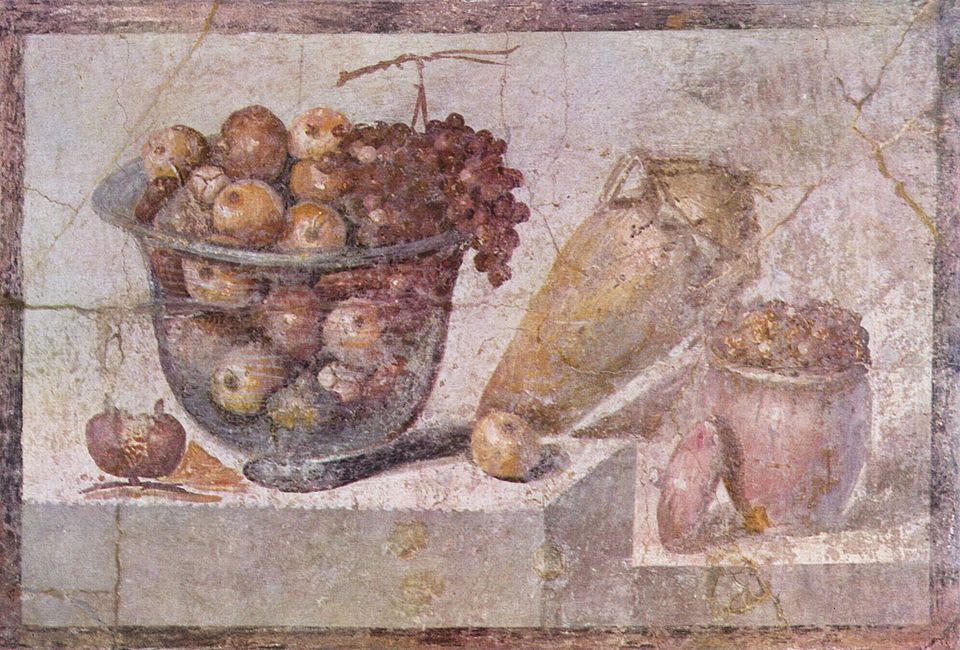
Image: Fresco of fruits, photograph by the Yorck Project via Wikimedia (House of Julia Felix, Pompeii; c. 70 CE; fresco)
Out There highlights intriguing art, places, phenomena, flora, and fauna.
Winter is upon us here in the northern hemisphere. We’re settling in for cold days and long, dark nights. Here’s how the winter season was imagined in late Roman Britain.
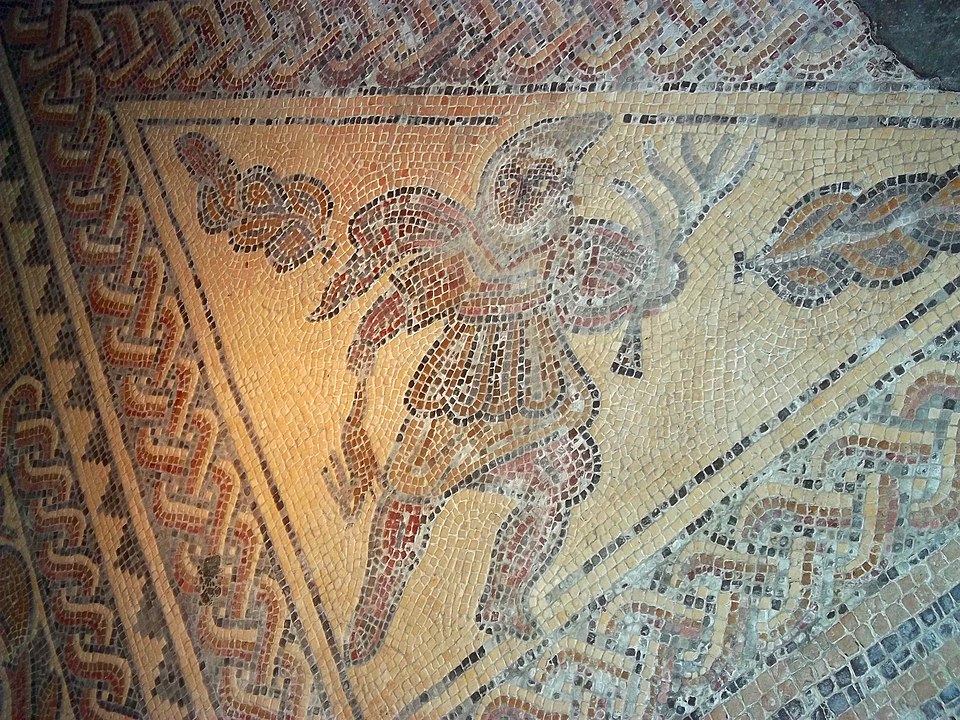
This figure comes from a floor mosaic at Chedworth Villa in western Britain. Each corner of the mosaic had a little allegorical figure representing one of the seasons. Winter appears bundled up in warm layers with a hooded cloak, carrying a hare in one hand (the reward of a hunt), and a symbolic leafless branch in the other.
Wishing you a warm, cozy, and cheerful winter season!
Image: Winter from Chedworth dining room floor, photograph by Pasicles via Wikimedia (Chedworth Roman Villa; 4th c. CE; mosaic)
Out There highlights intriguing art, places, phenomena, flora, and fauna.
Some modern holidays, including Halloween and Dia de los Muertos, are rooted in the idea that on certain special occasions the spirits of the dead can return and walk among the living. The living can join the celebrations by disguising themselves to mingle with the spirits.
The ancient Romans did not celebrate a holiday quite like our modern ones, but the idea that the dead could still be present in the living world, and that living people can use masks and costumes to blur the line between living and dead, is one that they would have recognized. Here is a detail of Roman funeral customs reported by the Greek historian Polybius:
After burying the body with the customary rites, they place an image of the deceased in the most prominent part of the house with a wooden shrine around it. This image is a mask of the deceased’s face, shaped and painted to be an extraordinary likeness of the dead person. They display these masks with great reverence on public occasions, and whenever some prominent member of the household dies, they are worn by participants in the funeral procession, whoever seems to best match the original’s appearance in shape and size. They also don appropriate clothing: if the ancestor was a consul or praetor, a toga with purple edges; if a censor, a wholly purple toga; if he had celebrated a triumph, a toga worked through with gold.
Polybius, History of Rome 6.53
(My own translation)
Our modern traditions are different (these Roman worthies weren’t going trick-or-treating), but there is something ancient about the feeling that, on certain special occasions, the line between living and dead may not be quite as clear as we think.
History for Writers looks at how history can be a fiction writer’s most useful tool, from worldbuilding to dialogue.
There’s an old law of probability often phrased that if an infinite number of monkeys sat at an infinite number of typewriters pressing random keys for an infinite amount of time, they would at some point type out Shakespeare’s Hamlet. The point is that, given a large enough scope of opportunity, things that are very unlikely but not impossible can and do happen.
One of the earliest known expressions of this idea comes from the Roman statesman and philosopher Cicero, although Cicero takes the negative view. He poses the idea as a thought experiment to reject materialist philosophies, like Epicureanism, which held that the world was not created by the gods but was the product of random collisions of matter:
How can anyone look on these things yet convince themselves that certain solid and discrete bodies are carried by force and gravity, and the beautiful and exquisite world is made by the fortuitous arrangement of these bodies? If someone thinks this is possible, I don’t see why they shouldn’t also think that innumerable shapes of the twenty-one letters, made out of gold or whatever material, could be tossed down on the ground so that one could read the words of Ennius’ Annals in them. For myself, I doubt that chance could make a single verse out of them.
Cicero, On the Nature of the Gods 2.93
(My translation)
As unlikely as it is that just tossing letters down on the ground once will yield any comprehensible lines from Ennius’ early Roman historical epic, the infinite monkey theory tells us that if we threw an infinite number of letters an infinite number of times, some verses of Ennius would eventually emerge, not to mention lines from Cicero himself, or any other text that could be written in the Latin alphabet.
One might say that Cicero’s mistake was an insufficiency of monkeys.
Serving exactly what it sounds like, the Quotes feature excerpts other people’s thoughts.
Cults are a staple of modern fantasy. When you need a shadowy organization for your hero to go up against, whether they’re protecting an ancient secret or scheming to bring about the end of days, you can’t go wrong with a cult.
There are plenty of modern examples of secretive organizations that draw in forlorn or gullible people and condition them to submit to the will of charismatic leaders. Such organizations can serve as models for imagining fictional cults, but if you want to write a cult in a fantasy setting, it can be helpful to look at ancient examples. One of the oldest documented examples of a secretive religious organization in conflict with larger society is the ancient Roman cult of Bacchus.
The cult of Bacchus emerged in southern and central Italy in the late third century BCE. It was centered on the worship of the god Bacchus, a version of the Greek Dionysus associated with wine, fertility, and ecstatic release. The Italian Bacchus also borrowed some traits from the Roman god Liber, connected with grapevines, wine, fertility, and freedom. The worship of Dionysus, Bacchus, and Liber was well established as part of the state religion of the Roman republic, which by this time had solidified its control over the whole of the Italian peninsula. The cult of Bacchus was a new religious movement that drew on older traditions but offered its followers new ways of celebrating them.
Followers of this movement practiced their worship in secret, not as part of the state-sanctioned public religion. Only initiated members of the cult were allowed to join in. Unlike traditional Roman religious celebrations, which maintained distinctions between social classes and had separate roles for men and women, initiates of Bacchus included people of all genders and classes who mixed together indiscriminately in their rites. Celebrations were raucous nighttime affairs that featured feasting, drinking, music, and dance.
The Roman elite was scandalized by the popularity of this religious movement. All the surviving sources describing its activity come from this hostile perspective and include lurid suggestions that the Bacchic revelers were practicing magic, engaging in wild sexual frenzies, and scheming at poisonings and other nefarious deeds. Despite these unfavorable sources, there is no reason to think that the cult of Bacchus was actually so outrageous. Seen in the context of the time, we may actually find the cult appearing in a much more favorable light.
To understand the cult of Bacchus, we need to set aside both the hostile attitude of the Roman elite and many of our modern associations with the term cult. While we associate the term today with secretive, manipulative organizations, cult, in its historic use, refers simply to the set of practices that are appropriate to the worship of a particular god or divine entity. All ancient gods received cult from their worshipers, from the official ceremonies for gods of the state to the everyday rituals that attended family and household spirits. Although the cult of Bacchus carried out its rituals in private, there is no indication that the organization was manipulative or coercive, or that members were isolated from the rest of society. In fact, in many ways, the cult offered a positive experience for its members.
Italy in the late third century BCE was recovering from the devastation of the second Punic War. From 218 to 204 BCE, the Carthaginian army led by Hannibal operated largely unchecked in Italy. The effects of war were far-reaching. Many young people from Rome’s Italian subjects were called up to fight in Rome’s legions, some never coming home again. Roman and Carthaginian armies alike ravaged farms up and down the peninsula. In the aftermath of the war, many small farms faced ruin, and a lot of Italian families had little choice but to sell their land to the aristocratic elite at whatever price they could get and move into cities like Rome looking for any work they could find to scrape together a living. Italy in the late third and early second centuries BCE had a vast population of poor people barely getting by, dislocated by war and poverty from their ancestral homes, and resentful of the elite who had come out of the war riding high on plunder and foreign slaves.
The cult of Bacchus offered relief from the pressures of life—if not a hope for a better world, at least a temporary distraction from the troubles of this one. It helped people who had been displaced from deeply rooted ties of family and community find new connections outside the limitations of gender and class. For people who had little joy in their lives and faced a hard daily grind just to eat, the appeal of a celebration full of food, music, and dance was strong. It’s not hard to understand why the cult gained a following in post-war Italy.
It’s also not that hard to see why the Roman aristocracy reacted with such alarm and hostility. The Second Punic War had hit Rome hard. Even though the Romans emerged victorious over Carthage in the end, a generation of potential recruits for Rome’s armies was killed or wounded in the fighting. Rome’s resources were stretched to the limit. What’s more, the war exposed weaknesses in Rome’s hold on Italy. Hannibal’s strategy was to deny Rome resources and fighting power by helping its subjects in Italy rebel. Not all of Italy took Hannibal up on his offer, but enough cities did, especially the Greek cities of southern Italy, to make the Roman elite nervous about their ability to maintain control of the peninsula. Since the cult of Bacchus particularly appealed to the southern Italian Greeks, it doesn’t take much to see why the Roman aristocracy in the years after the war saw disaffected poor Italians gathering together in secret and challenging established social lines as a dangerous thing that needed to be stamped out. The Roman state aggressively suppressed the cult of Bacchus, the first documented example in Western history of a religious movement persecuted by the state.
The cult of Bacchus may not fit the mold of the classic sinister fantasy cult, but understanding the context in which it arose and the forces which drew people to it can help with the worldbuilding for a story in which a cult may not be so benign. Desperate times drive people to find community, relief, and happiness in whatever ways they can. The cult of Bacchus was in reality a benevolent organization that provided much-needed fellowship, but unscrupulous people and organizations can take advantage of the same needs for darker ends.
Image: A scene of Bacchic revelry from a Roman sarcophagus, photograph by Wolfgang Sauber via Wikimedia (currently Anatalya Archaeological Museum; 2nd c. CE; marble)
History for Writers looks at how history can be a fiction writer’s most useful tool, from worldbuilding to dialogue.
The ancient Roman naturalist Pliny the Elder wrote a good deal about painting. His interest stemmed from curiosity about which plants and minerals were used to make make pigments, but he also recorded the names of famous artists and some details about their paintings.
Unlike the stretched canvases we are used to today, ancient painters worked on wooden panels, of which extremely few survive, or on plastered walls, a few of which have survived in places like Pompeii and Dura-Europus. Most of the famous painters of antiquity were men, but Pliny makes sure to note that women also took up the brush.
Women have also painted. Timarete, daughter of Micon, created the very old panel painting of Artemis of Ephesus. Irene, daughter and student of the painter Cratinus, painted an Eleusinian maiden, Calypso, Theodorus the juggler, and Alcisthenes the dancer. Aristarete, daughter and student of Nearchus, painted Aesculapius. Iaia of Cyzicus, who was a lifelong virgin, painted and engraved ivory at Rome during the youth of Marcus Varro [late second century BCE]. She mostly made images of women, including a large panel painting of an old woman at Naples, as well as a self-portrait made using a mirror. Nobody had a faster hand for painting than she did, and in fact she was so accomplished an artist that the prices for her works far exceeded those commanded by Sopolis and Dionysius, who were the most celebrated portrait painters of the time and whose paintings fill the galleries. A certain Olympias was also a painter, but all that is recorded about her is that Autobulus was her student.
Pliny the Elder, Natural History 35.147-48 (=35.40)
(My own translation)
Women created famous works, were paid well for their craft, and taught others. It is unsurprising that some of these women were daughters of well-known male painters, since art was often a family business in the ancient Mediterranean.
Wooden panel paintings were among the most highly-prized forms of art in ancient Greece and Rome. Thanks to writers like Pliny, we know more about the famous painters of antiquity and their paintings than we would ever know from the few examples that survive today. It is good to have evidence that women, too, took part in this prestigious art form.
Image: Women preparing for a ritual, cropped from a photograph by WolfgangRieger via Wikimedia (Pompeii, Villa of the Mysteries; 1st c. BCE; fresco)
Serving exactly what it sounds like, the Quotes feature excerpts other people’s thoughts.
If someone out there is looking for a good plot for an ancient Roman mystery thriller, here’s a tip. There’s a famous case in classical Roman law according to which it is possible to get someone killed and face no legal consequences. The catch is: you have to get lucky, and you have to use a wild animal like a bear.
To start with, we have to lay down a few fundamentals of Roman law: dominium and possessio. Dominium means ownership, the absolute right to control a particular piece of property. Possessio, unsurprisingly, means possession, the direct control of property.
In most cases, people have both dominium and possessio at the same time. You own a vase, which you keep in your house as decoration on a table—you have both the legal right to that vase (dominium) and direct physical control over it (possessio). It is also possible to have one without the other. If you lend that vase to a friend so they can decorate their house for a party, you still own the vase (dominium) even without possessio; as long as your friend has it in their house, they have possessio, but that doesn’t give them dominium.
Now, if someone uses that vase to smash someone over the head and kill them, it doesn’t matter who owned or possessed the vase. Inanimate objects are not responsible for what people do with them. The person who did the smashing is liable for the results of their actions. Neither an owner nor a lawful possessor is liable for what other people do with their property.
With animals, though, we get into a more complicated area. Sometimes people can directly provoke animals to cause harm, like spooking a herd of cattle into a stampede or siccing a dog on another person. In those cases, Roman law recognizes that the person who provoked the animals is responsible for the harm they caused, in the same way that someone who picks up a vase and smashes it over someone else’s head is responsible for the damage done by the vase. Yet animals can also act on their own initiative. A charging bull or biting dog can ruin someone’s day without a person directly commanding it, and you can’t sue an animal for the damage it causes.
To deal with cases where animals caused harm without direct human intervention, Roman law provided the action of pauperies. In a lawsuit for pauperies, the owner of an animal was held legally liable for harm the animal did when acting on its own nature. It didn’t matter whether the owner caused the animal to act, or was even present when the damage was done. The person who had dominium of an animal was responsible for what that animal did. (There was a limit, however: if a person was sued for damages done by their animal, they could escape all liability by handing over the animal in question to the wronged party. In this way, the limit of liability was the value of the animal itself.)
For domesticated animals, pauperies provided a degree of legal recourse, because a domestic animal always belongs to someone. Even if your bull breaks out of its paddock and goes on a rampage through town, it’s still your bull. Once the bull is off your property, it is no long in your possessio, but you still have dominium and the legal liability that goes with it.
Wild animals are a different case. Under Roman law, you can have dominium over a wild animal only so long as you have possessio of it. If you are hunting a deer and catch it in a trap, the deer belongs to you as long as it is in your trap or if you can get a rope on it to wrangle it back to your property, but if it breaks free and runs off through the woods, you loose your claim to it unless you catch it again. If another hunter kills the deer while it is running from you, you have no recourse against them, because as soon as the deer is out of your possessio, it is also out of your dominium.
So far so good. All of these legal principles have a sound practical purpose and make logical sense. When we put them together, though, an unexpected result emerges.
Suppose you have a bear in a cage. A bear is a wild animal, like a deer, so as long as it is in your direct physical control, it belongs to you. If the bear reaches out of its cage and mauls someone, you are legally on the hook for damage because it is an animal in your dominium. But what if it gets out? Once the bear escapes its cage and is running free, you no longer have direct physical over it, so you lose possessio. Because it is a wild animal, not a domestic one, as soon as you lose possessio, you also lose dominium. On one hand, that means that if someone else captures or kills the bear, you have no legal right to sue them or demand they return it to you. On the other hand, you also have no legal liability for any damage the bear does.
It would take a lot of luck to pull off, but if you can concoct the right scenario where a dangerous animal gets loose at the right time and kills the person you want to target, under Roman law, you would be free and clear.
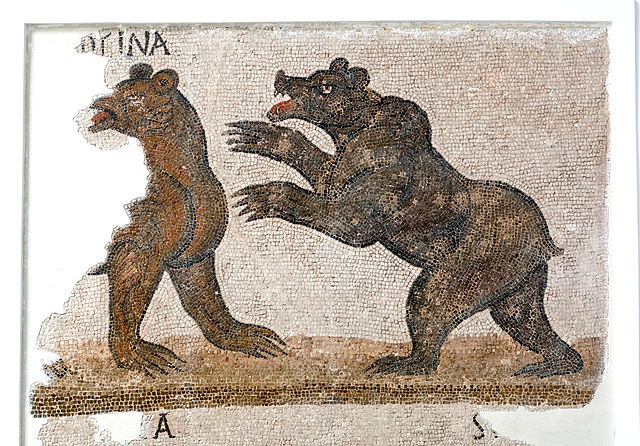
Image: Roman mosaic of a bear, photograph by Jerzystrzelecki via Wikimedia (currently Bardo Museum, Tunisia; Roman period; tile mosaic)
History for Writers looks at how history can be a fiction writer’s most useful tool, from worldbuilding to dialogue.
At least since Tolkien’s Ents smashed up Isengard, the idea of resurgent nature rebelling against those who would destroy it has been a theme in modern fantasy. The idea seems to be a product of modern industrialization and environmentalism. There is no comparable trope in the literature of the ancient Mediterranean, but the idea that humans exist in a relationship with nature that must be properly observed and maintained does find echoes there. The early Roman writer and politician Cato the Elder included this advice in his handbook on farming for those who wanted to cut down trees to clear land:
This is the Roman custom when clearing a stand of trees. With the sacrifice of a pig, use these words: “Whether you are a god or a goddess to whom this wood is sacred, since it is fitting for you to receive the sacrifice of a pig for the clearing of this wood, therefore for these reasons, whether I do it myself or someone does it at my command, let it be correctly done. Therefore with the burnt offering of this pig I pray the correct prayers, so that you may look kindly on me, my family, my household, and my children. For these reasons, therefore, may the burnt offering of this pig be worshipfully made.”
If you wish to plow the ground, make another sacrifice in the same way, adding the words: “for the purpose of doing this work.” As long as the work is ongoing, the same ritual must be done every day in some part of the land. If you miss a day, or if public or family celebrations interrupt the work, you must perform an additional sacrifice.
Cato the Elder, On Agriculture 139-40
(My own translation)
Cato does not elaborate on what might befall a farmer who failed to perform the correct ceremonies. Given what we know of Roman religion, it is more likely that bad luck or a poor harvest was the feared consequence, not angry spirits coming out of the woods to wreak havoc. Still, the idea that interfering with nature is something to be done carefully and with a good purpose is an ancient one.
Serving exactly what it sounds like, the Quotes feature excerpts other people’s thoughts.
Fulvia was a descendant of one of the leading families of the Roman republic and wife of Marcus Antonius, one of the men responsible for its end. Her family commanded both respect and enormous financial resources. While there was no formal role for women in Roman politics, aristocratic women were often important in connecting families and individuals. Fulvia went further than most Roman women, aiding her husbands’ ambitions not just with her family connections but with a canny knack for political theatre. She even raised and helped to lead her own army in the penultimate stage of the Roman civil wars.
The politics of the late republic were chaotic and sometimes violent. The violence of the times was a symptom of a deeper shift in the political and social landscape. Changes were under way in the Roman world that not everyone was astute enough to recognize or skillful enough to manage. Fulvia was among the most skillful players of this game, and although she ended up on the losing side, her history is a valuable window into what it took to survive the politics of the end of the republic.
From its earliest days, the Roman republic had survived by balancing the interests of two groups: the wealthy aristocracy and the ordinary people of Rome. The balance was not always easy to strike, and early Rome went through periods of tension, even violence, as these two groups hashed out a way of living together. Many things bound these groups together. The people fought in Rome’s armies, led by aristocrats; while generals got the glory that came with victories, the citizen-soldiers who fought for them expected to see their share of the profits of war. Elite families dominated the competition for political office, but they depended on the people to elect them, and could not afford to entirely ignore the peoples’ needs and opinions. Ties of patronage ran through all levels of Roman society, as the more privileged exchanged favors and protection for the services and support of those lower down the social ladder. For most of the history of the republic, the rich and the poor found ways of working together—sometimes with gritted teeth and held noses, but together nonetheless.
In the second century BCE, the compromises and concessions that had kept Rome functional began to break down. By this time, Rome had become a Mediterranean empire, but its politics were still organized for a city-state. The profits of conquest on such a grand scale made some of the rich so rich that they could now buy off voters, bribe juries, and force their way through political life without adhering to the traditional compromises. While the rich were getting richer, economic changes buffeted the poor, leaving many without the means of making a living.
Roman politicians of the late republic had divided into two camps, calling themselves the optimates and the populares. The optimates represented the interests of the elite. They tended to be conservative, even reactionary. The populares depended on the common people as their base of support. They pushed for reforms to better the lives of Rome’s poorer citizens at the same time as they rabble-roused in support of their own ambitions. Neither group was a political party as we would understand it, with a coordinated message or strategy, but individual politicians triangulated themselves between these two interest groups.
Optimates and populares alike were slow to realize that the political ground was shifting under their feet. By the end of the republic, there was a third constituency up for grabs whose support would be key to political success. In the last century of the republic, The Roman army had shifted away from the old model of a citizen militia into a professional force, which meant that the interests of soldiers were no longer the same as the interests of civilians. Rome’s soldiers and veterans were themselves slow to coalesce as a political force, but the middle of the first century BCE, astute politicians were starting to realize that Roman politics now had three major interest groups, not two: the aristocracy, the people, and the army. Success would come not to those who most ardently supported one, but who could most skillfully coordinate the support of at least two, if not all three.
Fulvia was one of the people who grasped this new reality. From her early days as a political actor, she was deep in the realm of the populares. Her first husband was Publius Clodius Pulcher, a scandal-prone popularis leader who was loved by the people as much for his outrageous provocations against aristocratic convention as for his reformist policies. Clodius also exerted power through his patronage of armed gangs on the streets of Rome. Fulvia and Clodius were inseparable, and she was as much a part of his public life as any of his male allies. When Clodius was killed in a clash with a rival’s gang, Fulvia had his bloody body publicly displayed, knowing the sight would rouse his supporters among the people. Under her leadership, Clodius’ followers smashed their way into the Senate house and turned it into Clodius’ funeral pyre.
After Clodius’ death, Fulvia retained the loyalty of his street gangs and was one of the few members of Clodius’ circle who remained in Rome amidst the optimatis backlash. She married again to Gaius Scribonius Curio, a former optimatis turned popularis. Unlike Clodius, Curio had some military experience under his belt. He and Fulvia allied with the rising general Julius Caesar, and Curio was tasked with recruiting soldiers for Caesar’s bid to take over the Roman state. Curio died while commanding part of Caesar’s army in Africa.
After Curio’s death, Fulvia married again, aligning herself even more closely with Caesar’s cause by taking his right-hand man Marcus Antonius as her new husband. Fulvia brought with her not only her family’s wealth and connections but also her ties to Clodius’ clients and supporters. After Caesar’s assassination, Antonius skillfully stage-managed his funeral as an opportunity to whip up the anger of the people against the assassins and their aristocratic supporters, and it is likely he was guided by Fulvia’s expertise at provoking and channeling popular outrage.
When Antonius and Caesar’s heir Octavian became the leaders of the two sides in a new round of civil war, Fulvia vigorously supported her husband, not just politically but militarily. Together with Antonius’ brother, she traveled around Italy raising troops for Antonius’ side and visiting towns where veterans had been settled to remind them of their loyalty to Antonius. While Antonius was away in the east, Fulvia’s army briefly held Rome against Octavian before being forced out, besieged at Perusia, and finally defeated. Fulvia was sent into exile, where she died of an unknown illness.
The literary sources are not kind to Fulvia, and they may exaggerate some elements of her life. She was on the losing side of the final stage of the Roman republic’s self-destructive civil wars, and like her husband Antonius, her memory was tarnished by Octavian’s supporters. A frequent theme in anti-Antonius propaganda was to portray him as effeminate, so making out his wife to have been overly masculine was a natural addition. Nevertheless, it seems clear that Fulvia was not shy of engaging with the man’s world of politics and war. She was a confident political operator, a popularis provocateur, a chief of street gangs, and a capable recruiter and leader of soldiers. She learned from the men in her life and shared the lessons she had gained from them.
What’s more, she grasped the fundamental shift in late republican politics: it was no longer enough to be with the aristocrats or with the people. Neither popularis nor optimatis could prosper if they did not get the support of the soldiers. It was a truth that the most successful politicians of the age, men like Caesar and Octavian, had realized, and a fact that laid the ground for the imperial age to come. If some of the civil war’s battles had turned out differently, we might look back to Fulvia as one of the founding figures of Rome’s first dynasty.
Image: Coin portrait of a woman, possibly intended to be Fulvia; photograph by Classical Numismatic Group via Wikimedia (Copenhagen; c. 41-40 BCE; copper alloy)
History for Writers looks at how history can be a fiction writer’s most useful tool, from worldbuilding to dialogue.
When you go on vacation, you want to make sure you get the best experience. If you’re rich enough, other people will do it for you. That was just as true in the past as it is today. Here’s a fragment of a letter that has survived on papyrus from the Ptolemaic period in Egypt about preparations for a tour of the Faiyum oasis.
A Roman senator, Lucius Memmius, was touring Egypt in the late second century BCE. Someone in Alexandria wanted to make sure that Memmius had a good trip, so instructions were sent on ahead to make sure everything was ready for the important guest.
From Hermias to Horos, greetings. Attached is a letter to Asclepiades. Make sure that these instructions are followed. Be well. Year 5, 17th of Xantikos, 17th of Meikheir (March 5, 112 BCE)
To Asclepiades.
Lucius Memmius, a Roman senator who holds a position of great worth and honor, is making a grand expedition from the city [of Alexandria] to the Arsinoite nome to see the sights. See that he is properly welcomed, and take special care to see that lodgings are furnished along with landing places at the proper locations […] Make sure that the welcoming gifts listed below are ready to be handed over to him at the landing places, and that the furnishings for the lodgings, the usual morsels for Petesouchus and the crocodiles, the equipment for visiting the Labyrinth, the […] and the offerings and supplies for the household sacrifice are provided. In all respects, take the greatest care that everything should be prepared for his enjoyment, and be zealous […]
P. Tebt. (Papyri from Tebtunis) 1.33
(My own translation)
It looks like Memmius’ itinerary included watching crocodiles being fed and visiting the Labyrinth, a sprawling ancient temple complex whose walls and passageways were famous in antiquity.
It’s also interesting to note that, although Hermias wanted to make sure that special care was taken for Memmius’ visit, Memmius was evidently following an established tourist route. Hermias does not need specify where lodgings should be prepared for him or what equipment is needed for visiting the Labyrinth. The crocodile feeding was apparently a customary spectacle. Asclepiades clearly knew what to do to receive an important visitor, Hermias just wanted to make sure he did it. Faiyum tourism was evidently an established practice at the time.
History for Writers looks at how history can be a fiction writer’s most useful tool, from worldbuilding to dialogue.



 Co-Geeking


047(js).jpg)

You must be logged in to post a comment.