Imagining a Minoan Home

Imagining the mundane details of daily life in past cultures can be difficult. Everyday things like houses, clothing, and daily routines tend not to be well-represented in textual or archaeological sources because they were so ordinary that no one thought to write about them or take care to preserve them. Yet these are exactly the sorts of everyday details that can be most useful when looking to the past for inspiration for worldbuilding. To try to understand what daily life looked like in the past, we often rely on chance finds and careful reading of sources that weren’t intended as guides to the mundane.

For example, we have only a limited idea of what an ancient Minoan house may have looked like. The Minoan civilization flourished on Crete and some of the southern islands of the Aegean Sea in the first half of the second millennium BCE, at its height between roughly 2100 and 1400 BCE. Minoan palaces have been thoroughly excavated at sites such as Knossos and Phaistos, but what about the homes of ordinary people?

We have a few valuable sources of evidence. One is this pottery house model found at Archanes, on Crete. This model shows many features that must have been part of everyday Minoan architecture: solid lower-story walls and a breezy columned upper story, windows barred with slats, a projecting balcony, and perhaps a small walled garden. (The entry door is on the other side of the model; the upper story is modern reconstruction.)

House model, photograph by Zde via Wikimedia (Archanes, currently Archaeological Museum, Heraklion; c. 1700 BCE; pottery)

To get a sense of how houses like this fit together to make up a village, we can look to the site of Akrotiri, a Minoan settlement on the island of Thera (now called Santorini) that was buried in a volcanic eruption sometime around the late 1600s BCE. Despite the destructive effects of the eruption, excavation at the site has found a tightly-built settlement of multi-story houses connected by streets and drainage channels.
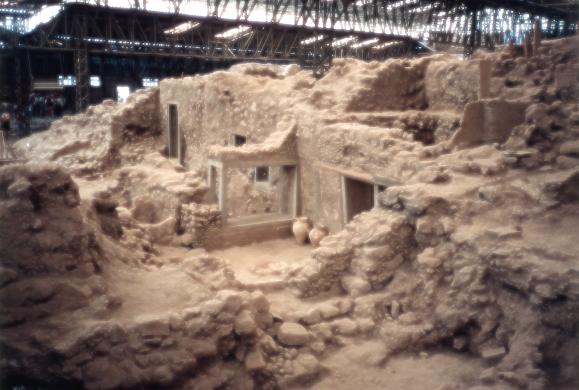
Photograph of Akrotiri excavation by F. Eveleens via Wikimedia


More evidence comes from a fresco that was preserved on the wall of a house at Akrotiri, depicting a panoramic view of the island. This segment shows the town. While the image is a little hard to interpret, we can clearly see a densely-built settlement with houses made of regularly cut stone sitting on many levels. These houses display many of the same features as the Archanes house: low doorways, porticoed porches, windows covered by slats, and people looking out from balconies or rooftops.

Akrotiri fresco, photograph by Dirk Herdemerten via Wikimedia (Akrotiri; c. 1700 BCE; fresco)

Akrotiri fresco, photograph by Dirk Herdemerten via Wikimedia (Akrotiri; c. 1700 BCE; fresco)

When we put all these different sources together, we can begin to imagine everyday life in a Minoan house: the shady lower floor and the breezy upper floor, the slivers of sunlight coming in through the window grilles, the gurgle of water running by in the drain channel right outside, and the endless chatter of the neighbors on their overhanging balcony. For creating any sort of pre-modern culture in a warm, dry setting like the Mediterranean, it’s not a bad start.

History for Writers is a weekly feature which looks at how history can be a fiction writer’s most useful tool. From worldbuilding to dialogue, history helps you write. Check out the introduction to History for Writers here.
Celebrating Hidden Youth With Rhodopis

161121bendisHidden Youth comes out today! Among the many short stories in this collection about young people from marginalized groups in history is my story, “How I Saved Athens from the Stone Monsters,” about the adventures of two flute girls, one Egyptian and one Thracian, on one strange and terrifying night in ancient Athens. I hope you’ll consider picking up the collection, not just for my story but for all the other amazing work in it.

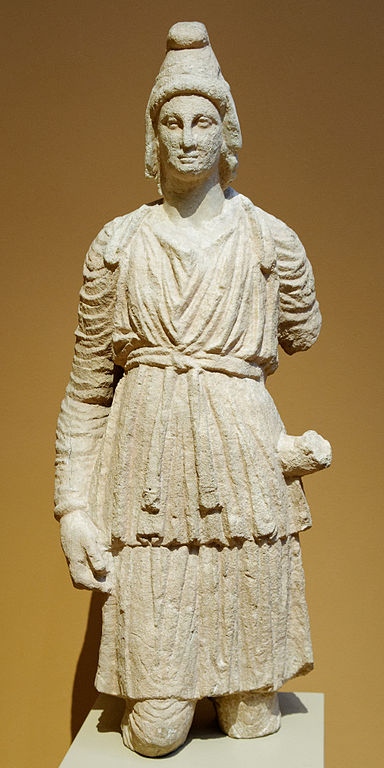
My story was inspired in part by the Egyptian and Thracian immigrant communities we know existed in Classical Athens. There were temples in the city to both the Egyptian goddess Isis and the Thracian goddess Bendis. But Athens wasn’t the only place Egyptians and Thracians crossed paths.

A famous Thracian courtesan named Rhodopis worked in Naucratis, the Greek trading city in Egypt in the 6th century BCE. She seems to have been a larger-than-life character whom people liked to tell stories about. It was apparently widely believed in antiquity that one of the three great pyramids at Giza was built for her by her lovers. Another fanciful story about her is the closest ancient equivalent to the story of Cinderella:

They say that one day, when Rhodopis was bathing, an eagle snatched her sandal from her serving maid and carried it away to Memphis. There the king was administering justice in the open air and the eagle, flying over his head, dropped the sandal in his lap. The king, moved by the beauty of the sandal and the extraordinary nature of the event, sent all through the country to find out whose it was. She was found in Naucratis and conducted to the king, who made her his wife.

– Strabo, Geography 17.1.33

(My own translation)

While this is obviously just a bit of a fairy tale, Rhodopis was a real person. One of her lovers was Charaxus, the brother of the lyric poet Sappho. Sappho evidently didn’t think much of the relationship. A fragment of one of Sappho’s poems throws a little shade the courtesan’s way (referring to Rhodopis as Doricha—it was not unusual for courtesans to use several different names):

O, Aphrodite, may she find you too bitter for her taste,

and don’t let her go boasting:

“What a sweet thing Doricha has got herself into

this time around!”

– Sappho, fragment from Oxyrhynchus papyrus 1231.1.1.(a)

(My own translation)

Herodotus reports that the rich offering Rhodopis made at Delphi at the end of her life to celebrate her good fortune—an enormous pile of iron roasting spits—was still to be seen there in his day. (Herodotus, Histories 2.135)

Rhodopis sounds like she would have been an interesting person to hang around with, and Hidden Youth is one more reminder that interesting people were everywhere in history, not just in the places we expect.

Image: Greek statue of Bendis, photograph by Marie-Lan Nguyen via Wikimedia (Cyprus, currently Metropolitan Museum of Art, New York; 3rd c. BCE; limestone)

Announcements from your hosts.

The Judean Date Palm Lives Again

The only living Judean date palm, at Kibbutz Ketura, Israel. Photograph by Benjitheijneb
The only living Judean date palm, at Kibbutz Ketura, Israel, photograph by Benjitheijneb via Wikimedia

The Judean date palm was a plant of great economic and cultural importance in the ancient Mediterranean. It grew extensively in Judea where it provided shade for people and livestock and its fruit was used for food and medicine. By the modern period, devastation in war and a changing climate had wiped out the trees. Then in the 1960s a two-thousand-year-old seed cache turned up in excavations at the palace of Herod the Great. The seeds sat in storage for another forty years until an attempt was made to cultivate some of them. Amazingly, one of the seeds germinated and grew. In a few more years, we get to find out what ancient Judean dates tasted like. If further efforts to breed the Judean palm with some of its nearest living relatives are successful, modern Judean date palms could return to the Mediterranean.

This story is a few years old, but I only stumbled across it recently. It’s wonderful that some things we once thought lost can come back.

Geeks eat, too! Second Breakfast is an occasional feature in which we talk about food with geeky connections and maybe make some of our own. Yum!