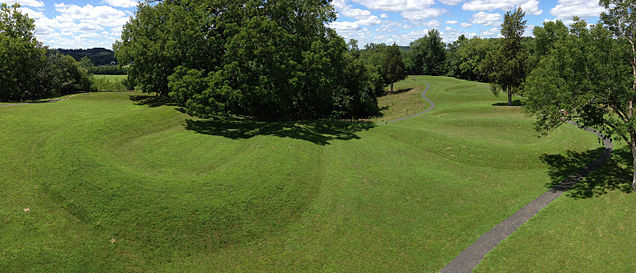
Serpent Mound, located in Ohio in the United States, is an enormous earthwork built on a grassy plateau above Ohio Brush Creek. It is one of many large earthworks in North America, but it is unusual in representing an image when seen from above. This image has been interpreted as a snake swallowing an egg.
Serpent Mound, photograph by Eric Ewing via Wikimedia
The date of construction is uncertain, but recent research suggests that Serpent Mound was created in the last few centuries CE when the river valleys west of the central Appalachian Mountains were occupied by a people known to modern archaeologists as the Adena culture. We have no way of knowing what they called themselves. The Adena were a sophisticated culture at the center of a trade network stretching north beyond the Great Lakes south to the Gulf of Mexico. One of the distinctive features of their culture was the construction of large earthworks, many of which served funerary purposes, but may also have marked ceremonial centers or areas for gathering and trade.
Well, no I don’t actually want one. I don’t have room for one to begin with, and I don’t live in the right climate anyway. That doesn’t change the fact that iwans are cool. Literally.
An iwan is a large room with a vaulted ceiling that has walls on three sides and the fourth side open to the air. They were built in the heat of Mesopotamia to create large shady spaces that were still open to light and air. The earliest iwans are thought to have been constructed under the Parthian empire in the first or second centuries CE. One of the earliest examples to survive into modern times was at Ctesiphon on the Tigris River, built by the Sasanian empire in the sixth century CE. Unfortunately, the building fell into poor repair over time and was destroyed by wars in the twentieth century, but in these old photographs you can still see enormous vaulted space.
Sasanian iwan, from Wonders of the Past vol. 2 via Wikimedia (photograph 1864). Note the people standing on top of the roof vault for a sense of scale.Photograph of the same iwan from half a century later showing ongoing decay via Wikimedia (photograph currently San Diego Air and Space Museum)
Aerial view of Dún Aonghasa, photograph by Ronan Mac Giollopharaic via Wikimedia
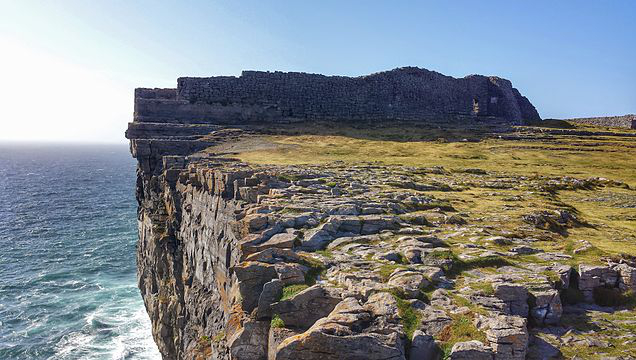
While doing some research on northern European hillforts recently, I found myself looking at some pictures of Dún Aonghasa (also known as Dun Aengus). It’s an impressive site. The fort is a series of concentric half-rings backing up onto 100-meter cliffs on the island on Inishmore off the western coast of Ireland. The earliest construction on the site has been dated to around 1100 BCE. Later additions were made around 500 BCE. It is one of the largest well-preserved examples of a type of structure that was built throughout northern and western Europe, from Spain to Sweden, in the prehistoric era.
The “cheveaux de frise,” a barrier of jagged stones set up to slow down attackers, photograph by Herbert Ortner via Wikimedia
There has been disagreement in the scholarship about the function of Dún Aonghasa and similar forts. While often identified as fortified settlements, some have suggested that they were actually sites of religious ritual. It has to be said that if Dún Aonghasa and sites like it were religious sanctuaries, they were amazingly well-defended ones. I think it is more likely that sites that were originally built for defense were centuries later repurposed as ceremonial sites, much like how medieval castles built for defense have centuries later become museums and tourist attractions.
The walls of Dún Aonghasa and the cliffs of Inishmore, photograph by Jal74 via Wikimedia
It may be hard to believe that such an enormous fortification was built in so remote a place, but forts like Dún Aonghasa were once fairly common across western and northern Europe. Most, however, have been lost to decay, erosion, and the reuse of stones. It is only in remote places like Inishmore that they still survive.
Thoughts for writers
Just a simple thought today: the world is full of interesting possibilities. Fortresses don’t have to look like medieval castles. Religious sites don’t have to look like cathedrals or Greek temples. History is huge and there are amazing things out there to inspire your imagination.
History for Writers is a weekly feature which looks at how history can be a fiction writer’s most useful tool. From worldbuilding to dialogue, history helps you write. Check out the introduction to History for Writershere.
We all know that the pyramids of Egypt were tombs for the pharaohs. (Yes, yes, and landing pads for Goa’uld spaceships; you can put your hands down now.) Thinking about what it took to build them, though, gives us an idea of what else they were.
The construction of the pyramids is a perpetual favorite subject of cranks and crackpots (Lost technologies of Atlantis! Sound waves!). Even among the more reality-bound, there is no end of theories ranging from the mundane (ramps and sledges) to the reasonably plausible (pulleys and levers) to the unlikely but not impossible (poured concrete). No matter what technique we imagine, however, one thing was definitely required: massive amounts of labor.
What most armchair pyramidologists miss about the problem of megalithic construction is that the physics of moving large stones are very simple. Apply enough force to a mass and it will move. Some things can make the application of force easier: ramps, pulleys, rollers, whatever you’ve got, but in the end it’s just a matter of force versus inertia. No matter how you go about building a pyramid, what you need in the end is the same: muscle power and time. With enough muscle power and time you can build pretty much anything, but labor is expensive. The real problem that would-be pyramid builders have to solve isn’t technological, it’s economic. The real question isn’t “How did they build the pyramids?” but “How did they afford the pyramids?”



 Co-Geeking


You must be logged in to post a comment.