Gamer Girls ca. 330 BCE

Image: via Esther MacCallum Stewart
Two girls playing knuckleones via Esther MacCallum Stewart

Not that this should come as any surprise to anyone, but girls have been gamers for over 2,000 years.

Here’s a statuette of two girls playing knucklebones from ca. 330 BCE. In the ancient Mediterranean, the heel bones of sheep (commonly, though inaccurately, called “knucklebones” in English) were used for playing a variety of games, as they still are in many parts of the world today. They could be rolled like dice or gathered up in games similar to jacks, which is what these two appear to be doing.

Knucklebones crossed the whole spectrum of ancient society. Men and women, girls and boys all played. The Greek comic playwright Aristophanes mentions them as the toys of poor children (The Wasps 295) while Suetonius quotes a letter by the Roman emperor Augustus enthusiastically recounting his gaming exploits (The Deified Augustus 71). It is hard to think of a pastime that is so widely shared today.

Of Dice and Dragons is an occasional feature about games and gaming.

The “Sheer Dumb Luck” Table

150910rpg

Sometimes the tools you use the most are the simplest ones. This is one of the simplest things in my arsenal when I run a role-playing game, but I use it all the time.

Your players will often ask you questions that you didn’t think of ahead of time. Is the guard wearing gloves? Are there any pine cones lying around? Does this planet have any beryllium deposits near the surface?

Of course, if it matters to the adventure whether or not the guard is wearing gloves, then you have your answer and you go with it, but often either yes or no will do, you just have to pick one. It can be exhausting to always be having to decide, so you can just flip a coin, but not everything in the world is a fifty-fifty chance. If you’ve already established that it’s a cold night, the chances that the guard is wearing gloves are pretty high.

That’s where the table comes in, which, in honor of my favorite Harry Potter character, I have dubbed: The “Sheer Dumb Luck” table.

150922luck

Simply pick the descriptor on the list that sounds right for whatever your players asked and roll 3d6. Is the guard wearing gloves? Very likely. Are there any pine cones? Somewhat likely. Any beryllium? Virtually impossible. If you roll equal to or under the number given, the answer is yes. If higher, no.

  • 4–Virtually impossible
  • 6–Very unlikely
  • 8–Unlikely
  • 10–Fifty/fifty
  • 11–Somewhat likely
  • 12–Likely
  • 14–Very likely
  • 15–Virtually certain

And the best thing about this table: sometimes, once you’ve rolled, you realize that the opposite answer is actually better. One way or another, you’ve answered the question and the adventure can keep rolling.

Like everything, it’s a tool, not a rule. Not everyone likes to leave as much up to chance in an adventure as I do. Use it if it helps, ignore it if it doesn’t.

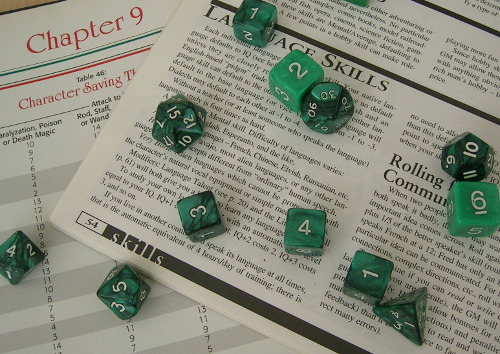
Images: Books and dice by Erik Jensen; “Five points…” via rosereturns.tumblr.com

Of Dice and Dragons is an occasional feature about games and gaming.

Garrisons: Solving the Wrong Problem

Sometimes you put a lot of time and effort into solving a problem, only to realize that you were coming at the problem from the wrong angle and your solution doesn’t actually fix anything, or even just makes things worse. (Or at least I do. I do this all the time.) It’s what I think of as “solving the wrong problem.” Blizzard Entertainment, creators of World of Warcraft, has been solving the wrong problem in the latest expansion, and garrisons are the manifestation of that mistake.

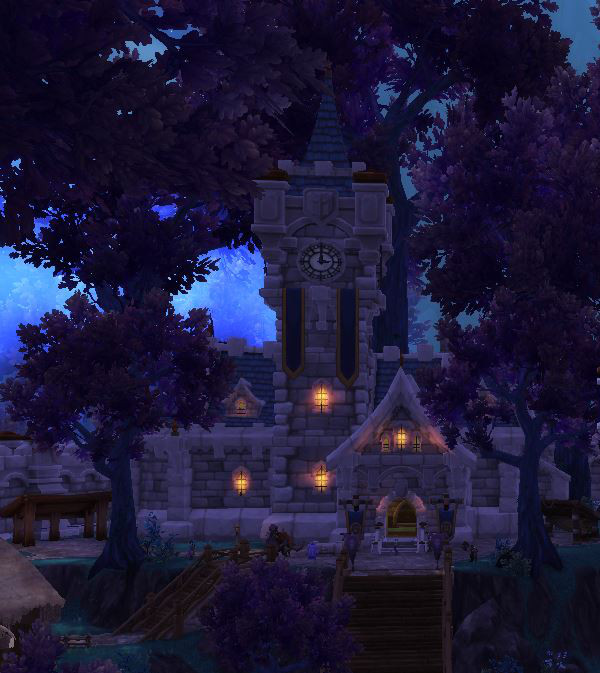
151105agarrison
The Aliance garrison, where I’ve spent entirely too much of my gaming time.

It’s not that there aren’t problems to be solved. WoW‘s player base is getting older and a lot of us have less time to play, can’t sit down and play in long sessions like we used to, and aren’t as interested in investing lots of time and effort into chasing big goals, but we still want to play and enjoy the game. Garrisons were, in my opinion, a good-faith effort at solving this problem, but they came at it from the wrong direction.

This weekend is Blizzcon, Blizzard’s big event when they talk about what’s coming for their games and we’re going to hear all about the next expansion for WoW. I hope we hear something that addresses what garrisons got wrong.

Continue reading

The Rumor Table

150910rpgSo, you’re game-mastering a tabletop role-playing game and your player characters decide to spread out around town and see if they can pick up any useful information about their current quest. How do you handle it?

There are lots of things you can do. If there’s some info you need to dump on them, now’s the time to hand it over. Or if you want them to just head out into the wilderness and figure it out as they go, you tell them that no one knows anything. You can always just make stuff up off the top of your head. Like with most GMing tasks, as long as your players have a good time, there’s no wrong way to do it. Here’s a tool that might make your job a little easier, though: the rumor table.

When I’m planning an adventure and I know that my players are going to have a chance to snoop around and ask questions, I like to prepare a rumor table for what they might find out. The table is a mix of true and false information that is more or less helpful. I plan it for a roll of 2d6 (you can make it bigger or smaller depending on your needs, but I find a 2d6 table covers most cases). For the numbers 2-12, come up with the following tidbits of information:

  • 2 – False, and potentially disastrous if the player characters believe it
  • 3 & 4 – False
  • 5 & 6 – False but with a grain of truth, such as true information that has been garbled or misinterpreted
  • 7 – Equal parts true and false
  • 8 & 9 – True
  • 10 & 11 – True and probably helpful to the characters at the moment
  • 12 – True and very important

Suppose your campaign is The Lord of the Rings and your characters are meeting for the first time at the Council of Elrond in Rivendell. (I mean, imagine a world in which The Lord of the Rings isn’t a famous novel and movie trilogy that your players already know but is your campaign that you wrote and they are playing through for the first time.)

Here’s what your table might look like:

  • 2 – Saruman is secretly on the side of good
  • 3 – Elves from Lothlorien have been attacking outlying villages on the borders of Rohan
  • 4 – Moria is abandoned and free of orcs
  • 5 – Smeagol has been sighted in Mirkwood heading east towards Dale
  • 6 – Rohan pays a tribute of horses to Sauron for the ringwraiths to ride
  • 7 – Denethor of Gondor has a palantir but he refuses to look into it
  • 8 – The Dunedain rangers were searching for Smeagol not long ago
  • 9 – Saruman has ordered the destruction of Fangorn forest
  • 10 – Wargs have been spotted in great numbers in the wildlands south of Rivendell
  • 11 – Theoden king of Rohan has become weak and listless and lets his advisers make most decisions
  • 12 – A balrog lurks in the depths of Moria

There are some advantages to using a rumor table. For one thing, it takes some of the pressure off you to come up with the perfect responses in the moment. Like mapping a dungeon ahead of time, it lets you prepare in advance. It’s also a convenient way of rewarding your players for good role-playing or taking the characters’ advantages into account. If the PC has a charisma bonus and the player does a good job role-playing the asking around, you don’t have to puzzle out just how much better information they should get; it’s easy to just give them a +2 on the rumor roll.

Another good thing about using the rumor table, if your players know that you have one, is it short-circuits the “it must be important or the GM wouldn’t have told us” metagaming. Your players have to think carefully and evaluate the information they get, just like their characters would have to do.

Now, of course, it’s a tool, not a rule. Use it with discretion. If the character your PCs happen to be talking to wouldn’t know (or wouldn’t say) the answer you roll, don’t use it. Either go up or down the table or make up something different. If there are things that your characters really need to know at a given point in the adventure, then that’s what you give them. (You can always roll the dice anyway, so they don’t know when they’re getting plot-critical stuff.)

Happy rumor-mongering!

Image by Erik Jensen

Of Dice and Dragons is an occasional feature about games and gaming.

Men, Women, and Games

Lots of women play video games, and lots of gamers are women. This is not news, yet for some reason we have to keep saying it.

The august Pew Research Center was the most recent group to say it. Here’s their Teens, Technology, and Friendships report from earlier this month about how teens use games, among other online services, to connect with one another. Among many other findings, 84% of teenage boys reported playing video games, as did 59% of teenage girls. All teens reported playing a wide variety of different types of games (which is to say: no, all those teenage girl gamers are not just poking at Barbie Sparkle Kardashian Krush on their phones; they’re doing everything from hacking up orcs in World of Warcraft to building imperial star destroyers in Minecraft).

So, if there are so many women playing games, why don’t male gamers see them? The results of another recent study, Insights into Sexism: Male Status and Performance Moderates Female-Directed Hostile and Amicable Behavior by Michael M. Kasumovic and Jeffery H. Kuznekoff showed that male gamers (specifically playing Halo 3) tended to be more aggressive and abusive in voice chat to players who sounded female than those who sounded male. Also not news. Anyone who’s spent time in any online chat environment is likely to have seen the kind of dreck that gets spewed at women who let their identities be known, so it’s understandable that many female gamers choose to conceal their gender when in mixed company.

The Kasumovic and Kuznekoff study offers another interesting detail, however. The abuse directed at the female-voiced player came primarily from male players who were performing poorly, while men who were doing well at the game tended to be positive or neutral in their comments.

I see three important takeaways from these two studies:

  1. There are women in your games. In fact, if you play a multiplayer game, they are all around you. Just because you don’t know they are there doesn’t mean they aren’t. If you don’t hear women’s voices, it only means that the environment is toxic enough that many women choose to stay silent rather than have to deal with it.
  2. The men who harass women in games are not doing it mindlessly or randomly. They are not equal-opportunity dirt-spewers but target women specifically because they are trying to reassert their position in a hierarchy. The people most invested in any hierarchy are not the ones at the top but the ones who are afraid of falling to the bottom.
  3. If you are a male gamer and you want to look like you’re at the top of your game: don’t spew crap at the women around you. Good gamers are decent to their fellow players. The only ones who feel the need to put others down are the scrubs who can’t cut it.

Of Dice and Dragons is an occasional feature about games and gaming.