We don’t usually think of cities as places where food is grown. Farmland is a rural thing, and the harvest must be brought to urban markets so that city-dwellers can eat. But urban agriculture is nothing new. The destruction of the Roman city of Pompeii by Vesuvius in 79 CE preserved the evidence of extensive food production inside the city walls. One place where ancient Pompeians could get fresh, super-local food was the house known today as the House of the Ship Europa. (The name comes from a detailed graffito on the house wall depicting a sailing ship with that name.)
This house sits among other houses on the southern side of the city. From the outside, it doesn’t look much different from the dwellings around it. On the inside, though, the house owners had made good use of the space they had for growing a variety of foods.
At the rear of the house, a large walled garden space stood open to the sky. Gardens were not uncommon in Pompeii, and many houses had open courtyards for leisure, but not all were as carefully planned as at this house. Archaeologists studied the layout of the garden, pollen deposits preserved under the volcanic ash, the types of planting pots and tools kept in the space, and even the shapes left in the ground by tree roots to determine how this garden was planted and what grew there.
The core of the garden was laid out in regular rectangular planting plots which match the ways Roman agricultural writers like Cato and Varro recommended planting grapevines. The roots of one large tree were identified as a filbert, a tree which is often planted at the edges of vineyards in modern Italy. The pollen samples from the site had an unusually high amount of grass pollen compared with other Pompeian gardens; while in other houses grasses were weeded out out flower beds or kitchen garden plots, at the House of the Ship Europa, grassy paths were allowed to grow between the grape vines.
Smaller tree roots were found in regular rows along the walls. Since young fruit and nut trees are typically grown by grafting branches from the desired species onto rootstock that may come from a different kind of tree, we cannot tell from the roots alone what smaller trees were planted in this garden. The rootstocks would have been suitable for plums, peaches, cherries, figs, olives, or almonds, and some or all of these foods may have been grown at the house. Elsewhere in the garden were a number of large perforated ceramic pots whose shape and size match the types of planting pots Roman writers recommended for growing citrons, a citrus fruit and ancestor of the lemon.
The burnt remains of filberts, grape seeds, figs, beans and dates were scattered in the layer of volcanic ash that covered the garden. Most of these plants could have been grown at the house, but date palms do not produce fruit in the climate of Italy, so the dates must have been imported. Perhaps the Europa celebrated on the wall of the house was a trading ship belonging to the family. The house may have functioned as a store selling both their own locally grown fruits and nuts and some imported produce from elsewhere in the Mediterranean.
The House of the Ship Europa gives us an idea of what kinds of foods were grown within the walls of Pompeii and were part of the diet of city’s residents. The city was not just a place of residence, but also an agricultural landscape, and we must imagine that other ancient cities were as well.
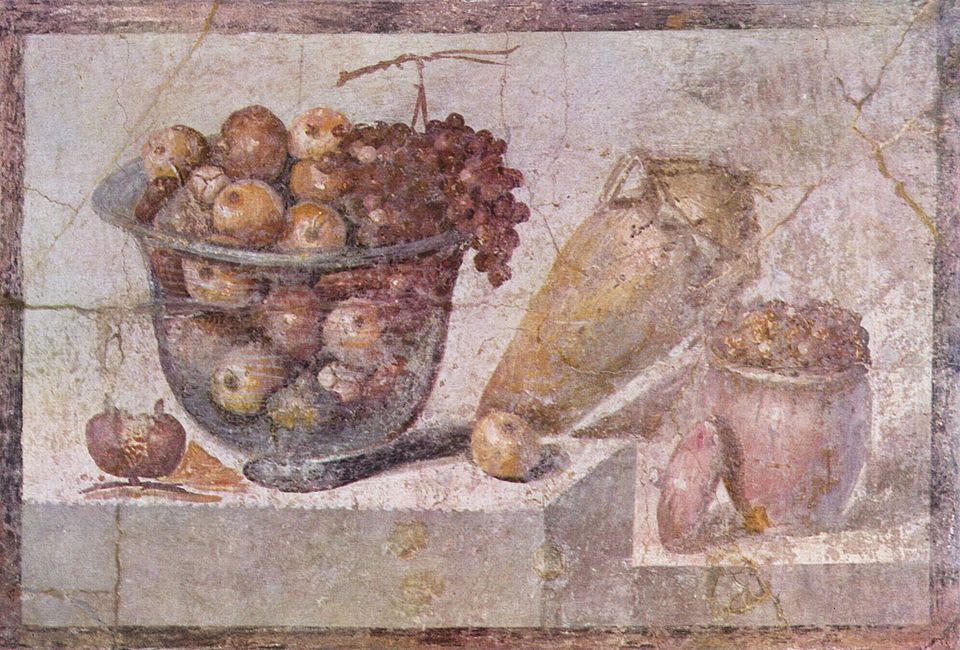
Image: Fresco of fruits, photograph by the Yorck Project via Wikimedia (House of Julia Felix, Pompeii; c. 70 CE; fresco)
Out There highlights intriguing art, places, phenomena, flora, and fauna.
 Co-Geeking
