If someone out there is looking for a good plot for an ancient Roman mystery thriller, here’s a tip. There’s a famous case in classical Roman law according to which it is possible to get someone killed and face no legal consequences. The catch is: you have to get lucky, and you have to use a wild animal like a bear.
To start with, we have to lay down a few fundamentals of Roman law: dominium and possessio. Dominium means ownership, the absolute right to control a particular piece of property. Possessio, unsurprisingly, means possession, the direct control of property.
In most cases, people have both dominium and possessio at the same time. You own a vase, which you keep in your house as decoration on a table—you have both the legal right to that vase (dominium) and direct physical control over it (possessio). It is also possible to have one without the other. If you lend that vase to a friend so they can decorate their house for a party, you still own the vase (dominium) even without possessio; as long as your friend has it in their house, they have possessio, but that doesn’t give them dominium.
Now, if someone uses that vase to smash someone over the head and kill them, it doesn’t matter who owned or possessed the vase. Inanimate objects are not responsible for what people do with them. The person who did the smashing is liable for the results of their actions. Neither an owner nor a lawful possessor is liable for what other people do with their property.
With animals, though, we get into a more complicated area. Sometimes people can directly provoke animals to cause harm, like spooking a herd of cattle into a stampede or siccing a dog on another person. In those cases, Roman law recognizes that the person who provoked the animals is responsible for the harm they caused, in the same way that someone who picks up a vase and smashes it over someone else’s head is responsible for the damage done by the vase. Yet animals can also act on their own initiative. A charging bull or biting dog can ruin someone’s day without a person directly commanding it, and you can’t sue an animal for the damage it causes.
To deal with cases where animals caused harm without direct human intervention, Roman law provided the action of pauperies. In a lawsuit for pauperies, the owner of an animal was held legally liable for harm the animal did when acting on its own nature. It didn’t matter whether the owner caused the animal to act, or was even present when the damage was done. The person who had dominium of an animal was responsible for what that animal did. (There was a limit, however: if a person was sued for damages done by their animal, they could escape all liability by handing over the animal in question to the wronged party. In this way, the limit of liability was the value of the animal itself.)
For domesticated animals, pauperies provided a degree of legal recourse, because a domestic animal always belongs to someone. Even if your bull breaks out of its paddock and goes on a rampage through town, it’s still your bull. Once the bull is off your property, it is no long in your possessio, but you still have dominium and the legal liability that goes with it.
Wild animals are a different case. Under Roman law, you can have dominium over a wild animal only so long as you have possessio of it. If you are hunting a deer and catch it in a trap, the deer belongs to you as long as it is in your trap or if you can get a rope on it to wrangle it back to your property, but if it breaks free and runs off through the woods, you loose your claim to it unless you catch it again. If another hunter kills the deer while it is running from you, you have no recourse against them, because as soon as the deer is out of your possessio, it is also out of your dominium.
So far so good. All of these legal principles have a sound practical purpose and make logical sense. When we put them together, though, an unexpected result emerges.
Suppose you have a bear in a cage. A bear is a wild animal, like a deer, so as long as it is in your direct physical control, it belongs to you. If the bear reaches out of its cage and mauls someone, you are legally on the hook for damage because it is an animal in your dominium. But what if it gets out? Once the bear escapes its cage and is running free, you no longer have direct physical over it, so you lose possessio. Because it is a wild animal, not a domestic one, as soon as you lose possessio, you also lose dominium. On one hand, that means that if someone else captures or kills the bear, you have no legal right to sue them or demand they return it to you. On the other hand, you also have no legal liability for any damage the bear does.
It would take a lot of luck to pull off, but if you can concoct the right scenario where a dangerous animal gets loose at the right time and kills the person you want to target, under Roman law, you would be free and clear.
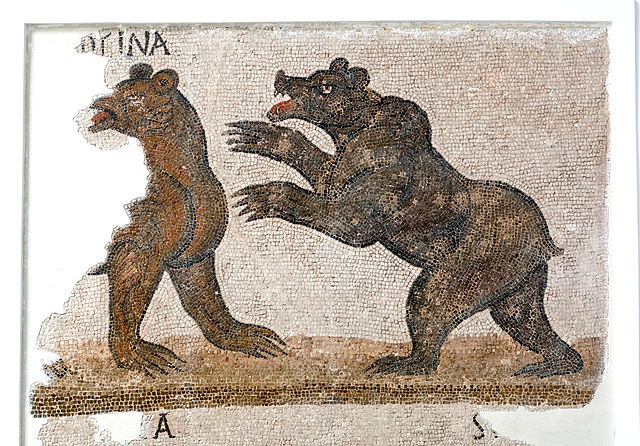
Image: Roman mosaic of a bear, photograph by Jerzystrzelecki via Wikimedia (currently Bardo Museum, Tunisia; Roman period; tile mosaic)
History for Writers looks at how history can be a fiction writer’s most useful tool, from worldbuilding to dialogue.
 Co-Geeking
047(js).jpg)
You must be logged in to post a comment.